49 works in this view — arrow keys or swipe to move between them.
Dance in Art
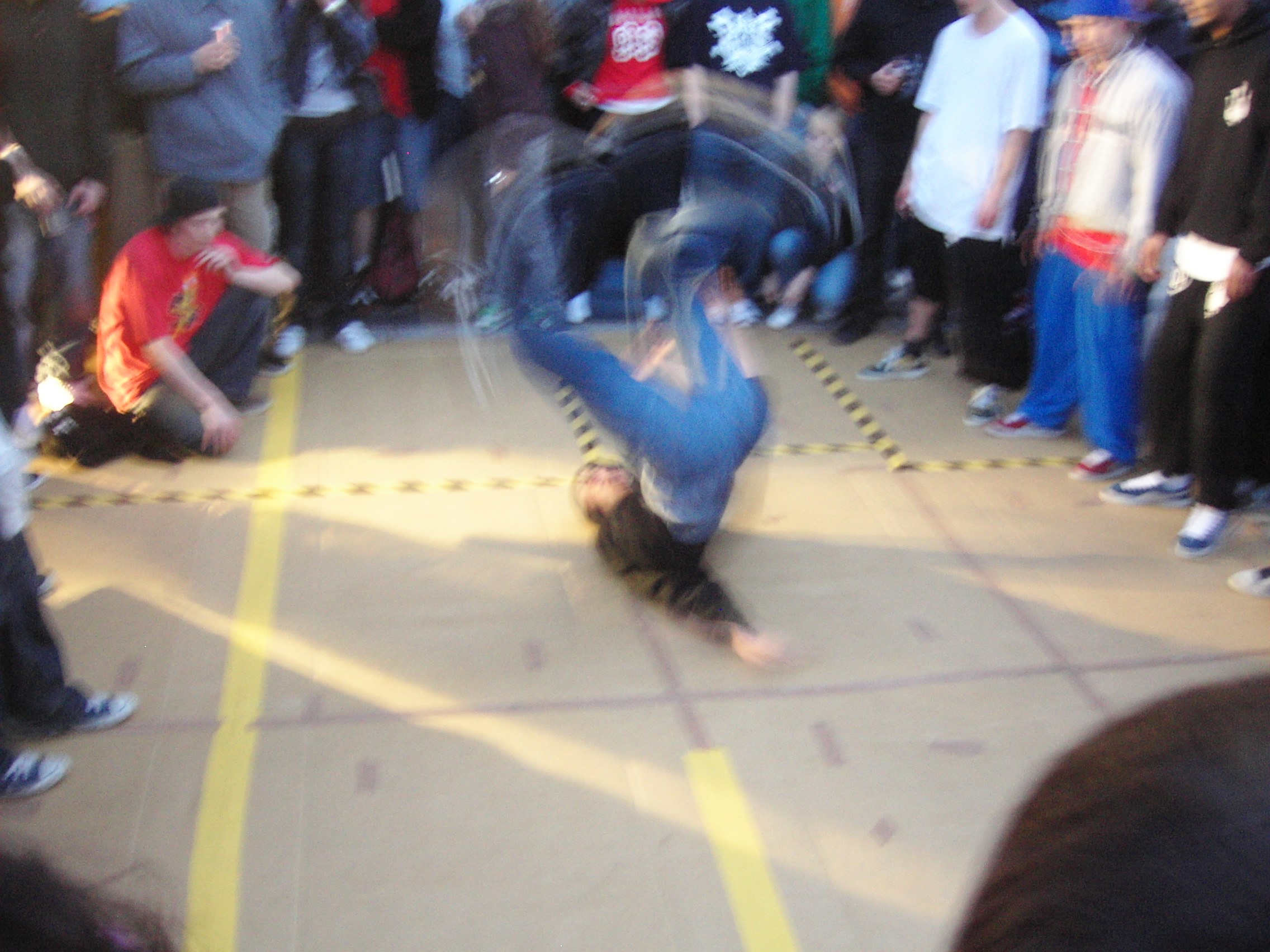
April 2007 breakdancing in Warsaw 18
Syced
- Source:
- Wikimedia Commons
- Rights:
- Public domain — free to use, share and adapt.
- Recorded as:
- cc0
This image documents the internationalization and grassroots spread of breaking beyond its American origins, showing how the dance form and its social structures (the cipher, the spectator frame, the emphasis on individual skill and improvisation) took root in European cities. For dancers, it is evidence of what breaking looked like in practice at street level in the mid-2000s, before the widespread availability of smartphones normalized constant video documentation.
What you are looking at
A breakdancer performs an inverted move—likely a headstand or freeze—in the center of a marked dance circle outlined in yellow tape on pavement. The dancer wears blue clothing and is captured mid-motion, body arched and limbs extended in a dynamic inversion. A large crowd surrounds the circle, standing several deep, watching intently. The spectators wear casual contemporary clothing in varied colors and include both adults and younger people. The setting is outdoors on what appears to be a city street or public plaza, with natural daylight illuminating the scene. The yellow tape defines the performance space as a cipher—the traditional circular format in which breaking and street dance are showcased. The image has the characteristic motion blur and image quality of an amateur photograph or video still from 2007.
The dancing
The primary dancer is inverted, weight supported on the head and upper back, with legs extended upward and body held in a controlled arch—a demanding freezing position in breaking that demands significant upper-body and core strength. The dancer's arms and legs are actively positioned to maintain the frame and aesthetic line of the move. The spectators form a static audience frame around the active performer, maintaining respectful distance from the marked circle. The contrast between the explosive control of the dancer and the still attention of the crowd is marked.
The dance depicted
This is breaking—also known as b-boying or breakdancing—captured at a freestyle battle or jam session in Warsaw in April 2007. The inverted freeze shown here is a signature move in breaking vocabulary, requiring years of training to execute safely and with control. The cipher format and spectator arrangement are the normative social structure for breaking performance, derived from hip-hop street culture. Breaking in Central and Eastern Europe was experiencing significant growth in the mid-2000s, and this image documents that regional expansion of the practice.
How it was made
This is a photograph or video still, most likely digital, from 2007. The motion blur in the dancer's body and the image softness suggest either a camera phone, consumer digital camera, or video capture from that era—technology with lower resolution and slower shutter speeds than professional photography. The amateur quality and documentary nature suggest this was taken by a spectator or community member rather than a professional photographer, which is typical of street dance documentation from this period. The image's circulation through Wikimedia Commons indicates it entered public knowledge and archive as community-generated culture documentation.
About this work
This is a photograph documenting a breaking battle or freestyle jam in Warsaw, Poland in 2007. It captures a breakdancer mid-freeze in the classic inverted position, surrounded by spectators in an outdoor cipher. Breaking was a minority practice in Poland at this time, and the image serves as evidence of the dance form's geographic dispersal from New York and Los Angeles to Central European cities in the 2000s. The photograph is valuable as documentary record of how breaking functioned as participatory street culture in a specific time and place—not as staged performance but as community gathering and skill demonstration.
How to look at it
Attend to the control and precision required for the inverted freeze: the dancer is not falling or tumbling but holding a fixed shape against gravity, which demands strength and balance developed through thousands of repetitions. Notice the cipher—the marked circle and surrounding spectators—which is not accidental but is the fundamental social technology of breaking, the format that distinguishes it from other dance practices. The motion blur in the image, rather than being a flaw, captures something true about breaking: it is fast, explosive, and demands constant flow between freezes and footwork.
The artist
Syced is identified as the photographer on Wikimedia Commons but no other biographical information is available in standard sources. The name and the documentary nature of the image suggest an individual documenting street culture in Warsaw, likely a participant or observer in the local breaking community rather than a professional photographer.
The period
Breaking emerged in New York in the late 1970s and was established as international practice by the 1980s, but its presence in Central Europe remained limited through the 1990s. The 2000s saw significant expansion of breaking communities across Europe, supported by international battle circuits, YouTube (launched 2005), and growing youth engagement with hip-hop culture. Poland's breaking scene was developing during this period, with battles and jams becoming regular events in major cities. The outdoor public-space cipher shown here was (and remains) the normative format for breaking, distinct from theatrical or competitive stage presentation.
Where it lives
The photograph is held in Wikimedia Commons, a public digital repository. It was contributed by user Syced and is identified as documentation from Warsaw in April 2007. No museum accession, archive, or institutional holding is recorded.
Dance in this work
Questions about this work
What is the move the dancer is doing?
This is a freeze, most likely a headstand or handstand variation, one of the fundamental vocabulary elements of breaking. Freezes are held poses that punctuate the flowing footwork and are used to demonstrate control, strength, and musicality. The specific inverted position shown here, held with the head or upper back as the base of support, is a high-difficulty move that typically takes years to develop safely.
What is breaking and where did it come from?
Breaking (or b-boying) emerged in New York City in the late 1970s as part of hip-hop culture, originally performed at block parties and outdoor public gatherings. It combines footwork, freezes, and power moves with musicality and improvisation. By the 2000s it had spread internationally, reaching Poland and other European cities, where it became embedded in local youth culture and street dance communities.
Why are they dancing in a circle?
The circle—called a cipher—is the traditional social and performance format for breaking. It serves multiple functions: it defines the performance space, it gives spectators equal sightlines, and it creates a democratic structure where any dancer can enter and take turns. The cipher is central to breaking culture and marks it as fundamentally different from staged or choreographed dance.
When was this photo taken and why does it matter?
This was taken in April 2007 in Warsaw, during the period when breaking was spreading from its American origins to European cities. It documents a moment in the early development of Poland's breaking scene and provides evidence of how the dance, its values, and its social structures transplanted themselves globally through grassroots youth culture.
More dance artwork