49 works in this view — arrow keys or swipe to move between them.
Dance in Art
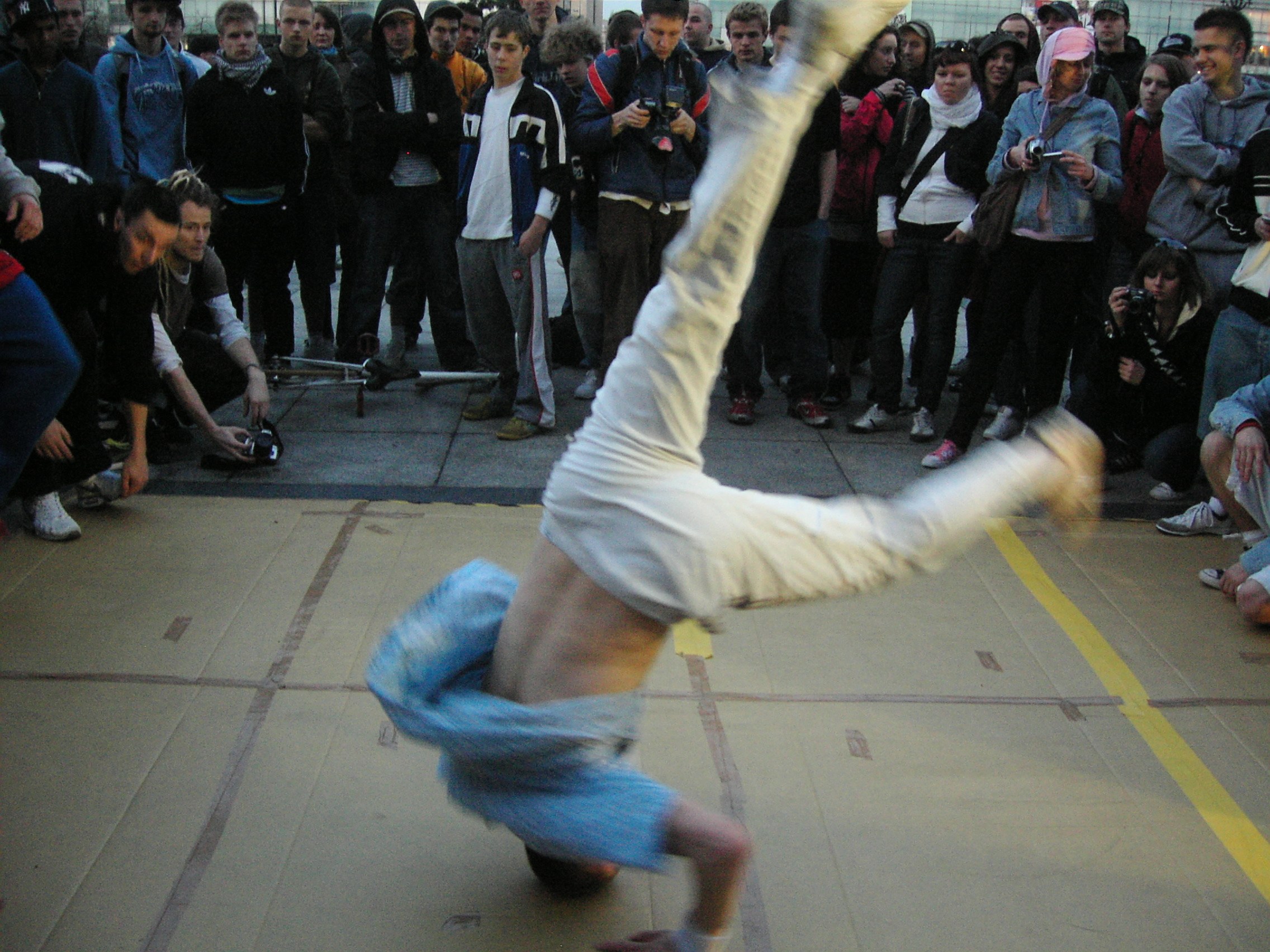
April 2007 breakdancing in Warsaw 63
Syced
- Source:
- Wikimedia Commons
- Rights:
- Public domain — free to use, share and adapt.
- Recorded as:
- cc0
Breakdancing is one of the most influential dance forms of the late 20th and early 21st centuries, and this image captures its practice in real time and in a non-commercial setting. The photograph also documents the shift in how street dance is witnessed and recorded—the crowd of phone-holders marks the moment when live performance became simultaneously a live-streamed or digitally archived event, changing how these dances circulate and persist.
What you are looking at
A breakdancer performs a headstand or inverted move in the center of a gymnasium or indoor sports hall, captured mid-motion with significant blur conveying dynamic energy. The dancer wears a white long-sleeved shirt and blue shorts or pants, with blue wrapping or tape visible on the lower legs. They are surrounded by a dense crowd of spectators—roughly 40–50 people of mixed ages and genders, many holding mobile phones and cameras to document the performance. The crowd forms an informal circle around the dancer, standing on what appears to be a gym floor marked with court lines (visible yellow line in the frame). The lighting is natural and even, suggesting daytime or gym lighting. The scene has the character of a freestyle jam session or informal battle rather than a formal stage performance.
The dancing
The primary dancer's body is inverted, with legs extended upward and upper body supported on or near the head—a foundational breakdancing power move. The motion blur on the legs and torso indicates rapid rotation or spin, characteristic of freeze moves or the approach to a power move. The dancer's weight appears concentrated on the upper body, with the body axis roughly vertical. Surrounding figures are stationary observers, many with arms raised holding recording devices, creating a clear visual distinction between the active dancer and the passive audience.
The dance depicted
This is breakdancing (b-boying), one of the four foundational elements of hip-hop culture. The inverted position and blur pattern suggest a freeze or the execution of a power move—likely a headstand, handstand, or the approach to a spin such as a windmill or backspin. Breakdancing emerged in the Bronx in the 1970s and by 2007 had become an international phenomenon practiced across Europe, including Poland. The informal gymnasium setting and phone-recording audience reflect how breakdancing circulates through grassroots jams and battles rather than institutional venues, though by the 2000s it was increasingly documented and shared digitally.
How it was made
This is a color photograph, likely digital given the date (2007) and the casual documentation context suggested by the crowd's phones. The photographer has captured motion blur intentionally or incidentally in the dancer's limbs while keeping the torso and surrounding crowd relatively sharp, which emphasizes the speed and difficulty of the move. The snapshot aesthetic and the presence of numerous spectators recording simultaneously suggests this is a candid document of a live moment rather than a staged or professional shoot.
About this work
This photograph documents a breakdancing performance in Warsaw in 2007, capturing a moment of executed skill—an inverted power move—in front of a youth audience armed with recording devices. Breakdancing had by this time become a global street dance practice, spreading from its Bronx origins through hip-hop culture and digital circulation. The image is valuable as evidence of how breakdancing was practiced, taught, and commemorated in post-2000 Europe, and of the role of mobile phones in democratizing the documentation of street dance.
How to look at it
Watch the blur pattern: it concentrates on the dancer's legs and lower body, suggesting rapid rotation around a vertical axis. The dancer's head and upper back appear sharper, implying those are the pivot points. This selective blur is characteristic of how fast top-rock or power-move execution looks in still photography. Notice also the crowd's composition—predominantly young, diverse in gender, and collectively engaged in documentation rather than passive spectatorship. The informal gymnasium setting, with its court markings, was a common venue for breaking jams in this era.
The artist
The photographer is credited as 'Syced' on Wikimedia Commons. No further biographical information is available from the record, and the username suggests this may be a pseudonym or casual contributor rather than a professional documentarian. The work was uploaded to a commons platform, indicating an intent to make it freely accessible.
The period
Breakdancing experienced a major revival and globalization in the early 2000s, driven by hip-hop's international reach and by its adoption in commercial and competitive contexts (battles, festivals, Olympic consideration). In 2007, breakdancing was practiced across Europe by youth communities, often organized through informal jams and battles rather than institutions. Poland, as part of post-1989 Europe, had absorbed hip-hop culture rapidly, and Warsaw had an active breaking scene by the 2000s. The prevalence of mobile phones in this photograph—Nokia-era devices visible in hands—marks the moment when digital documentation became immediate and ubiquitous.
Where it lives
The photograph was uploaded to Wikimedia Commons, a free media repository. It is identified as a casual street documentation rather than a professional commission or archival photograph. The Commons entry provides minimal metadata beyond the title, date, and location.
Dance in this work
Questions about this work
What move is the dancer performing?
The inverted position and motion blur suggest a freeze—possibly a headstand, handstand, or the entry into a spin move like a windmill. The exact move cannot be determined with certainty from the still image, but it is a foundational power move requiring strength and body control.
Why is everyone holding phones?
By 2007, mobile phones with cameras were widespread, and recording live performances had become common practice among youth audiences. This image captures the early stage of how digital recording democratized documentation of street dance, allowing participants to archive and share performances beyond the live moment.
Is this a competition or a casual jam?
The informal gymnasium setting, the lack of visible judges or formal staging, and the casual crowd arrangement suggest this is a freestyle jam session rather than a sanctioned battle. Breaking culture includes both competitive battles and informal jams where dancers practice and exchange moves.
Why does the photograph have motion blur?
The blur on the dancer's limbs likely results from the dancer's rapid movement during the exposure time of the camera. This is either an incidental effect of shooting in indoor lighting or a deliberate choice to convey the speed and difficulty of the move.
More dance artwork