49 works in this view — arrow keys or swipe to move between them.
Dance in Art
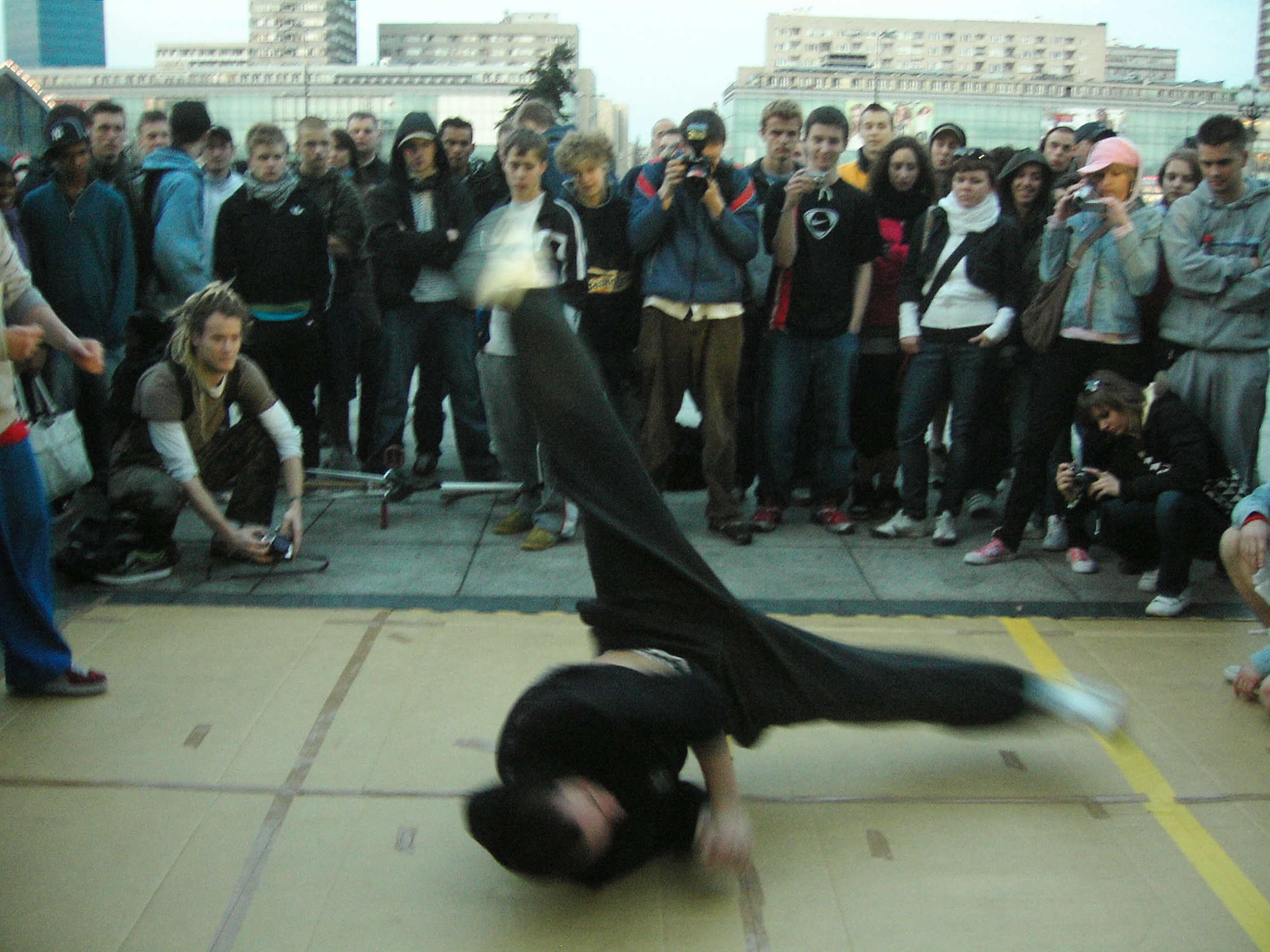
April 2007 breakdancing in Warsaw
Syced
- Source:
- Wikimedia Commons
- Rights:
- Public domain — free to use, share and adapt.
- Recorded as:
- cc0
This image documents breaking as it actually existed in the 2000s—not as a formalized theatrical or competitive discipline, but as a lived street practice in European urban space. The photograph captures how hip-hop street culture had globalized by 2007, making Warsaw as likely a site for breaking performance as any American city. For dance historians, it provides visual evidence of breaking's technical vocabulary in its authentic street context, and for hip-hop culture researchers, it documents how street dancers were already adapting to a media-saturated environment where performances were expected to be recorded and shared.
What you are looking at
A breakdancer performs an inverted freeze mid-rotation on a flat concrete plaza in Warsaw, their body horizontal to the ground, supported on their head and upper body. The dancer wears black clothing—a black long-sleeved top and dark pants—and executes the move with control and precision. A large crowd of roughly thirty onlookers, predominantly young people dressed in casual streetwear (hoodies, jackets, caps), forms a semicircle around the dancer, many holding mobile phones and cameras to record the performance. The setting is an urban plaza bounded by Soviet-era apartment blocks and modern high-rises visible in the bright daylight background. The composition captures the street performance moment: the isolation of the dancer in the center, the engaged spectators leaning in, the casual documentation of urban culture.
The dancing
The primary dancer executes a headstand or similar inversion, their legs extended vertically or angled, their weight distributed across the head and shoulders in a controlled, muscular position typical of breaking freezes. The body demonstrates significant strength and balance—the type of static hold that requires substantial upper body and core control. Surrounding figures are stationary spectators rather than dancers, creating a clear performer-audience dynamic. The dancer's isolation within the crowd emphasizes the individual skill display central to breaking culture.
The dance depicted
This is breakdancing (breaking or b-boying), a street hip-hop dance form originating in 1970s New York that emphasizes athletic moves, freezes, and improvisation. The inverted freeze shown here—likely a headstand, chair freeze, or similar inversion—is a signature element of breaking vocabulary, executed to demonstrate technical control and strength. Freezes are climactic moments in breaking performance, often used to punctuate a dancer's toprock and footwork sequences. The street setting and informal crowd document how breaking functioned in early 2000s urban culture as a participatory street performance, where dancers performed for small gatherings in public plazas, often filmed and shared informally.
How it was made
This is a color photograph, likely taken with a digital camera or mobile phone, capturing a live street performance. The image quality and color saturation suggest early-to-mid 2000s consumer digital photography. The photograph's composition—shooting from crowd level looking at the inverted dancer—is typical of how street performances were documented in this era: casual, handheld, and from an embedded viewer's perspective rather than from a professional distance. The presence of multiple people holding cameras indicates this was an informal social documentation practice, typical of how breaking and hip-hop culture spread before widespread social media.
About this work
This photograph documents a live breaking performance in Warsaw's public plaza, capturing the moment of a dramatic inverted freeze—one of breaking's signature technical elements. The image is historically significant as evidence of how breakdancing had become a recognized street performance form across European cities by 2007, performed for informal street audiences and documented through personal photography. It captures both the athletic demand of the dance and the social dynamics of street performance culture: the isolation and skill display of the dancer contrasted with the engaged, recording spectators.
How to look at it
Watch for the extreme inversion: the dancer's body defies gravity while remaining controlled and still, demonstrating the strength required for breaking's freezes. The photograph captures not the movement itself but the static moment of display—the moment when a dancer 'stops the clock' to show technical mastery. Note how the composition isolates the inverted body within the crowd: this framing reflects breaking's core structure, where individual dancers take turns performing in front of an audience, often a circle of peers. The casual recording devices in spectators' hands document an early moment in street performance's relationship to media, before TikTok and Instagram, when street dancers still performed primarily for local audiences.
The artist
The photograph is credited to Syced on Wikimedia Commons, suggesting it was taken by a participant-observer or street photographer active in Warsaw's urban culture. No further biographical information about the photographer is available in the catalogue record. The informal credit and Wikimedia publication suggest this was shared within open-access cultural documentation communities rather than through professional photography channels.
The period
In 2007, breaking was in the midst of a significant transformation: it had moved from underground street culture (1970s–1980s) through a period of commercial visibility (1980s–1990s) and was increasingly being formalized through international competitions like the UK B-Boy Championships (est. 2004) and World B-Boy Masters. Simultaneously, breakdancing retained strong street credibility and grassroots performance practice, especially in European cities that had embraced hip-hop culture later than North America. The early 2000s were marked by the rise of mobile phone cameras and digital photography, which democratized documentation of street performances. By 2007, video sharing was becoming possible through early YouTube (est. 2005), creating a moment where street performance was being simultaneously captured informally and beginning to circulate globally through digital platforms.
Where it lives
This photograph is held in Wikimedia Commons, a freely accessible digital repository of images, suggesting it was either uploaded by the photographer or by someone from the breaking or Warsaw cultural community. The attribution to Syced indicates the photographer's identity, though no professional affiliation or biographical details are recorded. Wikimedia's open-access model means the image was published for public educational use rather than commercial circulation.
Dance in this work
Questions about this work
What is the move the dancer is performing?
The dancer is executing a freeze, one of breaking's signature technical elements—in this case, likely a headstand, chair freeze, or similar inverted hold. Freezes are static, gravity-defying positions that require significant upper body strength and are used as climactic moments in a breaking routine to display technical mastery and physical control.
Why are so many people recording this performance?
By 2007, mobile phone cameras were ubiquitous, and street performances were routinely documented by spectators for personal sharing. This image captures the early digital era when street culture was being distributed informally—before YouTube and social media made viral sharing routine, but after cameras became common enough that every onlooker could record.
Was breaking common in Warsaw in 2007?
This photograph suggests breaking had established a street presence in Warsaw by the mid-2000s. Hip-hop culture had spread globally through the 1990s and 2000s, and European cities developed active breaking scenes. However, the street performance context indicates this was still primarily grassroots activity rather than formalized competition.
How does this differ from theatrical breaking performances?
This is street breaking in its original context: performed outdoors for an informal crowd, improvised, and documented casually by spectators. Theatrical or competitive breaking (as seen in championships or stage performances) would be choreographed, performed for paying audiences in formal venues, and professionally filmed. This photograph captures breaking before that formalization, or alongside it.
More dance artwork