49 works in this view — arrow keys or swipe to move between them.
Dance in Art
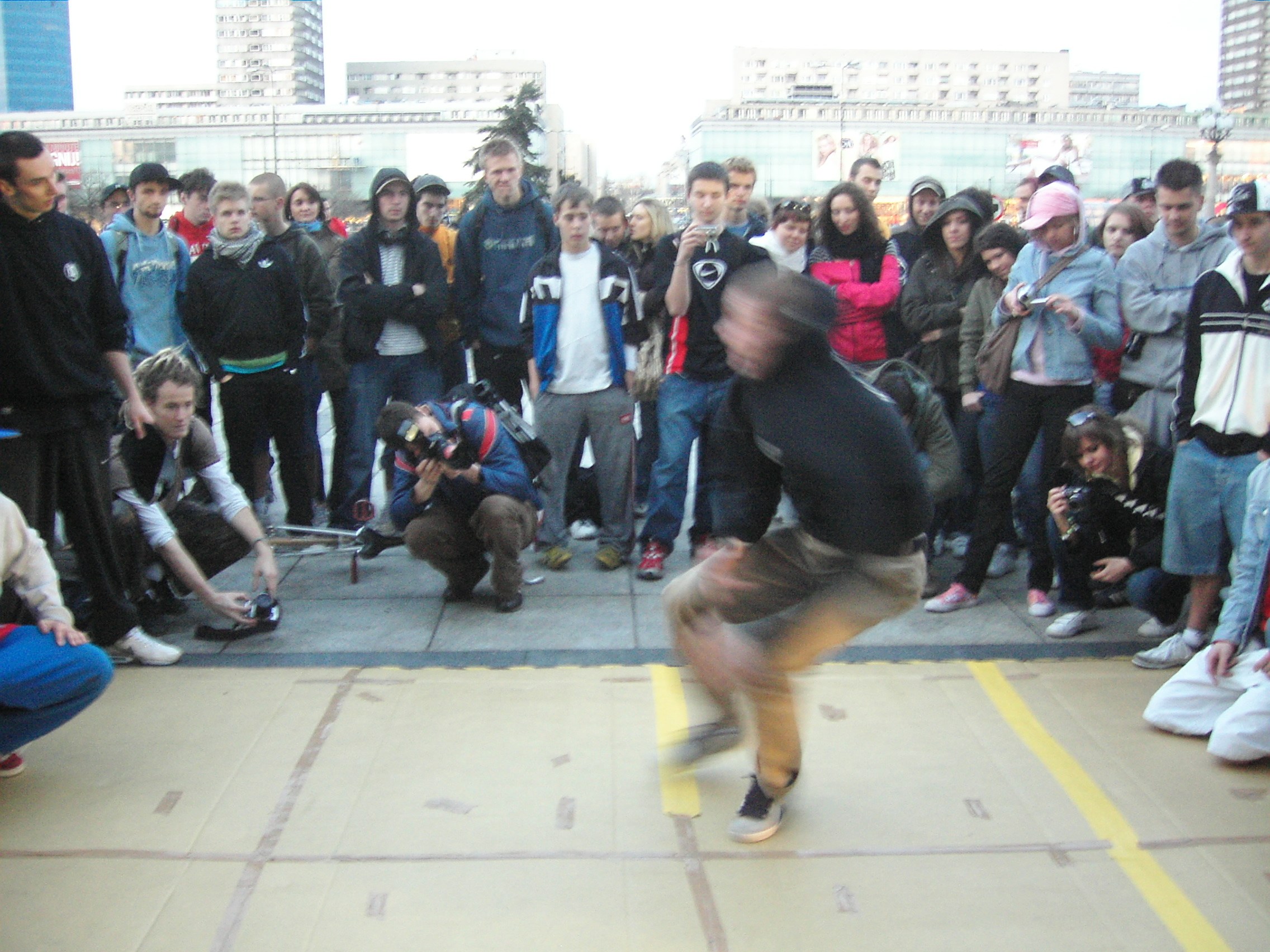
April 2007 breakdancing in Warsaw 76
Syced
- Source:
- Wikimedia Commons
- Rights:
- Public domain — free to use, share and adapt.
- Recorded as:
- cc0
Breaking's global migration is a significant chapter in late 20th-century dance history, and images of it in actual practice—not competition footage or museum reconstruction—are rare documentary evidence. This photograph captures the social dance form in its uncontrolled environment, showing the peer-learning and informal performance structure that is central to breaking culture and distinct from theatrical presentation.
What you are looking at
A large crowd of young people, mostly teenagers and young adults, gathered in an urban plaza in Warsaw. The setting is a hard-surfaced public space with yellow markings visible on the ground, surrounded by multi-story residential and commercial buildings in the background. The crowd forms a loose circle around a central performance area. One dancer in dark clothing is captured mid-movement in the foreground, body in a dynamic twisted position characteristic of breakdancing. The atmosphere is casual and social; spectators wear winter and early spring clothing—hoodies, jackets, caps, and bright colors like pink and red. The photograph has the slightly washed-out color and quality typical of mid-2000s digital cameras. The composition suggests this is an informal street gathering rather than an organized performance venue.
The dancing
The visible dancer in the center foreground is captured in an inverted or rotated position with the body twisted dynamically, weight clearly on the hands or head, knees bent, characteristic of breakdancing footwork and toprock transitions. The spectators surrounding the dancer stand upright and stationary, many watching intently, creating a clear spatial distinction between performer and audience. The crowd shows the casual stance and varied body positions of observers rather than participants. The density and composition suggest this is a 'cypher'—the social form of breakdancing where dancers take turns in a circle.
The dance depicted
This is street breakdancing (B-boying), documented in an uncontrolled public plaza setting. The photograph captures the social performance context of hip-hop street dance, where a solo dancer performs in an improvised circle formed by onlookers. The dancer's twisted, inverted body position shows the acrobatic foundation moves and dynamic footwork characteristic of breaking. The setting—a public plaza in Warsaw in 2007—reflects the global spread of breaking culture beyond its New York origins, established by the early 2000s as a recognized street and competitive dance form across Europe.
How it was made
This is a color photograph, likely taken with a compact digital camera or early smartphone. The image quality—moderate resolution, slightly overexposed highlights, the particular color cast—is consistent with casual documentation from 2007. The framing is candid rather than composed, shot at ground level within the crowd to capture the action. As a snapshot, it was not made for exhibition but for social documentation and likely online sharing, which is consistent with its path through Wikimedia Commons.
About this work
This photograph documents an informal street breakdancing session in Warsaw's public space, captured in 2007. It shows the dance in its lived social context: the cypher formation, the mix of dancers and spectators, the urban plaza as stage. Breaking by this period had fully globalized from its 1970s–1980s New York origins, and this image evidences the form as an established street practice in Eastern European cities. The photograph is valuable precisely because it is unstaged—it shows how breaking actually happened in public space, the social energy around it, and the demographics of European youth participation.
How to look at it
Attend to the body position of the dancer—the dynamic inversion and twist—which shows the physical vocabulary of breaking: the balance, control, and acrobatic skill required. Notice how the crowd's formation creates the social frame for the dance; the cypher is not an accident but the structural form in which breaking is performed. The casual dress and mixed-age crowd (teenagers to adults) reflects how street dance communities actually work, through peer teaching and social participation rather than formal instruction. The urban plaza setting—not a stage, not indoors—is essential to understanding breaking as street culture.
The artist
The photograph is credited to Syced on Wikimedia Commons. No further biographical information is recorded. The work appears to be casual street documentation, likely by a photographer or youth present at the scene, rather than professional or commissioned work. The upload to Wikimedia Commons as a freely licensed file suggests the photographer's intent to share public culture documentation.
The period
In 2007, breakdancing was well-established in European youth culture, roughly 25–30 years after its emergence in New York City. The early 2000s saw breaking transition from underground street dance and competition-scene practice to recognized urban cultural form, with growing visibility through film, music video, and YouTube. Poland and Eastern Europe had active breaking communities by the 2000s. The photograph captures this moment when breaking was neither new nor marginalized, but an accepted form of youth social expression in public space across Europe.
Where it lives
This photograph was uploaded to Wikimedia Commons, a freely licensed image repository. It is dated April 2007 and geolocated to Warsaw, Poland. The holding is the Wikimedia Foundation's collection. No institutional accession number or curatorial context is recorded; it functions as a user-contributed documentary photograph rather than an acquired artwork.
Dance in this work
Questions about this work
Is this a professional performance or a casual gathering?
This is a casual, informal street gathering. The cypher formation—the circle of spectators around the dancer—is the traditional social and performance structure for breaking. It is not staged or officially promoted, but it is a recognized and intentional practice within breaking culture. These gatherings happen spontaneously in public plazas and are central to how the dance is taught, performed, and preserved in street communities.
Why is breaking documented in street photography rather than concert or competition settings?
Breaking originated and continues to thrive as a street and social form, not primarily as a theatrical or competitive spectacle. While breaking competitions (b-boy battles) are significant, the majority of breaking occurs in informal peer gatherings like this one. Street photographs document the actual lived practice and are important historical evidence of how this dance form circulates and is performed outside institutional contexts.
What does this image tell us about breaking in Europe in 2007?
By 2007, breaking was an established presence in European youth culture with active communities in major cities including Warsaw. This photograph shows that breaking was no longer a marginal or exotic form but a normalized part of urban youth social life. The large crowd and casual atmosphere suggest breaking had significant local participation and spectator interest in Warsaw's youth communities.
More dance artwork