49 works in this view — arrow keys or swipe to move between them.
Dance in Art
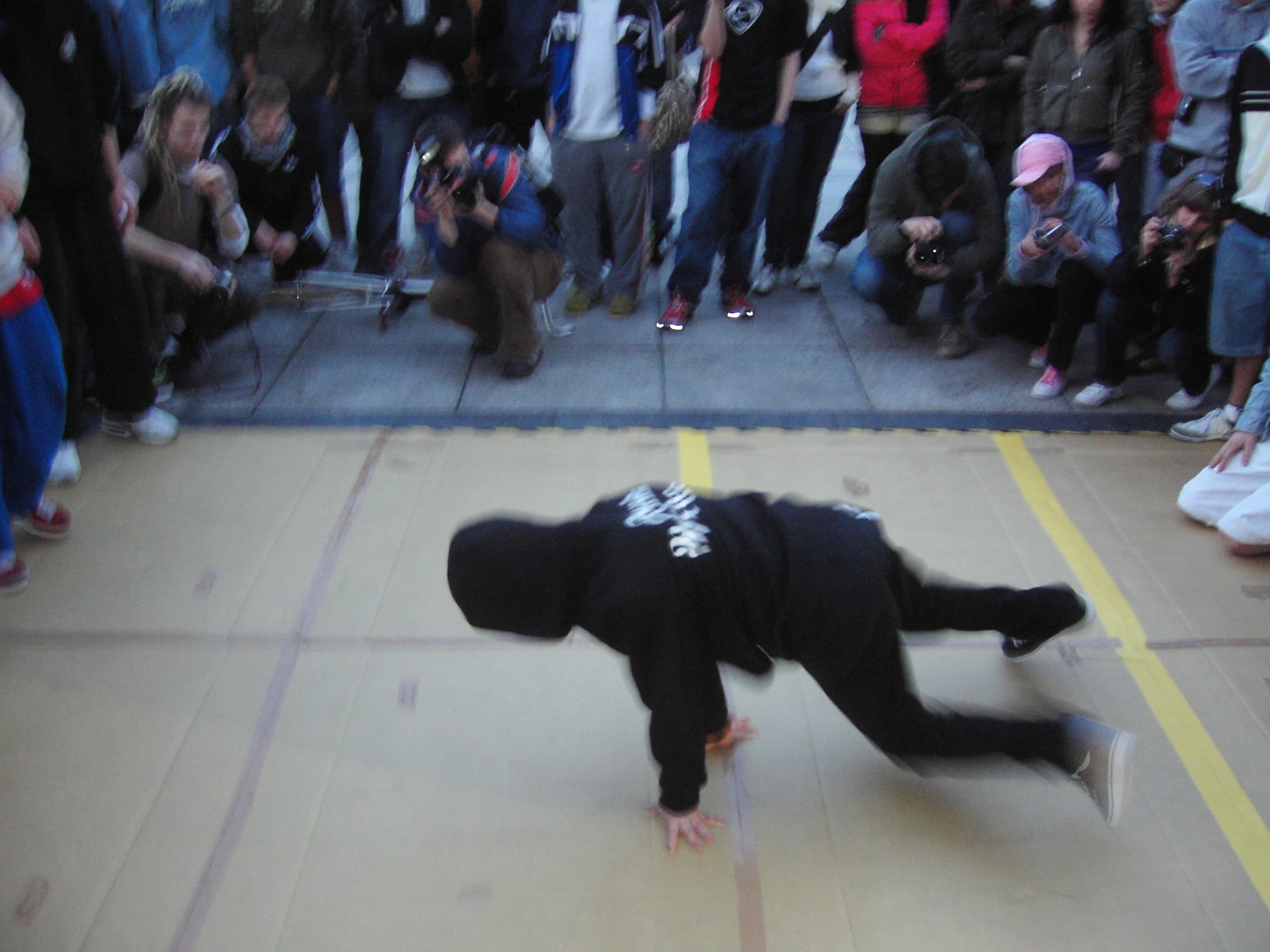
April 2007 breakdancing in Warsaw 67
Syced
- Source:
- Wikimedia Commons
- Rights:
- Public domain — free to use, share and adapt.
- Recorded as:
- cc0
Breaking is a living, evolving urban dance form central to contemporary dance culture worldwide, and this image documents its practice in a European context. The photograph also captures the democratization of performance documentation—the visible phones and cameras in the crowd show how digital technology was enabling dancers and audiences to record and share dance in real time, reshaping how breaking was transmitted and consumed.
What you are looking at
A breakdancer performs a horizontal freeze mid-movement in what appears to be an indoor gymnasium or community space, captured in a color photograph. The dancer wears all black clothing and is suspended nearly parallel to the floor, supported by hands and head in the characteristic inverted position of a headstand freeze. The performer is photographed from directly above, making the dynamic suspension the visual center. Spectators crowd around the perimeter—dozens of people, many wearing casual street clothes in reds, blacks, and blues, some holding phones and cameras to document the moment. The wooden gymnasium floor is marked with yellow court lines, establishing the indoor setting. The lighting is natural and even, suggesting daytime or well-lit interior conditions. The density of the crowd and their attentiveness indicates this is a public performance or demonstration rather than a practice session.
The dancing
A single male dancer is captured inverted, weight balanced on his hands and head while his legs extend upward. His body forms an extended line from his head through his torso to his feet, demonstrating the control and body awareness required to hold this position. The upper body remains compact and controlled, with arms positioned to support the freeze. No partner is visible; this is a solo performance emphasizing the individual dancer's strength, balance, and technical skill.
The dance depicted
This is breakdancing (breaking, b-boying), one of the four pillars of hip-hop dance culture. The headstand freeze or variant inverted position is a foundational element of breaking, demonstrating both power and control. Breaking emerged in New York City in the 1970s as part of the hip-hop movement but had spread globally by 2007, when this photograph was taken in Warsaw, Poland. The image documents breaking's presence in Eastern Europe, showing the dance's international reach beyond its African-American and Latino origins in the United States. The outdoor/gymnasium setting and the assembled crowd suggest this may be a cypher (an improvisational circle) or street performance, both common contexts for breaking.
How it was made
This is a digital color photograph, likely taken with a consumer or semi-professional camera given the sharpness and color saturation. The overhead angle suggests deliberate compositional choice—positioning the camera above the dancer to emphasize the difficulty of the inverted position and to frame the surrounding spectators. The photograph's documentary character and the visible crowd suggest it was taken during an actual public event rather than a posed studio session. The color film stock and image quality are consistent with early-to-mid 2000s digital photography technology.
About this work
This is a documentary photograph of breaking captured during a public performance in Warsaw in 2007. The image records a moment of technical virtuosity—an inverted freeze that demonstrates one of breaking's signature elements—while also documenting the social context of the dance: a gathered community bearing witness and recording the performance on their own cameras. Breaking by 2007 had become a genuinely global urban dance form, and this photograph places it within Poland's emerging hip-hop culture.
The work matters as evidence of breaking's internationalization and its establishment as a recognizable, publicly performed dance genre outside North America. The photograph captures both the individual technical achievement and the collective, social nature of breaking as street culture.
How to look at it
Watch how the photographer chose the moment of suspension—the freeze is held, making it readable as a technical feat. The overhead framing transforms the horizontal plane into a visual spectacle, making the difficulty of the inverted balance immediately apparent. Notice the crowd: their positioning, phones raised, and body language tell the story of breaking as a communal, witnessed practice. The gymnasium setting grounds this as an organized event, not spontaneous street dancing, which matters for understanding how breaking was being formalized and legitimized as a recognized dance practice by the 2000s.
The artist
The photograph is attributed to Syced on Wikimedia Commons, but no additional biographical or artistic information is available from the record. The work appears to be documentary street photography rather than a work by a photographer working primarily in art contexts.
The period
In 2007, breaking had been a visible global phenomenon for roughly a decade, having spread from its origins in 1970s New York through hip-hop's worldwide dissemination. By the 2000s, breaking was practiced competitively (Red Bull BC One, founded in 2004, was already establishing international prestige) and socially in urban centers across Europe, Asia, and beyond. Simultaneously, digital photography and camera phones were creating new possibilities for documenting street dance and sharing it instantly online. This photograph sits at the intersection of breaking's mature global presence and the rise of participatory media documentation.
Where it lives
The photograph is held in Wikimedia Commons, a public digital repository. The date April 2007 and location Warsaw are provided in the title; no additional provenance information is recorded.
Dance in this work
Questions about this work
What is the move being performed here?
The dancer is performing a headstand freeze or headstand-based inversion, one of the signature power moves in breaking. The freeze demonstrates strength, balance, and body control. Freezes are moments when a dancer holds a striking, often gravity-defying position to punctuate their improvisation and showcase technique.
Why was this photograph taken from above?
The overhead angle emphasizes the inverted position and makes the dancer's horizontal body line the visual center of the composition. This framing choice makes the technical difficulty of the move more visually apparent and transforms the gymnasium floor into a stage for the performance.
What does the crowd tell us?
The gathered spectators, some with cameras and phones raised, document breaking as a social, witnessed practice. This is a cypher or public performance event, not a solitary practice, which reflects how breaking functions as community-based street culture. The visible documentation also shows how digital technology was enabling real-time sharing of dance performance by 2007.
Why is this image important for understanding breakdancing?
It documents breaking's establishment as a globally recognized and practiced dance form outside its North American origins. The 2007 date and Warsaw location show breaking had become embedded in European urban youth culture by the 2000s, validating its status as a genuinely international dance practice.
More dance artwork