49 works in this view — arrow keys or swipe to move between them.
Dance in Art
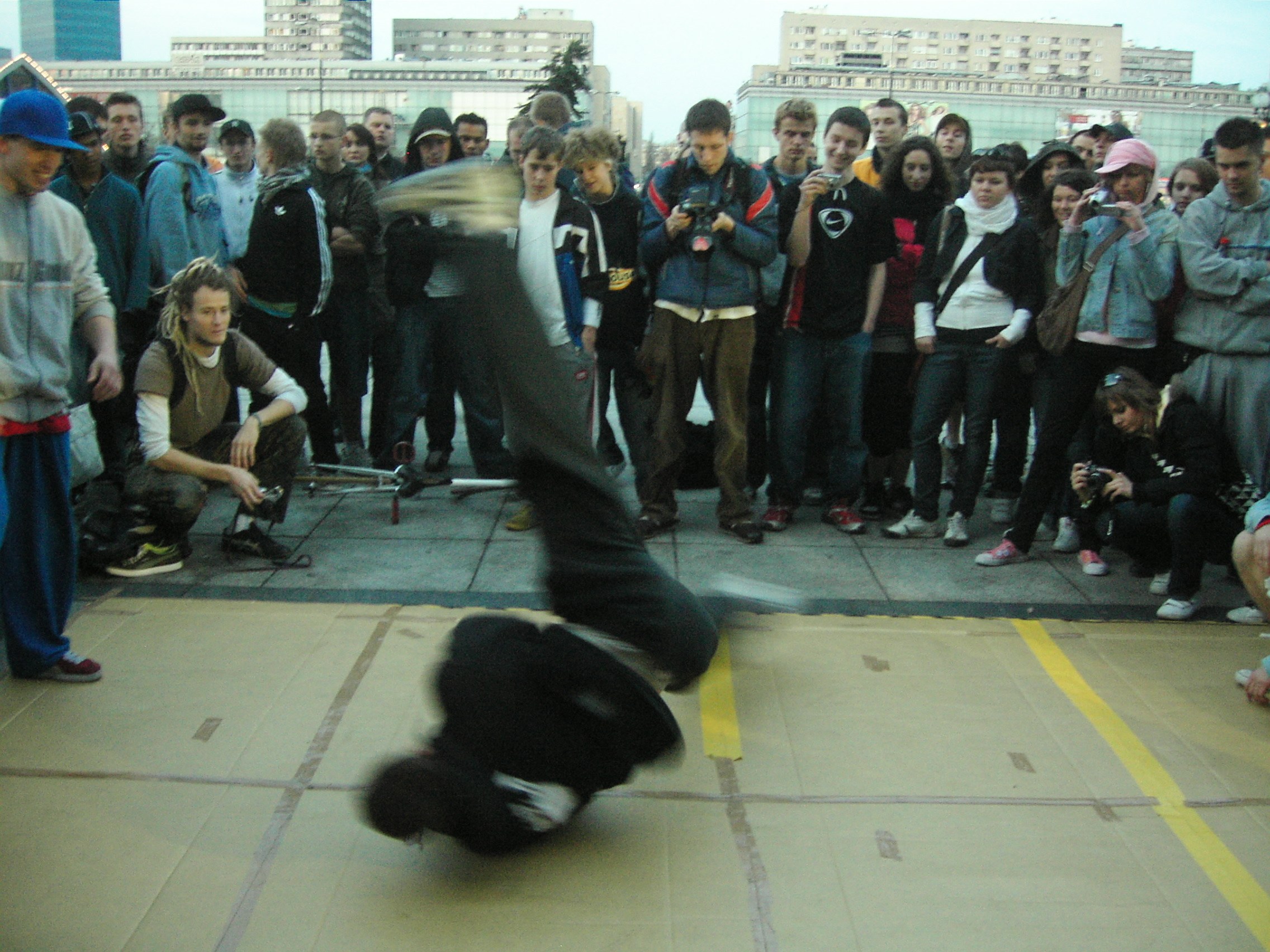
April 2007 breakdancing in Warsaw 10
Syced
- Source:
- Wikimedia Commons
- Rights:
- Public domain — free to use, share and adapt.
- Recorded as:
- cc0
Breakdancing is a crucial 21st-century vernacular dance form, yet it remains underrepresented in dance history documentation and gallery collections, which have historically centered European theatrical forms. This photograph provides evidence of how breaking functioned as active, participatory youth culture in European cities in the 2000s—not as spectacle but as peer-to-peer artistic exchange. The image also documents the internationalization of African American cultural forms and the ways local youth movements adapted and owned breakdancing as their own practice.
What you are looking at
A photograph captures a breakdancing performance or battle outdoors in an urban plaza, likely in Warsaw given the title. The ground is a hard-surfaced public space marked with colored lines (yellow visible). A large crowd of young people, numbering thirty or more, stands in a wide circle around two dancers. The central figure is captured mid-move, body inverted and blurred in motion—likely executing a freeze or power move involving an inversion or spin. A second dancer in dark clothing is also visible mid-performance. The spectators wear casual 2000s streetwear: hooded sweatshirts, baseball caps, jeans, and winter layers. The crowd's attention is focused intently on the dancers; several hold cameras or phones. Behind the circle, concrete apartment blocks rise in the background, suggesting a public housing estate or city center plaza. The sky is overcast but bright. The energy is one of intense, focused observation—this is a formal battle or showcase moment, not casual socializing.
The dancing
Two dancers are visible in the circle, both in the active phase of dynamic moves. The primary figure in the center is nearly horizontal or inverted, body weight on hands or head, limbs extended or tucked—a classic breakdancing freeze or power move. The second dancer stands in a dynamic posture nearby. The crowd forms a dense but organized cipher (dance circle), the standard formation for breakdancing competition, with spectators standing shoulder-to-shoulder in a ring. The spectators' postures are upright and alert, many leaning forward slightly to see. No one is dancing outside the active space; the circle boundary is clear and respected.
The dance depicted
This is breakdancing (also called breaking, b-boying, or b-girling)—a street dance style that emerged in 1970s New York and became a global youth culture phenomenon by the 2000s. The image shows a formal battle or showcase: two dancers taking turns demonstrating their skills in a cipher while peers judge and spectate. The performance captured includes power moves (the inverted, rapidly executed acrobatic elements) and freezes (held poses requiring significant strength). Breakdancing emphasizes improvisation, musicality, athleticism, and individuality within a competitive framework. This 2007 Warsaw image documents the international spread of hip-hop dance culture eastward into Europe by the mid-2000s.
How it was made
This is a color photograph, likely taken with a handheld camera or early digital camera given the slight motion blur in the active dancers and the snapshot aesthetic. The image is documentary rather than artistic in intent—it captures a lived moment of youth culture rather than a posed or staged composition. The photograph preserves the social context (the crowd, the circle formation, the public space) that is central to breakdancing culture; a still image alone cannot convey the speed and musicality of the performance, but the composition effectively shows the communal, spectatorial nature of the event. The photograph's grain and color palette suggest mid-2000s consumer digital photography.
About this work
This photograph documents a breakdancing battle or showcase taking place in an urban plaza in Warsaw in April 2007. Breakdancing (breaking, b-boying) is a street dance form born in 1970s New York that spread globally through hip-hop culture; by the 2000s it had become established in European cities including Poland. The image shows the form at its social core: a cipher (dance circle) where dancers compete or perform for knowledgeable peers who watch, evaluate, and often compete in turn. The photograph is valuable as documentation of how breakdancing functioned as living street culture in early-2000s Europe, away from concert stages or formal competition venues. It captures the aesthetic and social practice of the form in its natural habitat—a public plaza, young people, informal but structured rules, and intense focus on the performers' bodies and musicality.
How to look at it
Look first at the body of the inverted dancer—notice the precision and control required to hold an inversion or execute a fast spin without falling. Observe the crowd's formation and focus: the cipher is not an accident but a social technology that gives every spectator a view and turns the event into a collective experience rather than a performance for a distant audience. Notice the mix of spectators—some are competing next, others are there to watch and learn, some are documenting on camera phones. The moment captured is the peak of a move (the freeze or the height of an inversion), which is the breakdancer's equivalent of the ballet dancer's penché: the moment of maximum visual impact and technical difficulty. The composition treats the dancers and crowd as equally important—this is not a portrait of individual virtuosity but a photograph of social practice.
The artist
The photograph is attributed to Syced, a Wikimedia Commons user. No further information about the photographer's identity, background, or practice is available in the record. The image was uploaded to Wikimedia Commons, suggesting the photographer intended to contribute to open-access documentation of culture.
The period
By 2007, breakdancing had been a global youth culture movement for nearly three decades. The form emerged in New York in the early 1970s alongside hip-hop music and graffiti art, becoming a major phenomenon in the 1980s through films like *Flashdance* and *Beat Street*. By the 1990s, breaking had spread to Europe, and by the 2000s, formal battles and competitions were established across major European cities. Poland, like other post-Soviet Eastern European countries, saw youth enthusiastically adopt hip-hop culture in the 1990s-2000s as part of broader cultural opening and globalization. This photograph documents that moment when breaking was becoming institutionalized (through battles and recognized crews) while remaining rooted in informal street and plaza culture. The image also reflects the early era of digital photography and smartphone documentation of subcultural events.
Where it lives
The photograph was uploaded to Wikimedia Commons, a free media repository. It is catalogued as a documentary photograph of a public event. The Wikimedia Commons hosting suggests the image is available for reuse under an open license, though the specific license terms are not stated in the records provided to this gallery.
Dance in this work
Questions about this work
Is this a competition or a casual gathering?
This is a formal battle or showcase. The cipher formation, the crowd's focus, and the presence of cameras suggest that the dancers are performing for evaluation by knowledgeable peers. Breakdancing battles have rules: dancers take turns, others judge based on musicality, technical difficulty, originality, and execution. This is organized and intentional, though it is taking place in a public plaza rather than a concert hall or formal competition venue.
Why is the crowd standing in a circle?
The circle (called a cipher in breakdancing culture) is the traditional format for breaking. It gives every spectator an equal view, removes hierarchy between performers and audience, and creates a contained space for the dance. The cipher is a social and practical innovation that allowed breakdancing to flourish as a street culture: you need only an open space and willing participants, no stage or formal venue.
What move is the central dancer executing?
The blurred, inverted position suggests a power move—likely a freeze held momentarily or a spinning move executed at speed. Power moves are acrobatic tricks: headstands, spins, inversions, and flips performed to the rhythm of the music. They are the most visually spectacular element of breaking and require significant strength, control, and spatial awareness.
Why was breakdancing important in Warsaw in 2007?
Breakdancing was a major form of expression and cultural identity for young people in post-Soviet Eastern Europe. Hip-hop culture represented freedom, creativity, and connection to global youth culture after decades of political isolation. Breaking in Warsaw was not a foreign import being passively consumed but an active, local practice: Warsaw crews competed, developed their own style, and made the form their own.
More dance artwork