49 works in this view — arrow keys or swipe to move between them.
Dance in Art
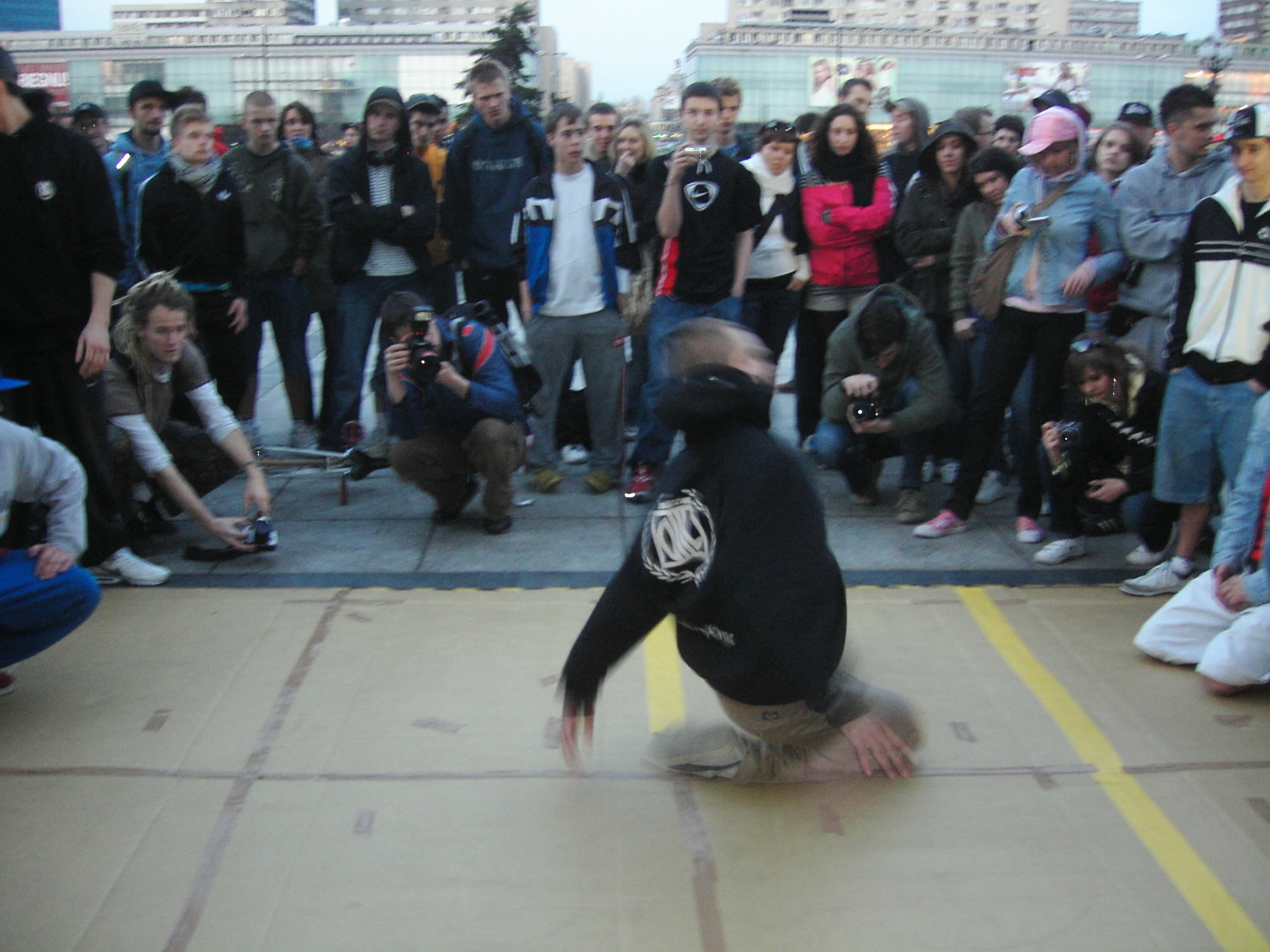
April 2007 breakdancing in Warsaw 69
Syced
- Source:
- Wikimedia Commons
- Rights:
- Public domain — free to use, share and adapt.
- Recorded as:
- cc0
Breaking is a foundational element of hip-hop culture and global street dance, and this image documents it at the moment of its European consolidation. The photograph also captures the shift from street dance as oral/physical tradition to street dance as documented, shared, and analyzed through digital media—phones and online platforms were beginning to replace word-of-mouth as the primary way young dancers learned from and engaged with each other.
What you are looking at
A breakdancer performs a headstand or freeze move in the center of a large public plaza in Warsaw, surrounded by a dense circle of spectators. The dancer wears dark clothing (black hoodie, khaki pants) and white sneakers, with their body inverted and legs extended upward. The crowd—mostly young people in casual 2000s-era clothing—stands in concentric circles around the performance, many holding mobile phones to record. The pavement is marked with yellow lines, suggesting a public square or marketplace. Tall apartment buildings and commercial structures line the background, and the light is overcast and diffused, typical of Central European spring weather. Several spectators squat or crouch to get closer views or better angles for filming.
The dancing
The primary dancer executes an inverted balance, likely a headstand variation or freeze, with the body weight supported on the head and upper back, legs extended vertically or slightly angled. The posture demonstrates the control and spatial awareness required of breakdancing. Spectators occupy multiple positions—some standing upright, others crouched or seated at ground level—creating a dynamic spatial relationship that frames the dancer as the focal point. The crowd's positioning and phone-holding gesture indicate both fascination and the early-2000s documentation practice of street performance.
The dance depicted
This is breakdancing (breaking or b-boying), a street hip-hop dance style that emerged in the 1970s Bronx and emphasizes athletic, acrobatic movement. The freeze shown here—a signature element of breaking—demonstrates the dancer's strength, balance, and ability to control the body against gravity. Breaking became a global street culture by the 2000s, with crews and individual dancers performing in public squares across Europe. The Warsaw setting and crowd size suggest this was a notable gathering or performance, possibly an organized battle or freestyle session, capturing breaking at a moment of peak popularity in European youth culture.
How it was made
This is a photograph, likely shot on a digital camera or early mobile phone, given the image quality, color palette, and slight motion blur consistent with 2007 smartphone or compact camera technology. The overhead or slightly elevated vantage point captures the full spatial arrangement of performer and audience, a practical choice for documenting street performance. The image's casual framing and documentation style suggest it was taken by a spectator or casual observer rather than a professional photographer, making it a folk record of the event rather than a curated artistic statement.
About this work
This photograph documents a breakdancing performance in Warsaw in April 2007, capturing a moment when breaking had become a mainstream street culture phenomenon across Europe. The image shows both the technical demand of the dance—the inverted balance freeze—and the social context in which breaking was performed: spontaneous, public, and documented by an engaged crowd using newly ubiquitous mobile phones. The work is evidence of how hip-hop street dance had globalized and localized across Eastern Europe by the mid-2000s, performed not in studios or theaters but in the everyday spaces of the city.
For dance historians, this image is valuable precisely because it is unstaged. It shows breaking as it was actually practiced in its street context, with real spectators, real documentation methods, and real urban topography. The freeze demonstrates the codified vocabulary of breaking that had been refined and standardized across decades and continents, while the crowd's engaged, phone-wielding attention captures the role of informal recording in spreading and legitimizing street dance.
How to look at it
Observe the precision of the freeze: the body control required to balance on the head, the angle of the legs, the stillness within what is otherwise dynamic movement. Note also the crowd composition—the density and proximity of spectators, the prevalence of cameras, and the careful choreography of spectatorship. The yellow lines on the pavement may mark the informal dance circle, a traditional feature of cypher culture. The moment captured is neither the peak of an explosive move nor the beginning of a sequence, but rather a sustained hold—a moment of rest and display that allows the dancer to demonstrate control and allows the photographer to capture the full figure.
The artist
Syced is credited as the photographer in the Wikimedia Commons record, though no further biographical information is available. The casual framing and the choice to document street performance suggest an interest in street culture, urban life, or youth culture documentation. The decision to release the image under a free license (its presence on Wikimedia Commons) indicates a commitment to open documentation of cultural practice.
The period
In 2007, breaking was in the midst of a global resurgence following its commercialization in film, television, and music video in the 1980s-90s, and its subsequent underground revival in the 2000s. The early 2000s saw breaking move from marginalized street practice to recognized youth cultural form, with international competitions, media coverage, and crews in major cities worldwide. Simultaneously, mobile phone cameras and early internet video platforms (YouTube launched in 2005) were beginning to shift how street dance was documented, learned, and circulated. In Poland and Eastern Europe specifically, breaking had taken root in the late 1990s-2000s as part of broader hip-hop adoption, with crews emerging in major cities.
Where it lives
This photograph is held in Wikimedia Commons, a free media repository. It was uploaded as a document of street culture and carries no accession number, acquisition information, or institutional holding. The metadata indicates only the date (April 2007), location (Warsaw), subject (breakdancing), and photographer name (Syced).
Dance in this work
Questions about this work
What is the move the dancer is doing?
This appears to be a freeze—a breakdancing staple in which the dancer's body is suspended in an inverted, acrobatic position. Freezes are codified moves within breaking, each with specific names and techniques. The exact variant here (headstand, backspin variation, etc.) is difficult to confirm from a still image, but the inverted balance and weight distribution are characteristic of breaking's foundational technique.
Why are there so many people watching and filming?
Breaking in the 2000s was popular among European youth, and a skilled dancer drawing a crowd in a public square was common. The prevalence of mobile phones in the crowd reflects 2007 technology, when camera phones were becoming standard but not yet ubiquitous. The crowd's documentation behavior also suggests this may have been a known gathering spot or an organized cypher or battle, not a chance encounter.
Is this a competition or just a street performance?
The image alone does not indicate whether this was part of a formal breaking battle, an organized event, or a spontaneous street cipher. The size of the crowd and the number of people filming suggest it was somewhat organized or at least well-attended, but the casual setting and lack of visible judges or formal structure suggest street performance rather than a sanctioned competition.
What does this tell us about breaking in Eastern Europe?
By 2007, breaking had established roots across Eastern Europe, including Poland, as part of global hip-hop culture. Street performance was a primary venue for its practice and transmission, and the integration of breaking into public urban space (plazas, squares, streets) was a key aspect of its localization. This image documents the moment when breaking was a vibrant, participatory street culture rather than a recognized art form in institutional spaces.
More dance artwork