49 works in this view — arrow keys or swipe to move between them.
Dance in Art
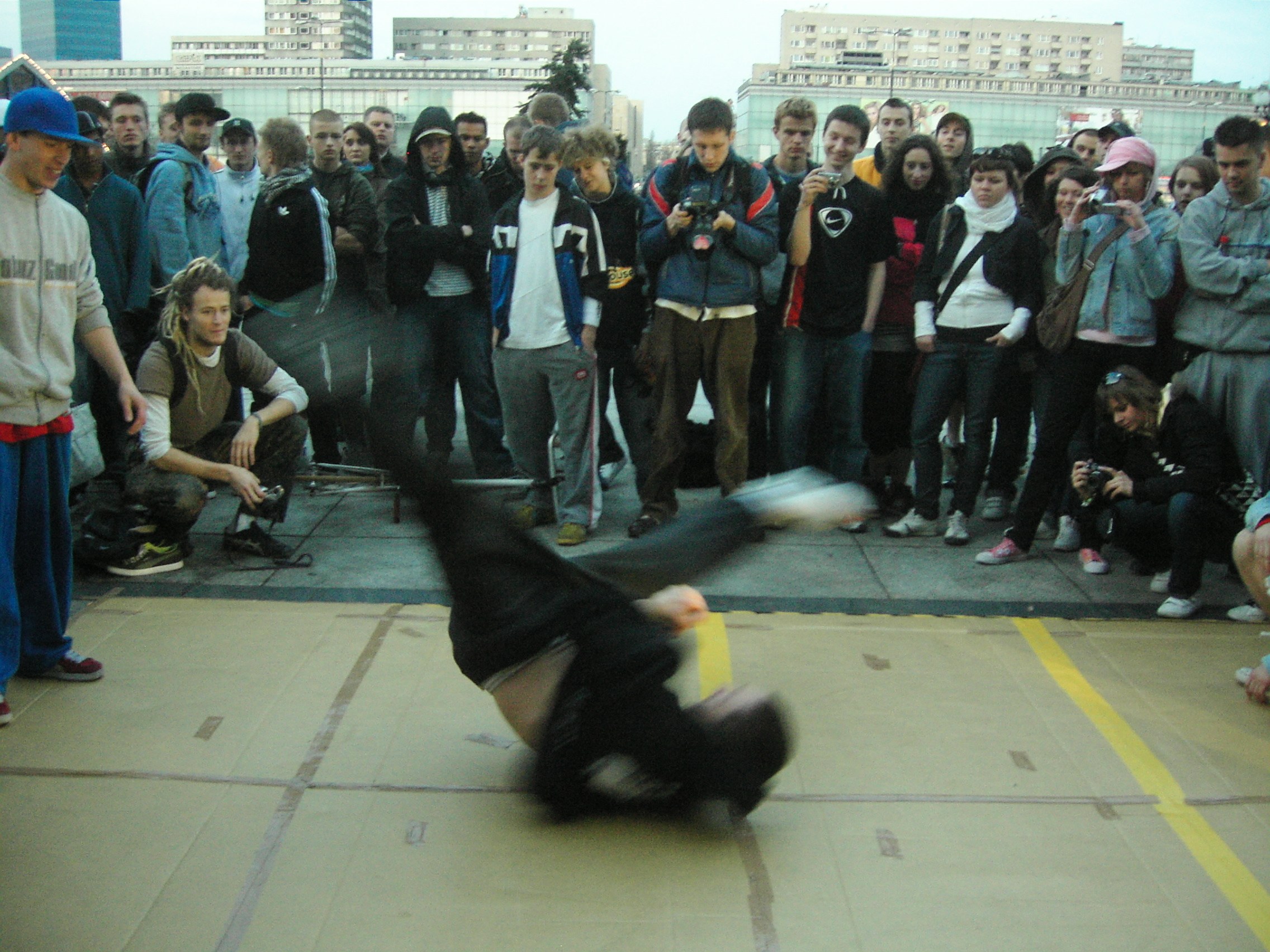
April 2007 breakdancing in Warsaw 9
Syced
- Source:
- Wikimedia Commons
- Rights:
- Public domain — free to use, share and adapt.
- Recorded as:
- cc0
Breaking has been recognized by UNESCO as an element of intangible cultural heritage, and street photographs like this one document the actual conditions of practice rather than the stylized versions seen in competition or media. This image shows the grassroots circulation and vernacular energy that define how the dance lives in communities.
What you are looking at
A breakdancer in mid-move performs an inverted, dynamic aerial maneuver—likely a headstand freeze or similar acrobatic element—while spinning or rotating, creating motion blur. The dancer wears dark clothing and is captured in the center of a concrete plaza. A crowd of roughly 30–40 spectators, mostly young people in casual 1990s–2000s street wear (hoodies, baseball caps, jackets), forms a loose circle around the performer. The setting is an urban public plaza with Soviet-era apartment blocks visible in the background; yellow and gray striping marks the ground. The light is natural daylight, bright and overcast. This is a street performance or jam session, likely captured during a breaking battle or freestyle showcase.
The dancing
The active dancer's body is inverted, with weight supported on the head and upper back in a dynamic rotating position—the legs are blurred by the spin, creating the circular momentum characteristic of power moves. The spectators stand casually, many watching intently with phones or cameras in hand, forming an informal cypher (the traditional circle for breaking). Their posture is upright and engaged, leaning in slightly toward the action. The composition emphasizes the isolation of the dancer within the observing community—a classic breaking social structure.
The dance depicted
This is breaking (also called b-boying), a street dance style originating in 1970s New York and central to hip-hop culture worldwide. The image shows a power move—one of breaking's most visually arresting elements, involving acrobatic spins, freezes, and inversions executed at speed and with control. The public plaza setting and informal cypher are canonical to breaking practice, whether in cyphers, jams, or battles. The photograph documents the street performance context that defines the dance's social function and aesthetics.
How it was made
This is a color photograph, likely shot on film or early digital camera circa 2007 (the date given). The motion blur of the spinning figure is an artifact of the camera's shutter speed capturing movement—it authenticates the moment of rotation and suggests the photographer was attempting to capture the dynamic action rather than a still pose. The slight grain and color palette are consistent with consumer-grade color film or early digital photography from the mid-2000s. The documentary quality places this in a tradition of street photography and hip-hop documentation.
About this work
This photograph documents breaking as a lived street practice in early 2000s Warsaw—evidence of hip-hop's global reach and localization beyond its American origins. It captures the social structure of breaking (the cypher) and the aesthetic priorities of the dance (dynamic power moves, physical risk, audience participation) in a moment of performance. The image is valuable as both a snapshot of urban youth culture and a precise record of how a foundational hip-hop practice was executed and experienced in Eastern Europe during this period.
How to look at it
Focus on the moment of the spin itself—the photographer chose to capture the movement in flight rather than a frozen climactic pose, making the motion blur essential to reading the power and effort. Notice the spectators' positioning and attention: they form a stable frame that emphasizes the dancer's aerial instability. The background buildings ground the image in a specific place and historical moment, anchoring this as a document of urban social practice rather than an idealized performance.
The artist
The photographer is credited as Syced. No other information about the artist's practice, training, or subsequent work is readily available from the record or image alone.
The period
In 2007, breaking was consolidating its status as a global phenomenon, visible in youth culture across Europe, Asia, and beyond. Hip-hop had emerged as a dominant cultural force in the 1990s and 2000s, and breaking—long established in the US—was becoming embedded in local street cultures worldwide. Simultaneously, the rise of digital cameras and mobile phones was shifting documentation practices; street performance was increasingly being recorded by spectators themselves. Warsaw, as a major Eastern European city, would have hosted active breaking communities by the 2000s, reflecting the dance's post-Cold War cultural integration.
Where it lives
The image is credited to Syced and held in Wikimedia Commons, a public-domain and free-licensed media repository. It was uploaded as a documentary photograph of street culture in Warsaw.
Dance in this work
Questions about this work
What is the blurry movement in the center of the image?
The dancer is executing a power move—likely a headstand spin or similar acrobatic freeze—that involves rotating the body at speed while inverted. The motion blur is a photographic artifact of the camera capturing spinning movement, and it authenticates the moment of dynamic action.
Is this a competition or just people dancing?
This appears to be a street jam or informal cypher (the traditional circle for breaking) rather than a formal battle. The casual dress, public plaza setting, and loose spectator formation are typical of community breaking sessions. However, the visual quality and crowd suggest this may also have been a larger public event.
Where did breaking come from?
Breaking originated in 1970s New York as part of hip-hop culture. It was created and developed by young dancers in the Bronx and spread globally throughout the 1980s and beyond. This photograph from Warsaw in 2007 shows how thoroughly the dance had been adopted in Eastern Europe by the 2000s.
Why are people standing in a circle?
The circle—called a cypher—is the fundamental social structure of breaking. It creates a defined performance space, focuses attention on the dancer, and allows others to step in when they choose. Breaking is fundamentally a participatory, turn-taking practice rooted in African diaspora dance traditions.
More dance artwork