49 works in this view — arrow keys or swipe to move between them.
Dance in Art
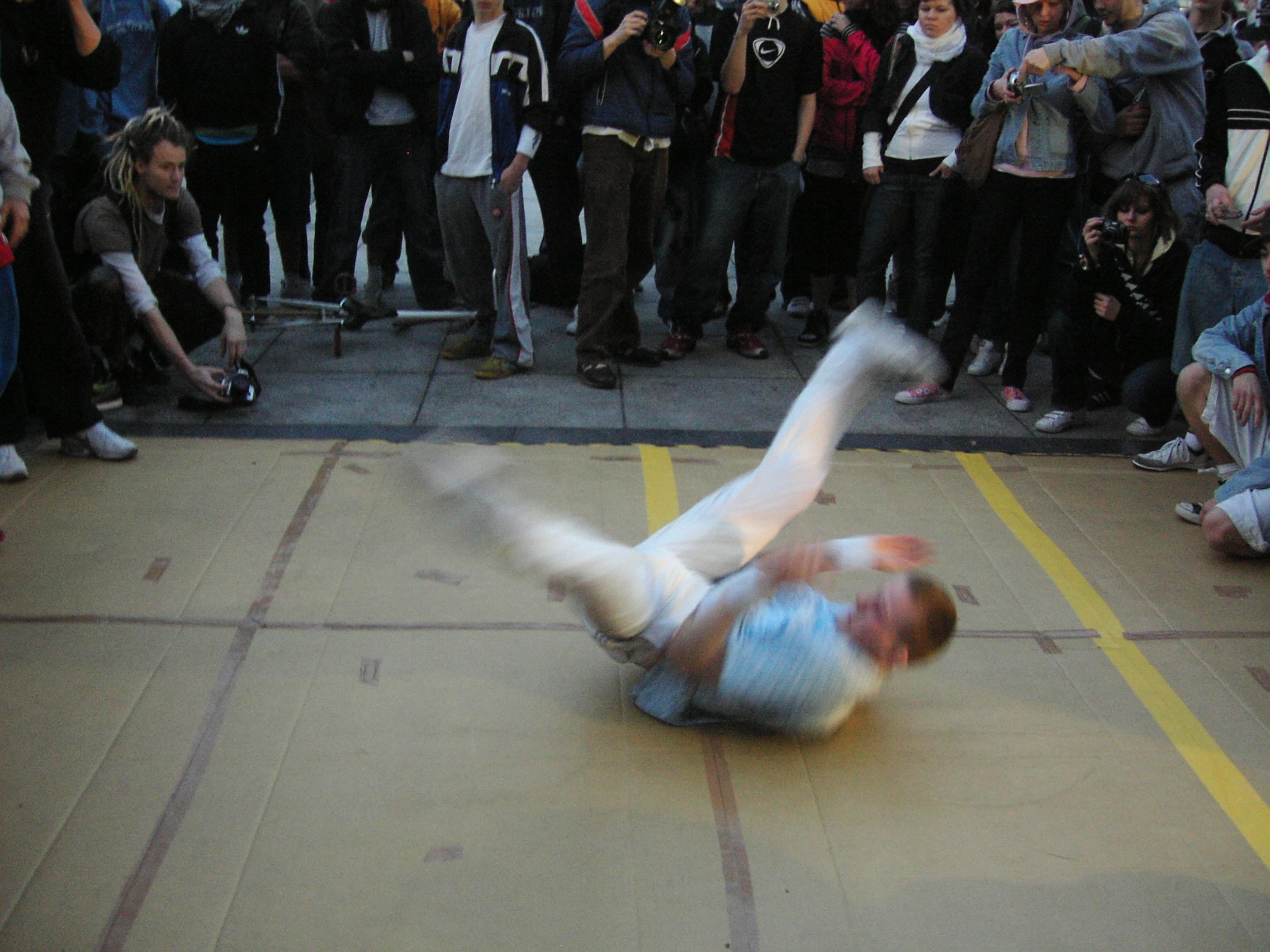
April 2007 breakdancing in Warsaw 54
Syced
- Source:
- Wikimedia Commons
- Rights:
- Public domain — free to use, share and adapt.
- Recorded as:
- cc0
Breaking originated as an African American and Latino youth art form in 1970s New York and became one of the four pillars of hip-hop culture. This photograph documents its global reach and institutionalization by the 2000s—showing that the form had spread to Warsaw and attracted enough interest to draw organized public audiences and media documentation, marking the transition from underground street culture to recognized performance genre.
What you are looking at
A breakdancer in a light blue shirt and white socks performs a freeze or power move on a concrete floor marked with yellow lines, captured mid-motion with significant blur conveying dynamic energy. The dancer is inverted or horizontal, supported on their hands or upper body, legs extended upward. The performance takes place in what appears to be an indoor public space—a gymnasium or community center with a polished concrete floor. A large crowd of spectators stands in a loose circle around the dancer, many holding cameras and phones, suggesting this is a documented public performance or battle. The crowd is dressed casually in winter clothing (jackets, long sleeves, hoodies), and the dense gathering indicates high interest in the event. The composition captures the moment of peak difficulty in the move, with motion blur emphasizing the speed and control required.
The dancing
A single male dancer, photographed from a low angle, executes an advanced inverted move with his body weight supported on his hands or upper back, legs extended skyward. The blur in the image makes precise footwork details difficult to discern, but the body position and extension suggest a freeze or power move—a signature element of breaking that demands upper-body strength and spatial control. The dancer's casual street clothing (jeans, light shirt, white socks) is typical breakdancing attire. The spatial relationship between the dancer and the surrounding circle of spectators shows the format of a freestyle cypher or battle, where the dancer occupies the center and the audience forms an attentive perimeter.
The dance depicted
This is breakdancing (breaking/b-boying), the street dance form that emerged from hip-hop culture in 1970s New York and spread globally. The image documents a public freestyle or battle event, likely taking place in Warsaw given the date and title. Breakdancing is characterized by four main elements: toprock (upright footwork), downrock (floor-based footwork), freezes (static inverted poses), and power moves (spinning or acrobatic moves). The blur captures a moment during a power move or freeze—the most visually striking and technically demanding elements—which are central to battles where dancers compete for audience and opponent respect. The presence of a large audience with cameras indicates this was an organized event or cypher with spectators.
How it was made
This is a color photograph, digital or film, taken in natural or mixed indoor lighting. The motion blur—particularly on the dancer's legs and body—suggests either a slower shutter speed or the photographer's own movement during capture. The composition and documentation style—capturing a public performance with multiple bystanders—is consistent with amateur or semi-professional event photography from the mid-2000s. The image quality and color saturation suggest a digital camera from the 2000s era. The photograph's existence on Wikimedia Commons indicates it was taken as documentary record of a public cultural moment rather than as fine art.
About this work
This photograph documents a breakdancing cypher or public performance in Warsaw in April 2007, capturing a single dancer mid-move during an advanced freeze or power sequence. The image preserves a moment of street dance culture during the early 2000s, when breaking had become an established global phenomenon with organized competitions and public performances across Europe. The photograph is valuable as documentary evidence of how breakdancing was practiced and displayed in Eastern Europe during this period, and of the public interest and spectatorship surrounding the form. The motion blur and composition effectively convey the athleticism and technical difficulty central to breaking as a performance practice.
How to look at it
Observe the body position: the dancer is inverted and horizontal, with legs extended upward—a configuration impossible in most other dance forms and characteristic of breaking's power moves and freezes. The motion blur is essential to the image's meaning; it conveys speed and difficulty that a sharp image would diminish. Notice the audience formation—a loose circle rather than a seated audience—which is the standard structure of freestyle cyphers and battles where the performance and response are continuous and participatory. The casual clothing and gymnasium setting document that this is street dance in its functional context, not a theatrical performance.
The artist
Syced is credited as the photographer on Wikimedia Commons. Beyond this attribution, no further biographical or contextual information about the photographer is available in the record.
The period
By 2007, breakdancing had been a global cultural phenomenon for over three decades. In the 1980s and 1990s, breaking spread from New York to Europe, Japan, and beyond, evolving from underground street culture into an organized competitive scene with battles, crews, and international recognition. By the 2000s, breaking was being documented extensively through amateur photography and video, and public cyphers and battles were common in major cities worldwide. In Poland specifically, hip-hop culture and breaking had become established youth subcultures by the 2000s, visible in organized events like the one documented here.
Where it lives
This photograph is held on Wikimedia Commons, indicating it is publicly available and likely released under a free or public-domain license. It was uploaded as documentary record of a public event and is presented as found visual culture rather than as a curated museum acquisition.
Dance in this work
Questions about this work
What is the dancer doing in this freeze position?
The dancer is executing an inverted freeze or power move, supporting their body weight on their hands or upper back with legs extended. This is one of the most visually striking elements of breaking and requires significant upper-body strength, control, and spatial awareness. Freezes are moments of peak technical difficulty and visual impact in breaking performances.
Why is there so much motion blur in the image?
The blur captures the speed and dynamism of the movement. It results from a slower camera shutter speed or movement during exposure, and effectively conveys the athleticism and momentum of the power move. It emphasizes that this is a moment of extreme motion and control.
What is the circle of people doing around the dancer?
They are participating in a cypher—the standard format for freestyle breakdancing where dancers take turns performing in the center while others watch, encourage, and wait their turn. This is both a performance and a participatory social activity, central to breaking culture. The presence of cameras suggests this may have been an organized event or battle.
When and where did breaking originate?
Breaking emerged in 1970s New York City among African American and Latino youth, evolving from earlier street dance traditions and becoming one of the four core elements of hip-hop culture (along with DJing, MCing, and graffiti). By 2007, when this photograph was taken, breaking had spread globally and become an organized international competitive scene with crews, battles, and formal recognition.
More dance artwork