49 works in this view — arrow keys or swipe to move between them.
Dance in Art
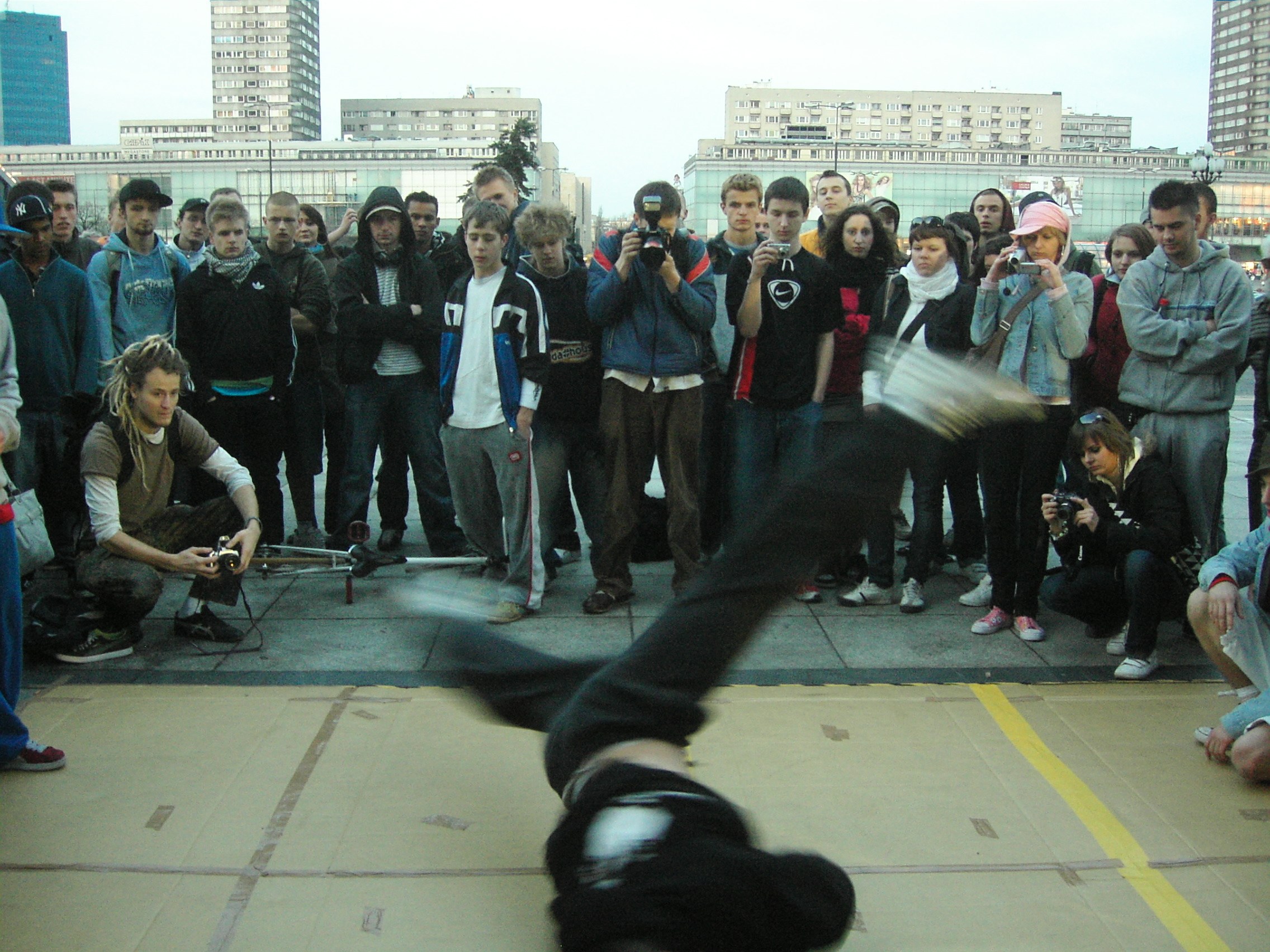
April 2007 breakdancing in Warsaw 36
Syced
- Source:
- Wikimedia Commons
- Rights:
- Public domain — free to use, share and adapt.
- Recorded as:
- cc0
Breaking is a dance form built on improvisation, competition, and mastery of the body under extreme conditions—freezes and power moves are not learned quickly or lightly. This photograph documents that practice and skill in a public, non-professional setting, showing how breakdancing has embedded itself in street culture globally. For historians of hip-hop and street dance, it is evidence of how the form circulated and was practiced in the early 2000s, before institutionalization through competition and media.
What you are looking at
A large crowd of young people stands in a semicircle on a concrete plaza in an urban setting, watching a breakdancer in motion at the center. The breakdancer is captured mid-freeze, their body inverted and blurred by movement, legs extended upward. The surrounding spectators—wearing early-2000s casual clothing including hoodies, baseball caps, and layered jackets—hold cameras and phones, documenting the performance. In the background, a wall of light-colored building facade with regular window patterns rises behind a turquoise-tinted barrier. The daylight is overcast, flattening shadows across the grey plaza. This is plainly a street performance or informal dance battle, with the crowd serving as both audience and documentation crew.
The dancing
The central dancer's body is horizontal and inverted, performing a freeze or power move that requires extreme body control and upper-body strength. The motion blur indicates rapid rotation or momentum. The spectators stand in an open formation, maintaining distance from the active dance area, with several holding cameras at eye level. The crowd's posture is alert and focused—heads turned toward the dancer, bodies still. No other dancers are visible engaging with the central performer; this is a solo performance for an audience rather than a competitive exchange.
The dance depicted
This is breakdancing (also called breaking or b-boying), a street hip-hop dance form that emphasizes improvisation, power moves, freezes, and virtuosic body control. The inverted freeze captured here—likely a headstand, handstand, or baby freeze variant—is a signature element of breaking, requiring significant strength and practice. Breakdancing emerged in the 1970s in New York and spread globally by the 2000s, when this photograph was taken. The informal plaza setting and crowd documentation are typical of contemporary breaking culture, which exists both as competitive sport (with judged battles) and as street performance and social gathering.
How it was made
This is a color photograph, likely taken with a digital camera, given the image quality and the 2007 date. The photographer has captured motion blur in the dancer's body while keeping the spectators relatively sharp, suggesting a moderate shutter speed that freezes some elements while allowing movement to register. The flash or available light creates the characteristic flattened, slightly cool-toned quality of daylight documentary photography. This is a documentary photograph rather than a posed studio image, reflecting the spontaneous, public nature of street dance culture and its visibility in the social-media-enabled 2000s.
About this work
This is a document of breaking culture in Warsaw in 2007, captured during what appears to be an informal public performance or gathering. The photograph records not only the breakdancer's technical skill—the inverted freeze is demanding and requires years of practice—but also the social context of street dance: the spectators with cameras, the public plaza as performance space, the mixture of ages and styles in the crowd. It is evidence of how breakdancing had become a global and localized practice by the 2000s, anchored in street culture but also increasingly documented and shared through photography and digital media.
Breakdancing's presence in a European city like Warsaw, performed in daylight to a mixed crowd of onlookers, shows how thoroughly the form had traveled from its New York origins and how it functioned as both personal expression and community event. The photograph is valuable as a moment of social and cultural documentation as much as a record of dance technique.
How to look at it
Watch the blur at the center of the frame: the photographer has chosen to show the freeze in motion, rather than a static held position. This emphasizes the dynamism and difficulty of the move—the body is not resting but rotating or suspended. Notice also the framing: the dancer is small within the frame, surrounded by spectators, making the audience and the social context of the performance as visually important as the dance itself. This compositional choice reflects the reality of street dance, which is as much about gathering and collective witnessing as it is about individual skill.
The artist
Syced is credited as the photographer. No further information about the artist is available in the record or readily established from the image.
The period
By 2007, breakdancing had been a visible part of global youth culture for thirty years, having originated in the Bronx in the mid-1970s. In the 2000s, breaking was experiencing a resurgence in popularity, driven partly by its inclusion in international competitions, media coverage, and the rise of digital video platforms that allowed performers to share and learn from each other globally. Breaking in Eastern Europe, including Poland, was part of this global circulation, often developing through underground scenes and street performances before gaining institutional recognition. The casual, documentary quality of this photograph—the amateur videography, the public plaza setting—reflects how breaking existed simultaneously as street culture and as increasingly mediated and documented practice.
Where it lives
The photograph was sourced from Wikimedia Commons, a digital archive of openly licensed media. It is dated April 2007 and tagged as documenting breakdancing in Warsaw, Poland. No holding collection or accession information is recorded.
Dance in this work
Questions about this work
What is the dancer doing in the freeze?
The dancer is performing a freeze—a signature power move in breakdancing where the body is inverted and held in a controlled position, requiring significant upper-body and core strength. The motion blur suggests the dancer may be in the middle of rotating into or out of this position, adding to the difficulty and visual impact of the move.
Why is everyone filming?
By 2007, documenting street performances with cameras and phones was becoming standard practice, especially in hip-hop and street dance communities. These recordings circulated online and served as proof of skill, entertainment for absent friends, and material for sharing across networks. Breaking culture has always valued the documentation and circulation of impressive moves and battles.
Is this a competition or just a public performance?
The image does not provide clear evidence of a formal competition structure (judges, stage, formal rules), though it could be either a casual street jam or a more organized event. The informal setting and crowd composition suggest it may be a public gathering or performance rather than a ranked battle, but the focused attention and documentation by spectators indicate the performance is being taken seriously.
How did breaking get to Warsaw?
Breakdancing spread globally through films, music videos, touring performers, and eventually through internet video sharing and social media. By the 2000s, breaking had established scenes in most major cities worldwide, including Eastern European cities like Warsaw, where local performers learned the form and developed their own styles and communities.
More dance artwork