49 works in this view — arrow keys or swipe to move between them.
Dance in Art
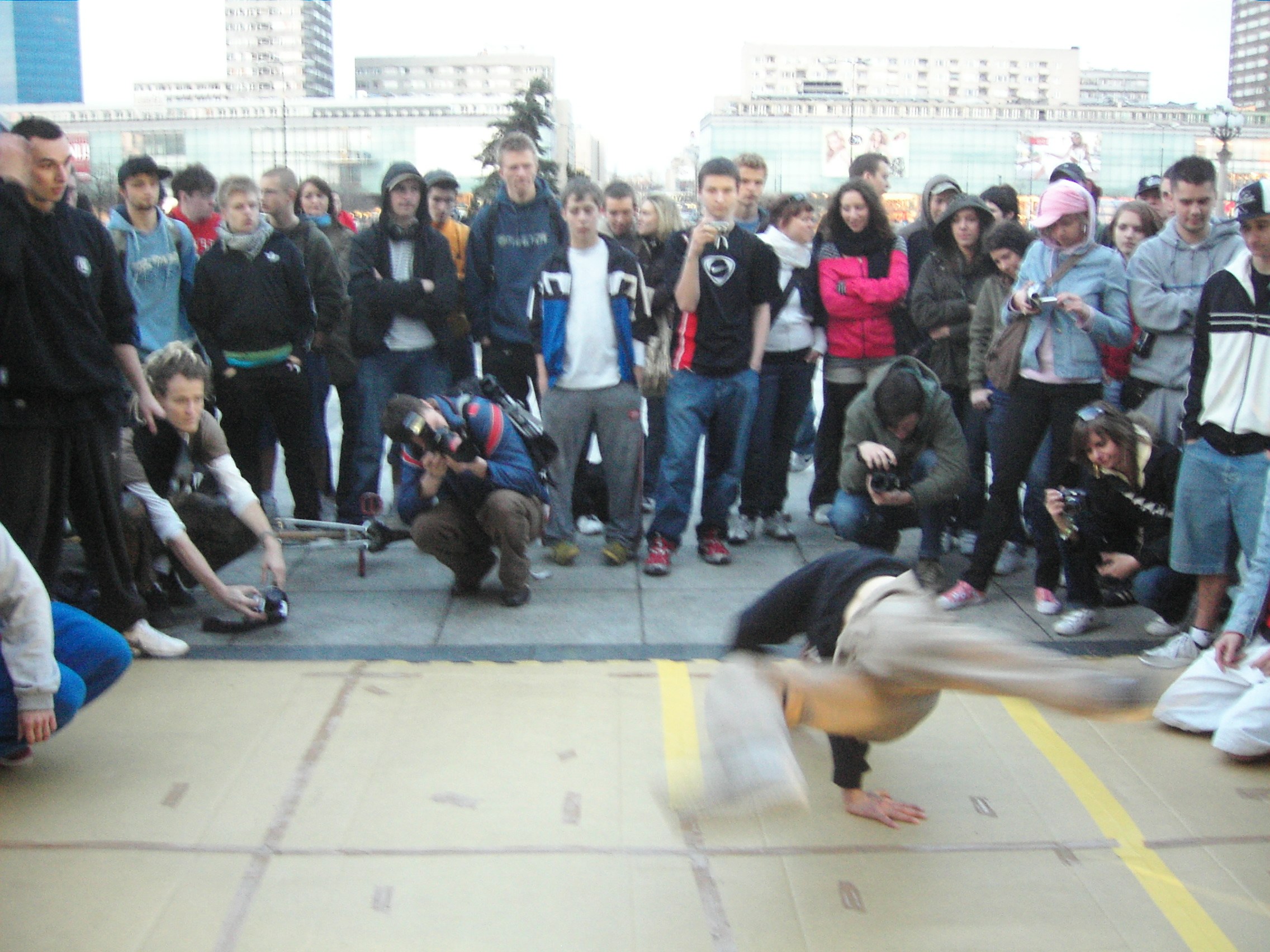
April 2007 breakdancing in Warsaw 74
Syced
- Source:
- Wikimedia Commons
- Rights:
- Public domain — free to use, share and adapt.
- Recorded as:
- cc0
This photograph is a direct visual record of breaking as a lived street practice in early 2000s Europe—not as a marketed show or a staged documentation, but as dancers performing for each other and passing crowds. It documents a specific technological moment: the transition from video as a scarce distribution medium to video as something captured casually on personal devices, which would fundamentally change how street dance was circulated and learned. For historians of hip-hop and street dance, the image is evidence of how breaking had become ordinary urban culture by 2007, embedded in everyday city life across multiple continents.
What you are looking at
A large crowd of spectators—perhaps 40–50 people—gathers on a city plaza in Warsaw, forming a loose circle around two breakdancers in the center. The setting is urban and modern: concrete paving with yellow line markings is visible underfoot, and multi-story residential and office buildings rise in the background, their facades pale and repetitive. The light is bright and even, suggesting an overcast day. One dancer is captured mid-move, body horizontal and weight supported on hands in an inverted position—a freeze or power move typical of breakdancing. The other dancer crouches or prepares nearby. The crowd is dressed in casual contemporary clothing—hoodies, jeans, baseball caps, bright jackets—and many spectators are recording the performance on mobile phones held at arm's length. The mood is relaxed and participatory; this is clearly a street performance with an informal audience drawn by curiosity.
The dancing
Two male breakdancers occupy the center circle, one performing an explosive inverted freeze with weight concentrated through the hands and upper body, the other positioned in a dynamic crouch or waiting posture. Both wear contemporary streetwear: baseball caps, hoodies, and track-style clothing. The performers' bodies demonstrate the extreme body control and inversion characteristic of breaking: the horizontal line of the airborne dancer's body, the tension through the shoulders and arms, and the precision of hand placement all show trained skill. The crowd stands upright and still, their bodies angled inward toward the performance; many hold mobile devices at chest or head height.
The dance depicted
This is breaking, also called b-boying (or b-girling if performed by women), a foundational element of hip-hop street dance culture. Breaking emerged in New York in the 1970s and by 2007 had become a global phenomenon. The image captures a public jam session or street performance, common in European cities in the 2000s as breaking transitioned from underground practice to visible urban culture. The specific move shown—an inverted freeze or backspin variant—is a signature element of breaking's athletic vocabulary. The presence of a substantial audience recording on mobile phones is historically significant: it documents the moment when street dance began to be mediated and circulated through consumer technology rather than experienced only in live community performance.
How it was made
This is a color photograph, apparently digital (the image quality and color saturation suggest early-to-mid 2000s digital capture). The photograph is a documentary or documentary-adjacent image rather than an artistic composition; it records an actual event rather than staging one. The composition is snapshot-like: the photographer stands within or very close to the crowd, shooting at roughly eye level, which places the viewer inside the social space of the performance rather than observing from a distance. This proximity and candid framing are typical of social documentation or street photography. The photograph was uploaded to Wikimedia Commons, indicating it was intended for open reuse rather than retained as a personal archive.
About this work
This photograph documents a breakdancing jam session on a Warsaw street in April 2007, capturing both the athletic movement of the dancers and the social context of breaking's emergence as a visible street culture in post-2000s Europe. The image is valuable precisely because it is ordinary: not a studio documentation, not a stage performance, but a moment of public culture-making in a city plaza, with the apparatus of early social media visible in the spectators' mobile phones. Breaking had been part of global hip-hop culture for three decades by this date, but the visibility of street jams and the casual circulation of performance video on phones represented a new phase in how dance culture was created, witnessed, and preserved.
How to look at it
Look first at the arrested moment of the freeze: the dancer's body is fully inverted and supported entirely through the hands and arms, with the spine and legs extended in a near-horizontal line. This is not a stable pose but a moment of explosive control—the freezes in breaking are brief, weight-bearing acts that require tremendous shoulder and core strength. The second figure is positioned to enter the circle next moment, creating a visual rhythm typical of crew jams, where dancers take turns. Look also at the crowd: the phones held at arm's length are not incidental details but evidence of how performance documentation was beginning to shift from professional cameramen to audience members. The casual, daytime setting in a public plaza—not a club or stage—is also crucial: breaking at this period existed simultaneously as street culture and as a practice moving toward formalization and institutional recognition.
The artist
The photographer is credited as 'Syced' and the image was made available on Wikimedia Commons. No other biographical or contextual information about the photographer is recorded. The image appears to be documentary social photography rather than the work of an established artist; it belongs to a broader practice of street photography and social documentation that became routine as digital cameras and internet platforms made casual image-sharing normative.
The period
By 2007, breaking had been part of global hip-hop culture for more than three decades, but was still gaining mainstream visibility and institutional recognition in Europe. The period 2005–2010 saw breaking begin to appear in competitions, academic study, and cultural policy discussions in Europe; the 2008 Beijing Olympics included breaking-related performances, and by 2012 breaking was on track for Olympic inclusion (formalized in 2020). The early 2000s were also the moment when YouTube (founded 2005) and mobile video cameras transformed how street dance was documented and learned—crews could now post performances globally within hours rather than circulating VHS tapes or relying on in-person transmission. This photograph captures that transitional moment: a street jam documented casually by phones that would have been unthinkable as distribution media a decade earlier.
Where it lives
The image was uploaded to Wikimedia Commons, a free media repository. It is attributed to a photographer or user credited as 'Syced,' but no further information about the original source, holding institution, or archival status is recorded in the catalogue.
Dance in this work
Questions about this work
What is breaking?
Breaking (also called b-boying or b-girling) is a street dance form that emerged from hip-hop culture in New York in the 1970s. It combines upright footwork and body movements (toprock) with explosive athletic elements (drops, spins, freezes, and power moves) performed on the ground. Freezes, like the one visible in this image, are sudden stops in which the dancer holds an acrobatic pose for a moment before returning to movement.
When did breaking become visible in Europe?
Breaking began to spread globally in the 1980s, but became widely visible in European public space during the 1990s and 2000s. By 2007, when this photograph was taken, breaking was an established feature of street culture in major European cities, though it was still in the process of gaining institutional recognition and competing for space with other forms of public performance.
What do the mobile phones in the image tell us?
The spectators recording on mobile phones document a technological shift in how street dance was preserved and circulated. Before smartphones and video platforms, breaking crews relied on in-person transmission, VHS tapes, and occasional television coverage. By 2007, casual video documentation on personal devices was becoming routine, which would accelerate how breaking knowledge spread globally and how street dancers could build audiences and learn from each other across distances.
Why photograph a street jam rather than a stage performance?
Street jams are the primary context in which breaking happens: crews gather in public spaces to practice, battle, and perform for their own communities. Documenting a jam session rather than a formal stage show captures breaking in its native social context and as a living practice, not as a professionalized or curated form.
More dance artwork