49 works in this view — arrow keys or swipe to move between them.
Dance in Art
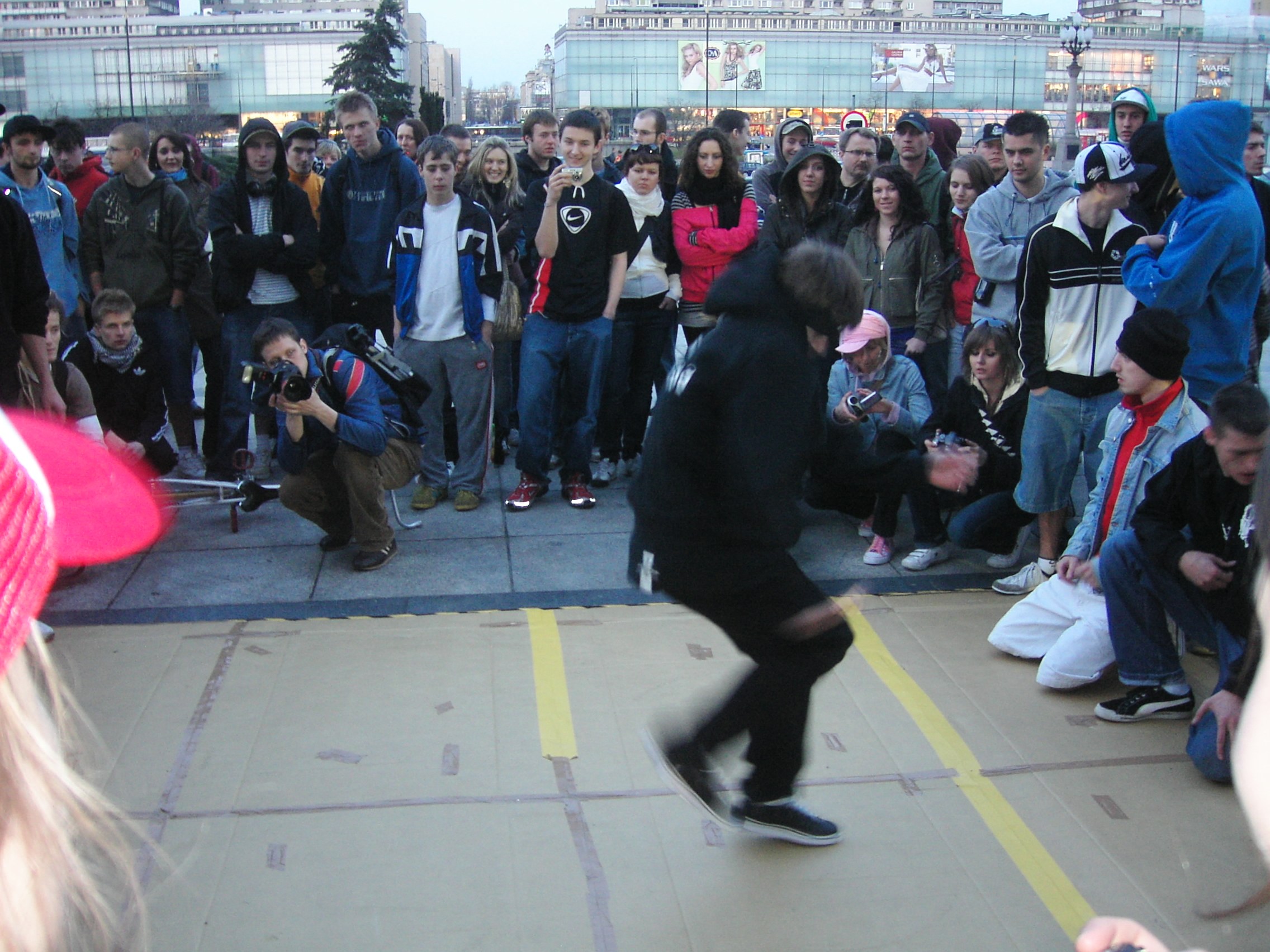
April 2007 breakdancing in Warsaw 66
Syced
- Source:
- Wikimedia Commons
- Rights:
- Public domain — free to use, share and adapt.
- Recorded as:
- cc0
This image is a primary document of breaking's expansion beyond its American roots into European street culture by the mid-2000s. It shows how breaking functioned as participatory street performance in early-2000s urban youth culture, performed for and recorded by peer audiences rather than professional venues—a mode of transmission and circulation that was reshaping dance globally.
What you are looking at
A large crowd of young people, predominantly wearing casual winter clothing—hoodies, jackets, beanies—gathers in a paved urban plaza bounded by modern glass-fronted commercial buildings. The scene is shot in daylight with cool, overcast lighting typical of Eastern European winter. In the center of the crowd, a solitary dancer in black clothing performs for the assembled spectators, who form a loose circle around them. The pavement is marked with yellow and white lines. The setting appears to be a major city square or shopping district; the architecture and crowd composition suggest a public gathering or informal street performance rather than an organized event with stage or formal structure.
The dancing
A single dancer occupies the center ground, captured mid-movement in a dynamic, off-balance posture characteristic of breaking. The dancer's body is tilted, knees bent, with the weight shifted onto one leg in a moment of active improvisation. The surrounding crowd—roughly 40–50 people—stands in a loose, informally organized circle, many holding mobile phones or cameras to record the performance. Several spectators are crouched or sitting at ground level to get closer views. The crowd's stillness and focused attention contrasts sharply with the dancer's kinetic energy.
The dance depicted
This is breaking (B-boying), the acrobatic, improvisational street dance that emerged from hip-hop culture in 1970s New York. The solitary dancer is performing a freestyle session for an audience of onlookers in what appears to be a public plaza. The dynamic, grounded movement style, the one-on-one performance format, and the informal street setting are all canonical to breaking as a social and competitive practice. The crowd composition and mobile phone documentation suggest this is part of Warsaw's early-to-mid-2000s breaking scene, when the style was becoming established in European cities outside its American birthplace.
How it was made
This is a digital photograph, likely taken by a mobile phone or compact digital camera common in 2007. The image resolution and color palette are consistent with early digital consumer photography of that era. The snapshot aesthetic—uncontrolled composition, peripheral figures partially cropped, natural daylight—documents the moment without artistic intervention, functioning as a documentary record rather than a composed artwork. This medium choice is itself historically significant: the proliferation of mobile phones with cameras in the mid-2000s coincided with the explosion of video documentation and social media sharing that transformed how street dance was recorded, circulated, and learned.
About this work
This photograph captures a breaking session in Warsaw in April 2007, showing a lone dancer performing in an urban plaza for a crowd of onlookers, many recording on mobile devices. It documents a specific moment in the globalization of breaking, when the style had spread from its New York origins to Eastern European cities and was becoming embedded in youth culture worldwide. The image preserves not just the dance itself but the social context of early-2000s street performance: the informal plaza setting, the spontaneous gathering, the ubiquitous mobile phone cameras that were beginning to reshape how dance was documented and shared. For dance historians, it is a record of breaking's geographic reach and its integration into urban public space.
How to look at it
Attend to the isolation of the dancer within the crowd: breaking is a solo improvisational form, and the spatial separation between performer and audience is key to how it functions socially. Notice the crowd's composition and posture—the phones and cameras, the seated spectators—which shows breaking as a peer-to-peer performance event rather than a formal concert. The paved plaza and modern buildings frame this as street culture embedded in public urban space. The moment captured is one of active improvisation, not a static pose; the off-balance posture shows the dancer mid-move, which is essential to understanding breaking's aesthetic of continuous, unpredictable motion.
The artist
The photographer is credited as Syced and the image is sourced from Wikimedia Commons, suggesting it was uploaded as part of a documentarian or archival impulse around 2007–2010. No further biographical information about the photographer is available in the record, but the documentary approach and the decision to share it openly suggest an interest in capturing subcultural practice.
The period
In 2007, breaking was roughly 30 years old as a practice but still relatively recent and evolving in Europe. The mid-2000s saw a significant expansion of breaking beyond its hip-hop core audience, partly driven by media visibility (breaking had appeared in major films and on television) and partly by the internet's role in spreading instructional video and community knowledge. In Poland specifically, the early-2000s marked the emergence of visible breaking crews and scenes in major cities. This photograph sits at the intersection of breaking's establishment as a globally distributed practice and the technological shift toward mobile documentation—a moment when street dance was moving from ephemeral performance into recorded, shareable media.
Where it lives
The image is held in Wikimedia Commons, a public-access digital repository. The photographer is credited as Syced, and the title and date are provided in the catalogue record; no further institutional holding or accession information is recorded.
Dance in this work
Questions about this work
What is breaking and where did it come from?
Breaking (also called B-boying or B-girling) is an improvisational, acrobatic street dance that originated in New York City in the early 1970s as part of hip-hop culture. It emphasizes improvisation, footwork, spins, and freezes performed to hip-hop and funk music. By the 1980s and 1990s, it had spread globally; this 2007 photograph documents its presence in Warsaw, showing how thoroughly it had been adopted into European youth culture.
How is breaking different from other hip-hop dances?
Breaking is distinguished by its emphasis on solo improvisation, athletic ground-based movement, and a competitive or social performance format where dancers take turns ('battles'). Unlike choreographed hip-hop styles, breaking is improvisational and has a strong freestyle element. The solitary dancer in this image, performing for an informal crowd, exemplifies breaking's one-on-one, spontaneous social structure.
Why is this photograph historically significant?
This image documents breaking as an established street practice in a European city in the mid-2000s, showing how completely it had traveled from its American origins. It also captures the technological moment when mobile phone cameras began documenting street culture—the spectators' phones are recording devices, marking a shift toward how dance knowledge is now circulated online rather than learned only in person.
What can we tell about the breaking scene in Warsaw from this image?
The large, attentive crowd suggests breaking had achieved visibility and popularity in Warsaw's youth culture by 2007. The informal plaza setting indicates that dancers were performing in public spaces, not specialized venues. The mobile phones indicate an engaged audience that was recording and likely sharing performances, showing how breaking crews used emerging social media to build community.
More dance artwork