49 works in this view — arrow keys or swipe to move between them.
Dance in Art
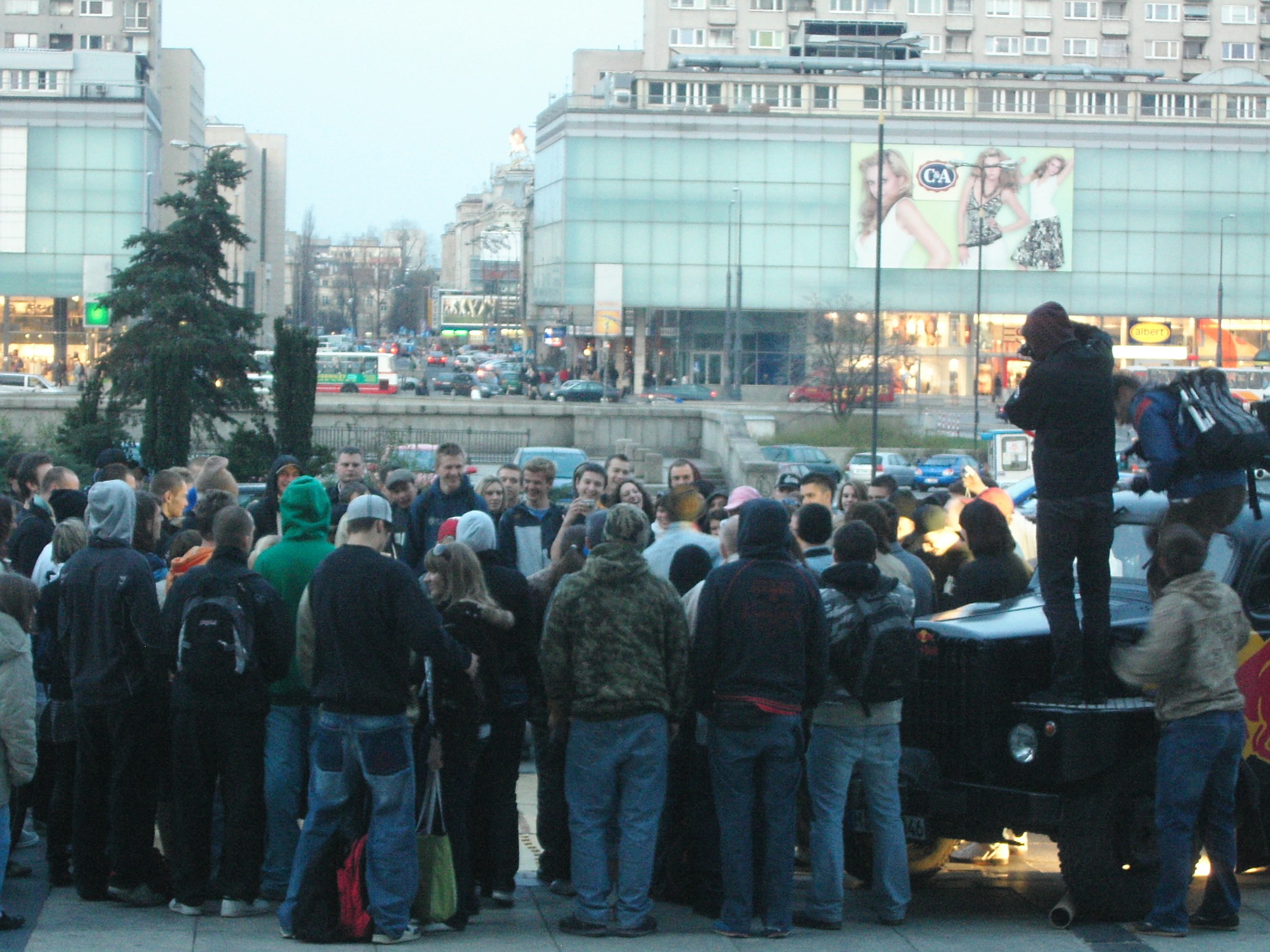
April 2007 breakdancing in Warsaw 21
Syced
- Source:
- Wikimedia Commons
- Rights:
- Public domain — free to use, share and adapt.
- Recorded as:
- cc0
Breaking emerged in 1970s Harlem and the Bronx; its presence in Warsaw in 2007 demonstrates how thoroughly African American street dance had been adopted and localized across the world within a generation. The photograph captures a moment when breaking was shifting from subcultural novelty to normalized youth practice in European cities. For dance historians, this image is evidence of how street cultures circulate, adapt, and embed themselves in new geographic and social contexts.
What you are looking at
A large crowd of young people gathers in an urban plaza in Warsaw on an overcast day, their attention focused on a performance or gathering at ground level. The setting is a modern European city square flanked by contemporary multi-story residential and commercial buildings; a large illuminated advertisement for C&A clothing is visible on the glass facade of a shopping center across the plaza. The crowd is densely packed, most wearing winter or autumn clothing—dark hoodies, jackets, and beanies—suggesting cool weather. The gathering has the character of a street event or spontaneous assembly; some participants hold phones or cameras, suggesting documentation or spectation. The foreground shows the backs of standing spectators; the middle ground opens to the plaza surface where the activity is centered, though the actual dancers or focal point are obscured by the crowd itself.
The dancing
The image captures spectators rather than dancers in clear detail. What is visible shows young people standing upright, some with arms at their sides, others gesturing or holding recording devices. The crowd orientation suggests attention toward ground-level movement, typical of circle-based or freestyle street dance where the performance space is horizontal and audience members surround the action. No formal dance frame or partnered holds are evident from what the camera captures.
The dance depicted
The catalogue identifies this as breakdancing in Warsaw, April 2007. Breaking (b-boying) is a street dance form that evolved in 1970s New York and became a global cultural practice by the 2000s. The crowd gathered around a central point on the pavement is consistent with how breaking is practiced—dancers typically perform in a circle (a 'cypher') with spectators and other dancers standing around the perimeter, waiting to enter or watching. The urban plaza setting, the casual winter clothing of participants, and the documentation by smartphones all align with contemporary street dance culture. However, the crowd density obscures the actual dancers and their movement vocabulary, so specific elements of breaking technique—toprock, freezes, power moves, footwork patterns—cannot be verified from this image.
How it was made
This is a photograph, almost certainly digital or scanned from a digital camera original, shot in daylight under overcast conditions. The image quality and the presence of mobile phones in participants' hands suggests a date consistent with the 2007 attribution—the early smartphone era when casual documentation of street events was becoming standard. The photograph is documentary in intent rather than composed or staged; it captures a moment of street culture as it occurred. The wide angle and crowd-inclusive framing prioritize the social and public nature of the event over technical dance detail.
About this work
This is a documentary photograph of a breaking (b-boying) event in Warsaw's public urban space, captured in April 2007 by photographer Syced. It documents the globalization of hip-hop street dance culture to Eastern Europe during the 2000s, when breaking had become an established international youth practice. The image privileges the social structure of breaking—the cypher, the crowd, the public gathering—over individual technical display, making it a record of how the dance functioned as participatory street culture rather than performance.
How to look at it
Focus on the crowd structure itself: the circular arrangement of spectators is the visual signature of breaking culture, the cypher in which dancers take turns and others watch and wait. The wide angle and street-level perspective show how breaking colonizes public urban space. The casual documentation by participants (visible phones) is itself a marker of early-2000s digital culture. The image does not show technical mastery or individual moments of virtuosity; instead, it records the social and spatial logic of how breaking happens in public—as gathering, as turn-taking, as street occupation.
The artist
Syced is credited as the photographer. The name and practice suggest a documenter of Warsaw street culture; the image was uploaded to Wikimedia Commons, indicating an intent to share documentary material publicly. Beyond this, the artist context is not established in the available record.
The period
By 2007, breaking had been established globally for over thirty years. The early 2000s saw a resurgence of interest in street dance in Europe, aided by hip-hop media circulation, dance competition platforms, and the internet's role in spreading movement vocabulary and event information. Breaking was beginning to move from purely street-based practice toward competitive and institutional contexts (it would later be included in the 2024 Olympics). Warsaw, as a post-socialist European capital, was experiencing the cultural shifts of EU accession (2004) and increased connection to global youth culture. The photograph captures breaking at a moment when it was both street practice and emerging cultural institution.
Where it lives
The photograph was uploaded to Wikimedia Commons, a public image repository. The attribution to photographer Syced and the date April 2007 are recorded in that source; the specific location and event are not further documented in the catalogue record.
Dance in this work
Questions about this work
Why can't I see the dancers clearly?
The photograph captures the crowd and gathering from the outside, showing spectators' backs and the crowd formation rather than the performance circle at the center. This documentary angle prioritizes the social event over technical detail. Breaking, as a street practice, organizes itself around a central performing space surrounded by onlookers—this photograph documents that structure rather than the movement itself.
How did breaking reach Poland by 2007?
Breaking originated in New York in the 1970s and became a global hip-hop practice by the 1990s through recorded media, touring, and international competition circuits. Poland's EU accession in 2004 and increased internet access accelerated youth culture exchange. By the 2000s, breaking was practiced in youth communities across Europe, including Eastern European cities.
What makes this a street dance rather than a stage performance?
The setting is an urban public plaza, not a theater or formal venue. Participants wear casual street clothing, and the gathering appears spontaneous and open—anyone could enter the cypher. The cypher formation itself (dancers and spectators arranged in a circle on the ground) is the defining social structure of street-based breaking, distinct from stage breaking performed for a frontal audience.
More dance artwork