49 works in this view — arrow keys or swipe to move between them.
Dance in Art
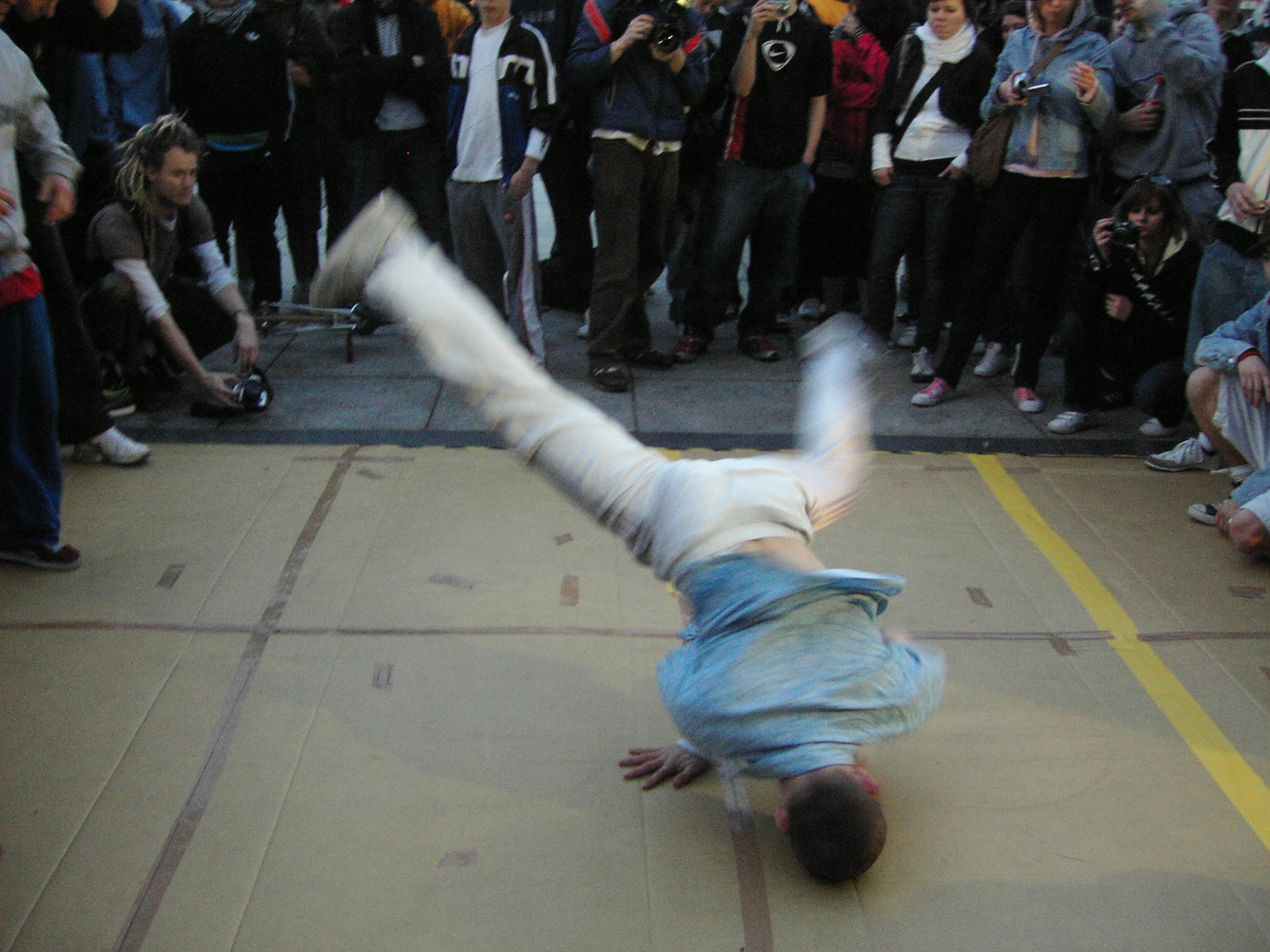
April 2007 breakdancing in Warsaw 55
Syced
- Source:
- Wikimedia Commons
- Rights:
- Public domain — free to use, share and adapt.
- Recorded as:
- cc0
This image captures breaking not as a staged theatrical form but as it is actually practiced in urban public space: a peer-to-peer display of technical mastery within a community context. It documents the global reach of a distinctly African American and Latino street dance form, showing its presence in Eastern European youth culture by the 2000s.
What you are looking at
A breakdancer performs a headstand or inverted move on concrete pavement outdoors, captured mid-action with legs extended upward and body weight supported on the head and hands. The dancer wears light-colored (white or cream) pants and a blue jacket. The performance takes place in an urban street setting, likely a public plaza or pedestrian area, with a large crowd of spectators standing in a circle around the dancer. The photograph is taken from within the circle, at ground level, emphasizing the dramatic inversion of the body. Spectators hold mobile phones and cameras, documenting the performance. The setting and crowd formation suggest this is a street performance or a public gathering, possibly a battle or competition, given the organized circular arrangement typical of breakdancing events.
The dancing
The primary dancer is inverted, supporting their full body weight on the head and upper back, with both legs extended vertically or slightly curved. The positioning suggests a freeze or sustained move—a signature element of breakdancing vocabulary. The body is in an extreme inversion that requires significant upper-body strength and control. The crowd, standing at varying distances around the performance circle, frames the dancer as the focal point; their posture and phone-holding suggest they are witnesses rather than participants.
The dance depicted
This is clearly breaking (also called b-boying), the street dance form that emerged from hip-hop culture in 1970s New York and spread globally. The move being performed is a freeze or headstand, one of the canonical technical elements of breaking that demands muscular control and spatial awareness. Breaking is characterized by acrobatic moves, footwork patterns, and freezes that showcase individual dancer skill. The urban outdoor setting and the spectator circle (cypher) are hallmarks of breaking practice and performance in street contexts. The documentation by multiple camera-holders suggests this may be part of a battle or competitive showcase.
How it was made
This is a color photograph, likely digital, taken at ground level during the moment of the freeze. The motion blur on the dancer's legs and the sharp focus on the torso and head suggest a relatively fast shutter speed or action photography technique, freezing a moment that would otherwise be in rapid motion. The low angle and proximity to the action create dramatic foreshortening and emphasize the difficulty of the inversion. The image's grain and color saturation are consistent with early-to-mid 2000s digital photography.
About this work
This photograph documents a breaking performance in Warsaw in April 2007, capturing a dancer mid-freeze during a street performance. Breaking had by this date become a global youth practice, established in Europe through battles, competitions, and street culture over the preceding two decades. The image records both the technical vocabulary of breaking—the dramatic inversion and bodily control required—and the social context in which breaking thrives: the street cypher where dancers perform for peers and document each other's skill.
How to look at it
Attend to the geometry of the body: the complete inversion and the balance required to sustain weight on the head and hands. The photographer's position—inside the cypher, at the level of the action—creates an immersive perspective that conveys the audience's view of the move. Notice the spectators' phones: this image itself is one of many being captured in real time, a form of documentation that is integral to how breaking communities share, learn, and validate skill.
The artist
Syced is identified as the photographer. No further biographical information is available in the catalogue record.
The period
Breaking emerged in New York in the early 1970s and became a global phenomenon over subsequent decades. By 2007, when this photograph was taken, breaking had been established in Europe for over 20 years through international battles and the circulation of video documentation. The early 2000s saw the rise of digital photography and mobile documentation, reflected in the spectators' phones visible in this image. Breaking remained primarily a street and underground practice in most of Europe, though it was beginning to gain recognition as a sport and performance art form.
Where it lives
This photograph is held in Wikimedia Commons, a public archive of media. It is credited to Syced and dated April 2007. The image appears to be user-generated documentation of a street performance.
Dance in this work
Questions about this work
What is the move the dancer is performing?
The dancer is performing a headstand or head freeze, one of the foundational acrobatic moves in breaking. This move requires significant neck and upper-body strength and is typically used as a showcase moment in a breaking performance or battle.
Why are the spectators standing in a circle?
The circular formation is called a cypher and is the traditional social structure of breaking. Dancers take turns in the center while others watch, offer encouragement, and document the performance. The cypher is central to breaking culture as both a learning and competitive space.
Was breaking established in Poland by 2007?
Yes. Breaking had reached Europe by the late 1980s and early 1990s, arriving through video, international battles, and youth cultural networks. By 2007, breaking was practiced in most European countries, including Poland, primarily in urban street and youth contexts.
Why are so many people photographing the performance?
Documentation is integral to breaking culture. Video and photographs allow breakers to study moves, share performances across distances, and build reputation within the global community. This distributed documentation was especially important before live streaming became ubiquitous.
More dance artwork