49 works in this view — arrow keys or swipe to move between them.
Dance in Art
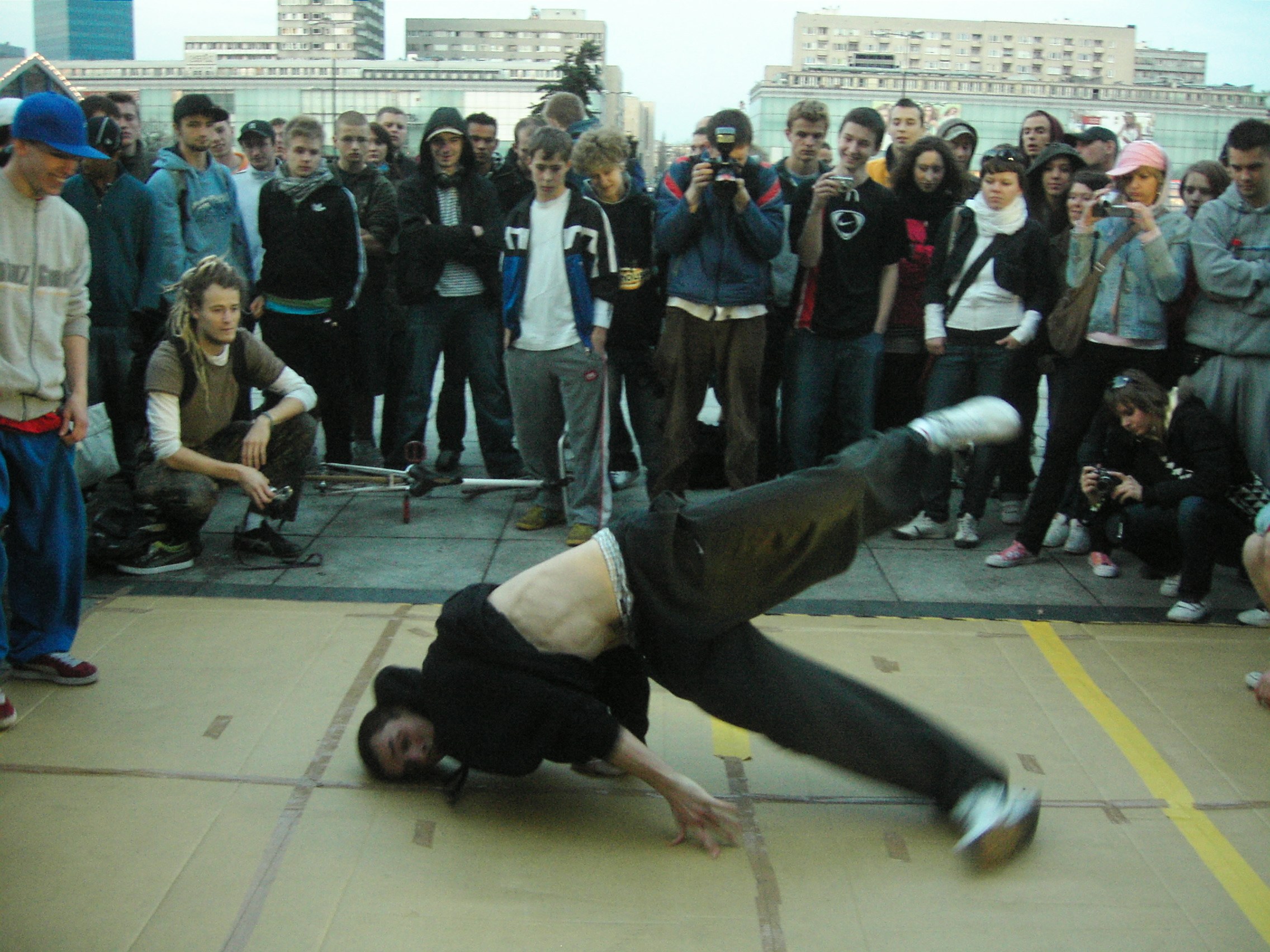
April 2007 breakdancing in Warsaw 25
Syced
- Source:
- Wikimedia Commons
- Rights:
- Public domain — free to use, share and adapt.
- Recorded as:
- cc0
Breaking is often studied through performance videos, competition footage, and retrospective interviews, leaving a gap in documentation of informal street performance and the role of spectators in shaping the scene. This photograph captures the social texture of that practice—the cypher, the crowd, the moment of technical virtuosity—and documents the early stages of breaking's global expansion into Poland and Eastern Europe during a period when the dance was becoming international but before it became an Olympic sport.
What you are looking at
A breakdancer performs a headspin or inverted freeze on a concrete plaza in Warsaw, captured mid-move with their body nearly horizontal, head near the ground, legs extended upward. A large crowd of onlookers—roughly 30–40 people of mixed ages—forms a circle around the performer, many holding cameras or phones to document the moment. The setting is an urban rooftop or elevated plaza with modernist apartment blocks visible in the soft, overcast daylight behind the crowd. The concrete surface is marked with yellow and other colored lines, suggesting a designated public gathering space. The crowd's casual dress—hoodies, caps, winter jackets—and the quality of the photograph (faded color, visible grain) places this in the mid-2000s. The energy is that of a street performance or freestyle gathering, with spectators actively witnessing the moment rather than passively observing.
The dancing
The primary dancer is inverted, supporting their body weight on their head and upper shoulders while their legs extend upward in a clean vertical line—a classic headspin position requiring substantial upper-body and core control. The body is nearly rigid, demonstrating the muscular tension required to maintain the freeze. The surrounding crowd varies in posture: some stand with arms lowered watching; others raise cameras or phones to eye level; a few crouch or bend to get closer angles. The spatial relationship is crucial—the crowd forms an intimate circle (often called a 'cypher' in hip-hop culture) that frames and honors the dancer's technical feat.
The dance depicted
This is breakdancing (also called breaking or b-boying), one of the four foundational elements of hip-hop culture. The headspin shown here is an advanced freeze—a momentary pause that showcases technical control and is typically performed as part of a longer routine combining toprock, footwork, freezes, and power moves. The setting and crowd formation confirm this is a freestyle or battle context rather than a rehearsed performance; street dancers gather in public spaces (plazas, parks, transit hubs) to freestyle and compete informally. The presence of multiple spectators with recording devices suggests this was either an organized jam or a performer drawing crowds in a high-foot-traffic urban area. Breaking emerged from New York in the 1970s and had become a global phenomenon by 2007, with strong scenes in Eastern Europe.
How it was made
This is a color photograph, likely digital or scanned from film, showing visible grain and the color cast typical of mid-2000s amateur or semi-professional documentation. The photograph captures a decisive moment—the peak of the inversion—rather than motion blur, suggesting either a fast shutter speed or a still-frame from video. The slight graininess and color saturation indicate this may have been taken on a compact digital camera or mobile phone of the era, reinforcing that it was shot by a spectator or casual documentarian rather than a professional photographer. The image's circulation on Wikimedia Commons suggests it was meant for public sharing and informal archive.
About this work
This is a documentary photograph of a breakdancer performing a headspin in a public plaza in Warsaw in April 2007. It captures a moment in the performance that demands the most control and technical precision—the freeze—freezing it for the viewer as the dancer freezes it in time. The crowd and the urban setting locate this within street dance culture and the informal, ephemeral world of freestyle performance. The image is valuable not as artistic composition but as evidence: it documents how breaking was being danced in Eastern Europe in the 2000s, what public gathering looked like around the practice, and how dancers and spectators were already using camera phones to document and share performance.
How to look at it
The viewer should attend to the dancer's body control—note the vertical alignment of the legs and the tension visible in the torso, which indicates this is a held freeze rather than a momentary pass-through. The crowd formation is equally important: the cypher is not accidental but a fundamental structure of breaking culture, where spectators form a circle that creates space, witnesses the performance, and generates energy through their presence and reaction. The photograph captures the headspin at its most stable point, which is the point a breaking dancer would choose to hold and display; this is the visible climax of the technical sequence.
The artist
Syced is credited as the photographer; the name suggests this may be a pseudonym or stage name common in online media sharing of the era. No further biographical information is available. The image's presence on Wikimedia Commons under a public-domain or permissive license indicates it was shared intentionally for public use, a practice consistent with mid-2000s culture around documenting underground dance scenes.
The period
Breaking emerged in New York in the 1970s and became a global phenomenon by the 1980s and 1990s, but the 2000s saw significant regional expansion, particularly in Europe. By 2007, breaking had established strong scenes in cities across Eastern Europe, including Warsaw, where public plazas became sites of freestyle practice and informal competition. This photograph coincides with a period when mobile phone cameras and digital cameras were making documentation of street performance democratized and ubiquitous; spectators at street performances were increasingly recording and sharing footage online. Breaking itself was becoming more codified and professionalized through international battle circuits, but street freestyle remained the foundational practice where dancers developed and demonstrated skill.
Where it lives
The image was uploaded to Wikimedia Commons by user Syced, identified only as 'April 2007 breakdancing in Warsaw 25', suggesting it is one of a series documenting a particular event or location. It carries the filename structure and metadata typical of early-2000s digital photography shared to open-access archives. No institutional holding is recorded.
Dance in this work
Questions about this work
What is a headspin and why do breakdancers do it?
A headspin is a freeze in which the dancer balances on their head and shoulders while rotating or holding their body in a nearly horizontal position. It is one of the most visually striking and technically demanding freezes in breaking, requiring significant neck and shoulder strength and demonstrating control. Freezes like this serve as punctuation marks in a breaking routine—moments where the dancer pauses to display technical mastery before transitioning to the next sequence of movement.
What is a cypher in breaking?
A cypher is a circle formed by dancers and spectators around the performer(s). It is both a practical spatial arrangement—creating room for the dancer to move—and a cultural one, defining the breaking circle as a space of mutual respect, witnessed skill, and communal energy. The cypher is fundamental to breaking culture and appears in both street freestyle and formal battle settings.
Was breaking popular in Warsaw in 2007?
Yes. Breaking had established a significant following in Eastern European cities by the 2000s, including Warsaw, where public plazas became gathering sites for freestyle dancers. This photograph is evidence of an active scene where dancers were performing for public audiences and spectators were documenting performances, suggesting the practice had local visibility and community.
Why is this photograph shot from ground level?
The photographer positioned themselves low to capture the headspin at a striking angle—emphasizing the inversion of the dancer's body and the crowd's vertical relationship to the action. This angle is typical of spectator documentation, where cameras follow the direction and drama of the movement rather than adopting a neutral overhead view.
More dance artwork