49 works in this view — arrow keys or swipe to move between them.
Dance in Art
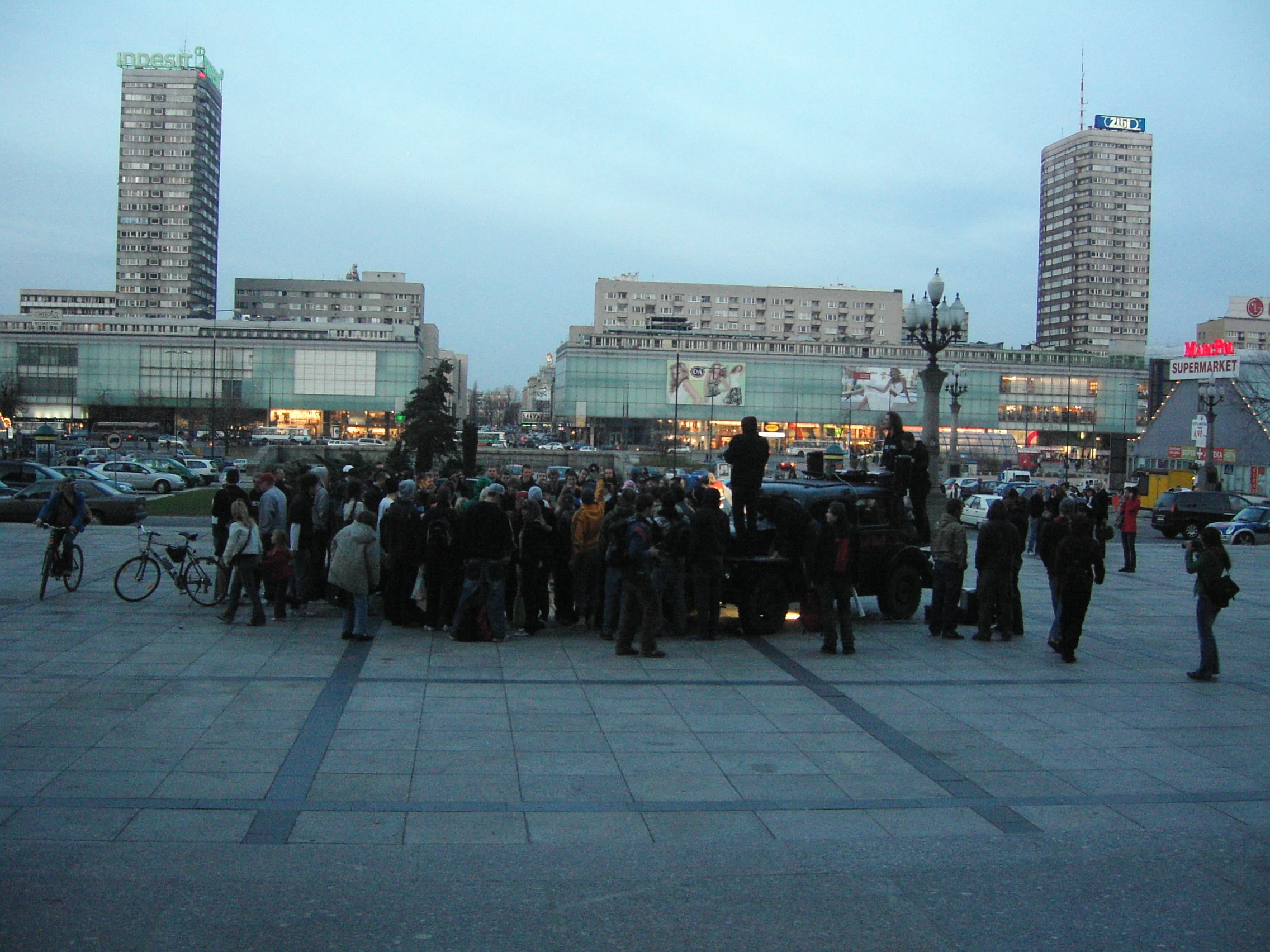
April 2007 breakdancing in Warsaw 19
Syced
- Source:
- Wikimedia Commons
- Rights:
- Public domain — free to use, share and adapt.
- Recorded as:
- cc0
Breaking has been studied primarily as an American and African diaspora practice; this image documents its presence and integration into Polish urban culture by 2007, helping establish the genuine globalization of the form beyond North America and Western Europe. The cipher formation itself—the collective spatial arrangement that enables freestyle—is a crucial structural element of hip-hop culture often overlooked in dance histories focused on individual technique, and this photograph preserves it as a lived spatial practice.
What you are looking at
A large crowd gathers in a public plaza at dusk in what appears to be Warsaw, occupying a broad paved square fronted by modern glass-facade buildings and mid-rise residential towers. The setting is distinctly urban and contemporary, with cars parked in the background and commercial signage visible on storefronts. The crowd is densely packed in the centre of the frame, many figures dressed in dark winter clothing, creating a concentrated mass of bodies. The light is cool and fading—the sky is pale blue-grey, suggesting early evening or winter light—and some building windows are beginning to glow with interior lighting. The crowd appears to have gathered for a public event or performance, with onlookers scattered at the periphery. Bicycles lean against lamp posts at the left edge, suggesting casual urban movement through the space.
The dancing
Individual bodies within the crowd are difficult to isolate, but several figures are visible in dynamic poses suggesting active movement rather than static observation. Some bodies appear to be in mid-gesture with arms extended or raised, consistent with freestyle movement vocabularies. The density of the crowd makes it impossible to observe complete dance phrases or sustained formations. Weight appears to be actively shifted and reweighted across multiple figures. No closed holds or partner formations are apparent—the movement appears to be individual or loosely group-based rather than formally partnered.
The dance depicted
This appears to document a street breakdancing cipher or freestyle hip-hop gathering, likely an informal public event or freestyle battle. Breakdancing (breaking, b-boying) is a competitive and social freestyle dance that developed in New York in the 1970s and spread globally by the 1980s. The outdoor urban plaza setting, the crowd formation with spectators circling performers, and the visible individual dynamic movement are all consistent with cipher culture—the circular gathering format that frames a freestyle space where dancers take turns performing. The crowding and informal assembly suggest this is a community gathering rather than a staged or ticketed performance, which is typical of street hip-hop culture.
How it was made
This is a colour photograph, likely digital, taken in available light without apparent flash. The image quality and colour saturation are consistent with mid-2000s digital photography. The medium preserves the documentary character of a moment in public urban space—the photographer has captured not a staged or posed scene but an actual event as it unfolded. The photograph's circulation via Wikimedia Commons indicates it is being used as a documentary record of street dance culture and public performance practice rather than as fine art.
About this work
This photograph documents a public breakdancing gathering in Warsaw in 2007, showing a street cipher—the informal circular gathering format central to hip-hop freestyle culture. The work is valuable as urban vernacular documentation: it records not a theatrical performance but the actual spatial and social practice of street dance as it occurs in contemporary European public space. The image shows how breaking has become a genuinely global street practice, visible in Eastern European cities and organized through informal community gatherings rather than institutional venues. It is an ethnographic record of dance-making outside the concert hall, capturing the social structure and public claim of freestyle culture.
How to look at it
Observe the crowd formation itself: the way spectators create a circular or gathered perimeter, leaving a cleared central space for movement. This spatial arrangement is not accidental—it is the defining structure of cipher culture and distinguishes street freestyle from concert performance. Look at the heterogeneity of the crowd (age, dress, posture) and the outdoor public setting; this is not a ticketed dance event but a community gathering. Note the varied individual postures visible within the crowd, suggesting multiple bodies in active motion rather than passive spectatorship.
The artist
The photographer Syced (username, possibly pseudonymous) uploaded this image to Wikimedia Commons, indicating a practice of documenting urban and street culture through accessible public distribution rather than fine art channels. The choice to share via open archive suggests an interest in cultural documentation and public knowledge rather than authorial ownership.
The period
By 2007, breaking had been a global street practice for nearly three decades, but its presence in Eastern European cities was still relatively recent and underrepresented in Western dance historiography. The 2000s saw rapid expansion of hip-hop culture into urban centres across Europe following earlier US military presence and transnational media circulation. This period also marked the emergence of organized breaking competitions and the beginnings of its path toward Olympic recognition (achieved in 2024). Street ciphers like this one were the primary venue for breaking practice and transmission outside institutional dance training.
Where it lives
The image was uploaded to Wikimedia Commons by user Syced in 2007 as a documentary photograph of a public event. It is preserved as part of the Commons' archive of global urban culture and serves as a freely accessible public record.
Dance in this work
Questions about this work
What is a cipher in breakdancing?
A cipher is the circular or gathered formation that dancers and spectators create around a freestyle space. It is both a physical structure and a social practice: the ring of bodies creates a bounded arena for individual dancers to perform, and spectators move in and out, taking turns dancing. The cipher is central to hip-hop culture because it enables peer evaluation, transmission, and the social framing of dance-making as community practice rather than commodity entertainment.
How did breaking reach Warsaw by 2007?
Breaking spread globally from the 1980s onward through media circulation (videos, music videos, films), touring b-boy crews, and transnational youth culture exchange. By the 2000s, breakdancing had established itself as a street practice in major European cities, often organized by young dancers who learned from imported media and from visiting international dancers or competitions.
How is street breakdancing documented differently from concert dance?
Street dance is typically documented through photography and video of actual public events, rather than through the staged lighting and fixed framing conventions of concert dance photography. Documentary photographs like this one preserve the spatial context, crowd formation, and informal social organization that are essential to street dance practice—elements that would be lost in a studio photograph of isolated dancers.
More dance artwork