49 works in this view — arrow keys or swipe to move between them.
Dance in Art
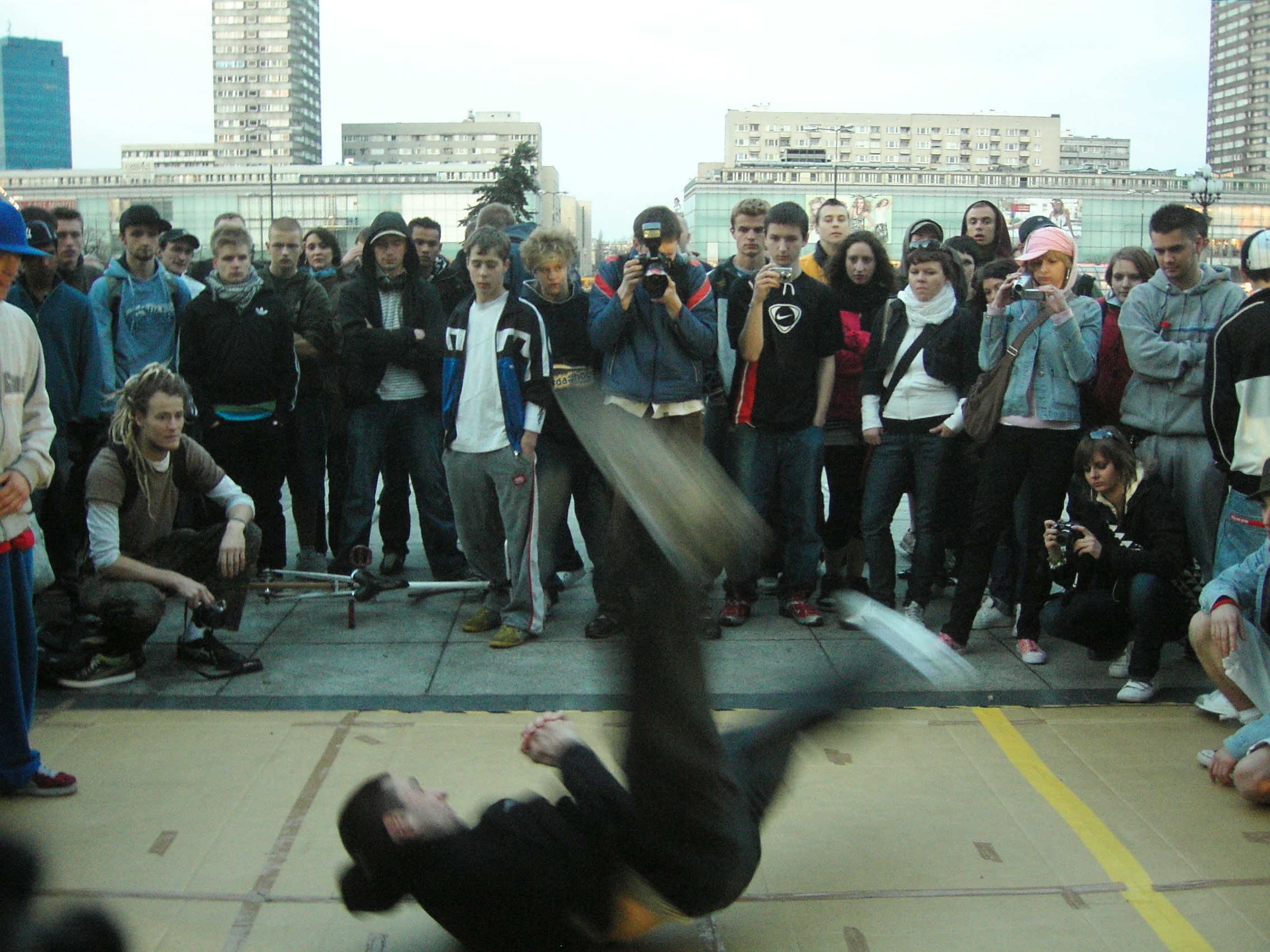
April 2007 breakdancing in Warsaw 32
Syced
- Source:
- Wikimedia Commons
- Rights:
- Public domain — free to use, share and adapt.
- Recorded as:
- cc0
Breaking has been central to global hip-hop culture for fifty years and was recognized by UNESCO as Intangible Cultural Heritage in 2023; this image is direct evidence of how breaking was lived and performed in non-American contexts during the digital shift. For dance historians and street culture researchers, it documents the transition between pre-internet and internet-era circulation of breaking knowledge, at a moment when mobile recording was beginning to reshape how street dances spread internationally.
What you are looking at
A breakdancing cipher on an urban plaza in Warsaw, filmed or photographed in 2007. The ground is light concrete with yellow markings; tall residential apartment blocks and commercial buildings rise in the background under overcast sky. A dancer in dark clothing performs an inverted move—head down, legs and torso in the air—at the center of a roughly circular crowd of roughly thirty spectators, most dressed in casual 2000s streetwear: hoodies, track jackets, baseball caps. Several onlookers hold cameras or phones, recording the performance. The crowd stands close, forming an informal cipher boundary, with some seated and crouching at the edges. The lighting is flat and natural, typical of an outdoor European city in daylight.
The dancing
One B-boy is captured mid-move in an inverted position—likely a freeze or headstand variation—with his body weight supported on his head and upper back, legs and torso extended upward at an angle. His arms appear to be engaged for balance. The spectators are static, eyes directed toward the dancer, with several holding recording devices (cameras, mobile phones) at shoulder or chest height. The composition emphasizes the spatial relationship between the soloing dancer and the witnessing community.
The dance depicted
This is breaking (B-boying), the street dance form that emerged in 1970s New York City and became a global youth culture phenomenon. The image documents a cipher—the circular freestyle format fundamental to breaking culture—in which dancers take turns performing improvised moves while peers and passersby witness and record. The dancer's inverted toprock or freeze variation is characteristic of breaking's emphasis on technical difficulty, control, and gravity-defying movement. The presence of multiple cameras indicates the documented, shareable nature of street dance performance in the early 2000s, when mobile recording and internet circulation were reshaping how street culture circulated.
How it was made
This is a color photograph, likely digital or digitally scanned, shot in available light. The image quality and color palette are consistent with consumer digital photography or film photography from the mid-2000s. The documentary framing—wide enough to show the full cipher and crowd—suggests it was taken by a bystander or participant rather than a commissioned art photographer, and its presence on Wikimedia Commons indicates it is publicly shared documentation of a cultural event rather than a curated artwork.
About this work
This photograph documents breaking (B-boying) as it existed in early-2000s urban Europe, captured live during a street cipher in Warsaw. It is a primary source for understanding how breaking functioned as participatory street culture after its global spread from American hip-hop origins—performed in public space, witnessed and recorded by community members, and circulated via digital networks. The image shows the social structure of breaking: the soloist at center, the protective cipher boundary, the peer witnesses, and the cultural practice of documenting and sharing performance through whatever cameras were at hand.
How to look at it
Attend to the moment chosen: the dancer suspended inverted, frozen mid-technique, at the apex of difficulty. The photographer has framed the entire cipher rather than isolating the dancer, emphasizing that breaking is a social and witnessed form—the crowd's presence is as much the subject as the movement itself. Notice the recording devices in spectators' hands: this detail dates the image to the mobile recording era and captures breaking's dependence on circulation and documentation for cultural transmission.
The artist
The photographer is credited as Syced and has shared this image on Wikimedia Commons. No other information about the photographer's practice, background, or intent is available from the catalogue record. The image appears to be documentary or ethnographic in approach rather than fine-art photography.
The period
In 2007, breaking was four decades into its global circulation, having moved from South Bronx block parties (1970s–80s) through international hip-hop adoption (1980s–90s) to widespread street culture establishment in European cities. Warsaw's breaking community was part of a decentralized global network sharing moves and styles via DVDs, video tapes, and increasingly via early internet platforms. This was the tail end of pre-YouTube street dance documentation—physical media and live ciphers still dominated knowledge transfer, though camera phones were beginning to accelerate digital circulation.
Where it lives
The image is held on Wikimedia Commons, a public repository of freely licensed media. It is tagged as documentary photography of a cultural event rather than acquired as fine art. The title and date are provided by the uploader; no institutional accession number or collection information is recorded.
Dance in this work
Questions about this work
Is this breaking or breakdancing?
Both terms are used interchangeably. 'Breaking' is the original term used by the B-boys and B-girls who created it in the 1970s South Bronx; 'breakdancing' is a media-era label. The style shown here—the inverted freeze and the cipher format—is recognizably breaking.
Why are so many people recording the dancer?
By 2007, mobile phone cameras and digital cameras were common, and recording street performances had become normal practice. Breaking depends on live transmission and documentation for survival and spread—dancers record each other to learn, to share within their community, and to gain visibility. This image captures that cultural practice.
What is a cipher?
A cipher is the circular formation fundamental to breaking culture. Dancers take turns performing improvised moves inside the circle while peers and audience members stand around the boundary, witnessing and responding. It is a participatory, non-hierarchical format derived from hip-hop's block-party origins.
Was breaking popular in Poland?
Breaking spread globally from the United States in the 1980s and 1990s, and by the 2000s active breaking communities existed in most European cities, including Warsaw. This photograph is direct evidence of that circulation and localization.
More dance artwork