49 works in this view — arrow keys or swipe to move between them.
Dance in Art
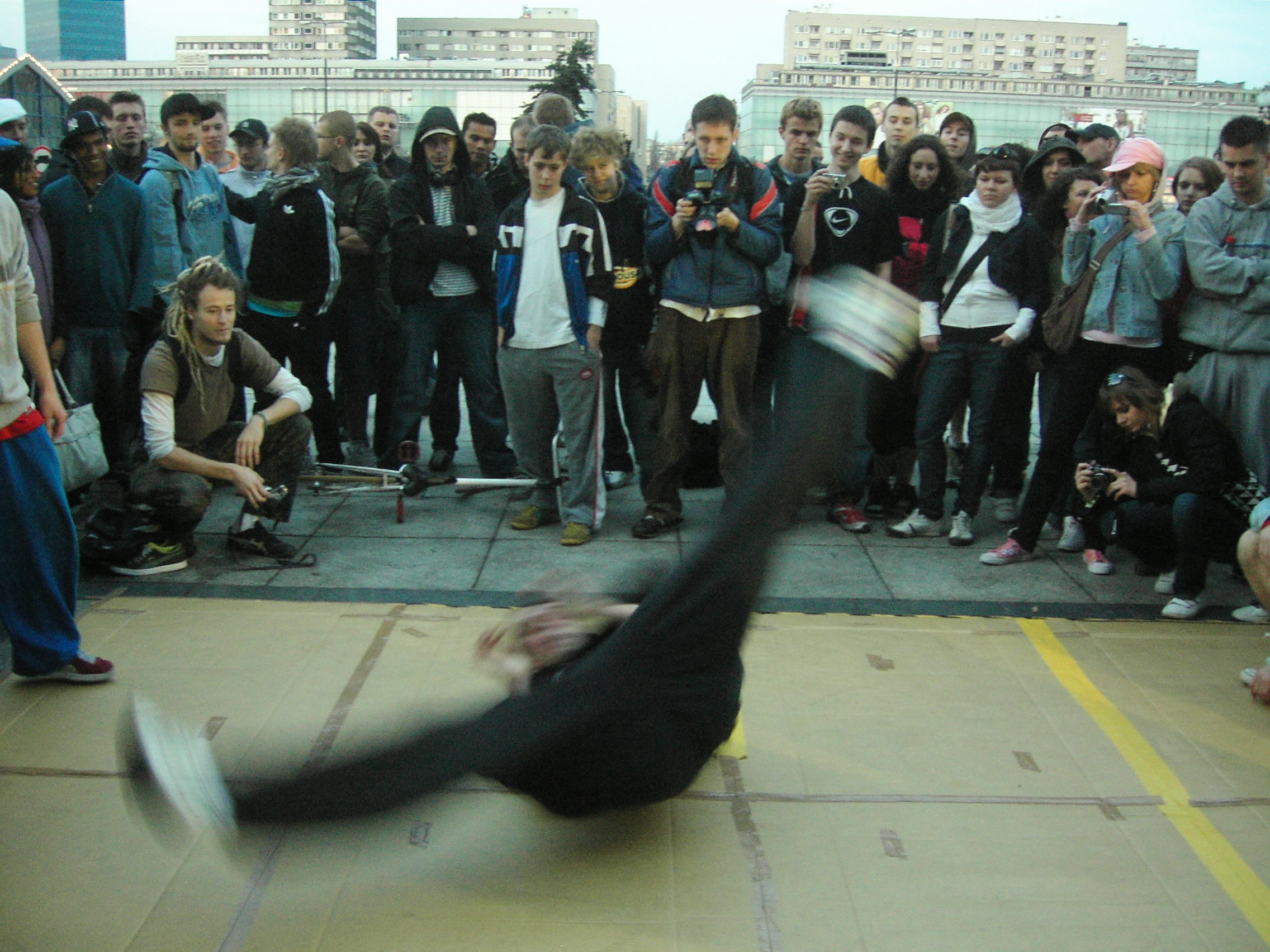
April 2007 breakdancing in Warsaw 12
Syced
- Source:
- Wikimedia Commons
- Rights:
- Public domain — free to use, share and adapt.
- Recorded as:
- cc0
Breaking is a foundational street dance genre that has influenced global contemporary dance, hip-hop culture, and youth aesthetics for fifty years, yet it is underrepresented in fine art and museum collections that emphasize theatrical or formalized dance. This photograph documents the social and spatial conditions under which breaking actually lives—as community practice, improvisation, and street spectacle—rather than as a stage performance or choreographed work. It is evidence of how breaking sustained itself and spread internationally through grassroots, peer-to-peer transmission in public space.
What you are looking at
A large crowd of young people gathers on a flat concrete surface in what appears to be an urban plaza or rooftop, with residential apartment buildings visible in the background under a hazy sky. The crowd forms a loose circle around a central performance area marked by a yellow line on the pavement. In the foreground, a dancer captured mid-motion performs a dynamic move—their body inverted or horizontal, limbs extended—with motion blur emphasizing the speed and athleticism of the movement. The spectators, dressed in early 2000s casual wear (hoodies, track jackets, baseball caps), watch intently, many holding mobile phones or cameras. The lighting is natural daylight, diffuse and even, suggesting an afternoon gathering. The composition captures the moment of performance itself rather than a posed arrangement.
The dancing
The central dancer is captured mid-movement with the body in a horizontal or inverted plane, arms and legs extended, creating a dynamic and acrobatic silhouette. The motion blur on the dancer's limbs indicates rapid rotation or momentum. The surrounding crowd—approximately 30–50 people—stands in a viewing circle at varying distances, their bodies angled toward the center, heads turned to follow the action. Weight and balance are distributed across a large group rather than concentrated on individual dancers; this is a freestyled, improvised moment rather than a structured partnered or ensemble formation.
The dance depicted
This is breakdancing (also called breaking, b-boying, or b-girling), a street dance style originating in 1970s New York hip-hop culture. The horizontal body position and rotational momentum visible in the motion blur are consistent with signature moves such as a windmill, backspin, or freeze—acrobatic top-rock transitions. The informal outdoor plaza setting, the spectator circle (a 'cypher' or 'battle circle'), and the casual documentation by onlookers are all characteristic of how breaking is performed and circulated in street and community contexts. The early 2000s dress and Warsaw location situate this within the global spread of breaking culture to Eastern Europe during that period.
How it was made
This is a color photograph, likely digital or digitally scanned film, with visible motion blur created by either camera movement or a slower shutter speed during the subject's movement. The blur is selective—sharpest on the crowd, progressively softer on the dancer—suggesting either panning or a focal-plane choice. The image quality and color palette are consistent with casual documentary photography from the mid-2000s, shot on a consumer or semi-professional camera. The photograph's documentary character—unposed, captured in process—is essential to its meaning; it records a lived moment of street culture rather than a staged or rehearsed performance.
About this work
This photograph documents an instance of breakdancing in an urban public space in Warsaw during April 2007. A soloist performs an acrobatic, rotational move in front of an assembled crowd of young people arranged in the characteristic cipher formation of breaking culture. The image captures both the virtuosity of the individual dancer and the participatory, community-centered nature of street dance: the circle of witnesses, the informal plaza setting, the mobile documentation. It is a snapshot of how breaking had become a global youth culture by the 2000s, practiced and celebrated across Europe and beyond the urban centers where it originated.
How to look at it
The viewer should attend to the moment of suspension or inversion the photographer chose to capture—the dancer is frozen at a point of maximum extension or rotation where the body is airborne and the movement is most visually striking. The motion blur is not accident but essential information: it tells us that this move is fast, requires tremendous control and momentum, and takes place in real time in front of onlookers. The composition emphasizes the relationship between performer and audience; the crowd is not background but context, essential to understanding breaking as a social practice. Notice too the documentary quality—the haziness of the sky, the ordinariness of the plaza, the casual dress—which anchors breaking as a street practice rather than a theatrical one.
The artist
Syced is a Polish photographer associated with street culture and urban documentation. Limited biographical information is available in public sources; the work appears to be part of community or hobbyist documentation of Warsaw's hip-hop and street dance scene in the mid-2000s. The image was later uploaded to Wikimedia Commons, making it part of the commons archive of global street culture.
The period
By 2007, breaking had been established for over 30 years but was still primarily associated with urban street culture and youth communities rather than institutional or theatrical performance. The early 2000s saw increasing global reach of breaking through music videos, DVDs, and internet distribution, particularly to cities in Central and Eastern Europe. In the same period, some choreographers and institutions were beginning to recognize breaking as a serious artistic practice worthy of stage presentation, though the street cipher remained the primary mode of practice and innovation. The photograph captures breaking at a moment when it was both deeply subcultural and beginning to register on broader cultural radar.
Where it lives
The photograph is held in Wikimedia Commons, a freely licensed media repository, and was uploaded with the title 'April 2007 breakdancing in Warsaw 12.' The catalogue information is minimal, suggesting the image was contributed by a community member documenting street culture rather than acquired through institutional collecting. Its presence in Wikimedia Commons makes it accessible as a public archive resource.
Dance in this work
Questions about this work
What is the move being performed?
The motion blur and horizontal body position suggest a rotational acrobatic move such as a windmill, backspin, or freeze—core moves in breaking vocabulary. The exact move cannot be definitively identified from a single frame, but the technique is clearly among breaking's signature acrobatic vocabulary. These moves require years of practice to execute safely and are considered high-skill elements.
Why are the people standing in a circle?
This is a cypher (or cipher), the traditional formation for breaking performance and practice. The circle allows the dancer in the center to perform while the surrounding participants watch, react, and wait their turn to dance. The cypher is central to breaking culture—it is how breakers learn, innovate, and compete, and it emphasizes community participation over spectacle.
When did breaking arrive in Poland?
Breaking reached Europe in the 1980s through music videos and cultural exchange, but it gained significant grassroots momentum in the 1990s and 2000s. This 2007 photograph documents breaking well-established in Warsaw by that point, with a visible local community and public plaza space dedicated to practice.
Is breaking the same as hip-hop dance?
Breaking is one of the foundational styles within hip-hop dance culture, originating alongside hip-hop music in 1970s New York. It emphasizes acrobatic moves, footwork, freezes, and improvisation within a cypher. Hip-hop dance is a broader umbrella that includes breaking, popping, locking, and other related styles, as well as choreographed hip-hop dance in theatrical and commercial contexts.
More dance artwork