49 works in this view — arrow keys or swipe to move between them.
Dance in Art
In Vaudeville: Acrobatic Male Dancer with Top Hatlabel QS:Len,"In Vaudeville: Acrobatic Male Dancer with Top Hat"
Charles Demuth
- Source:
- Wikimedia Commons
- Rights:
- Public domain — free to use, share and adapt.
- Recorded as:
- public_domain
This is direct evidence of how acrobatic dance was performed, costumed, and presented in early 20th-century American popular theater. For historians and dancers, it documents a form of athletic and theatrical virtuosity that has largely disappeared from commercial performance, yet influenced modern circus arts, competitive acrobatics, and contemporary dance. Demuth's choice to dignify the vaudeville acrobat as a serious subject also marks a moment when American artists were beginning to find artistic value in popular entertainment rather than dismissing it as lowbrow.
What you are looking at
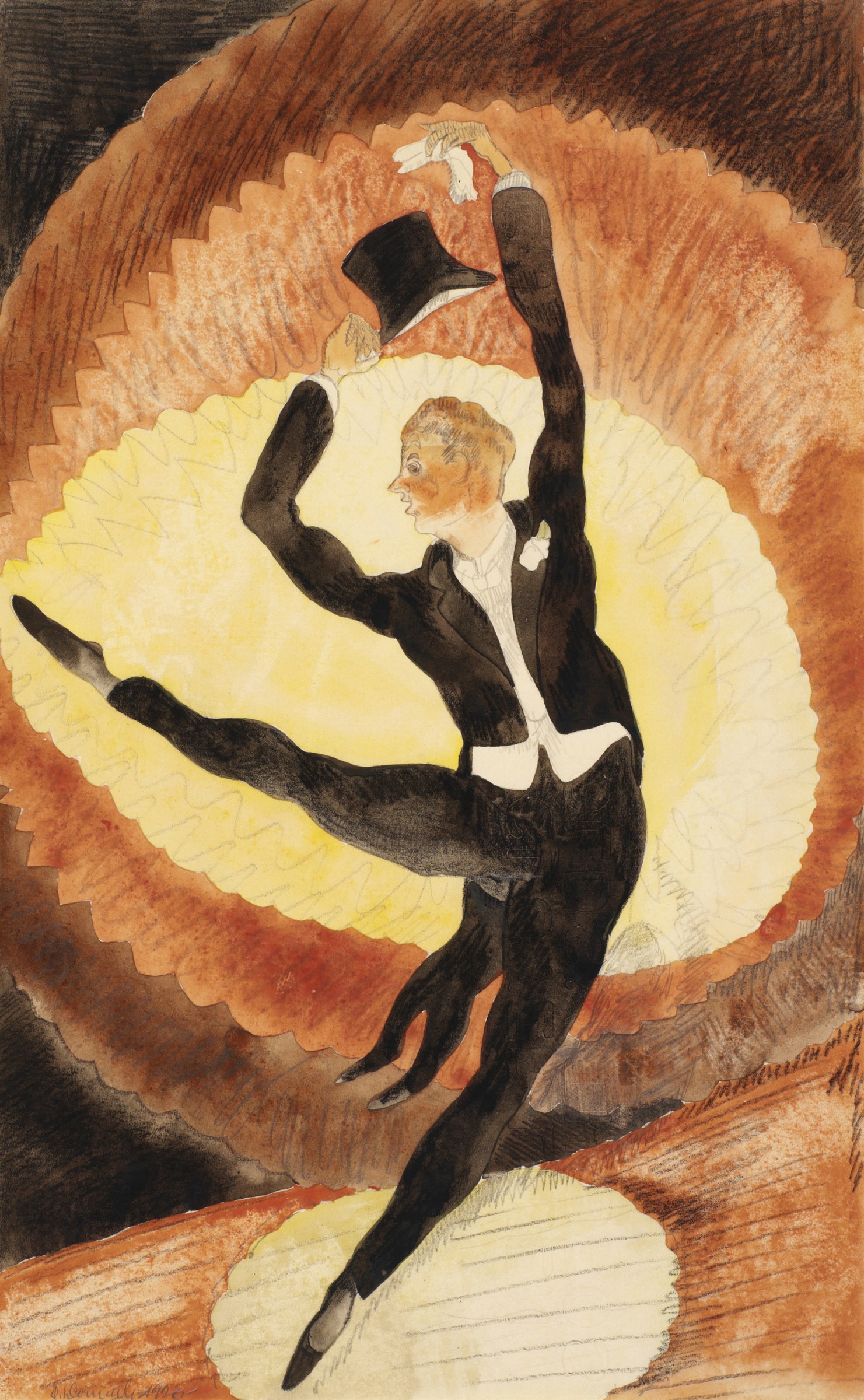
A male dancer in formal evening dress—black tailcoat, white shirt front, and black trousers—performs a dynamic acrobatic leap against a boldly simplified background. His body is airborne and inverted, legs splayed upward, one arm extended overhead holding what appears to be a top hat. The composition is staged against concentric halos of warm ochre, burnt orange, and pale yellow light that radiate from behind the figure, creating a theatrical spotlight effect. The background shifts from warm tones at the center to darker, almost charred grays and browns at the edges, suggesting the architecture of a vaudeville theater or music hall stage. The figure's profile is rendered in sharp line work, and the overall style is that of early 20th-century theatrical illustration, emphasizing the spectacle and the sense of defying gravity.
The dancing
The dancer's body is fully inverted in mid-air, with the trunk arched backward and legs kicked upward in a wide V-split. His weight is completely airborne; there is no contact with the ground. One arm reaches overhead, holding the top hat; the other arm is bent at the elbow. The composition captures the moment of maximum suspension, with the body stretched and extended to show amplitude and control. The rendering emphasizes the extreme extension and flexibility required, presenting the acrobat as both powerful and refined in formal dress.
The dance depicted
This is acrobatic vaudeville performance, the theatrical acrobatics that defined American vaudeville from the 1890s through the 1920s. The top hat and formal evening dress are the costume of the male acrobatic dancer—distinguishing this as a solo or featured acrobat rather than a tumbler, and positioning the acrobatics as entertainment spectacle meant to astonish middle-class theater audiences. The inverted leg split and extreme back arch are signature moves of adagio-style partner acrobatics and solo acrobatic performance of the era, emphasizing flexibility, strength, and balletic extension. Vaudeville acrobats were celebrated performers who combined gymnastics, dance, and theatrical presence, and the artist has captured both the athleticism and the showmanship of the form.
How it was made
This appears to be a watercolor and ink or gouache drawing, executed with precise line work and careful attention to the luminous background. The concentric radiating lines create depth and theatrical light through compositional technique rather than perspective. The style is characteristic of early 20th-century theatrical illustration and magazine or poster art, media designed for rapid circulation and immediate visual impact. The technique—sharp profile silhouette with a glowing background—is well-suited to both fine-art reproduction and commercial printing, suggesting the work may have been created for exhibition, publication, or theatrical advertising.
About this work
Charles Demuth's 1920 drawing captures the peak moment of American vaudeville acrobatics: a solo male performer suspended in an inverted leap, formally dressed and hat in hand, silhouetted against a theatrical halo of stage light. The work documents a specific but now largely forgotten form of theatrical dance—the acrobatic specialty that once commanded featured billing and substantial fees. Demuth, known for his precisionist paintings and his engagement with American popular entertainment, treats the acrobat with the same compositional rigor and visual drama he applied to industrial scenes and still lifes, elevating the vaudeville performer to the status of high-art subject.
How to look at it
Notice the exact moment Demuth chose to freeze: the instant of maximum flight, when the acrobat is neither ascending nor descending but suspended. The top hat, held aloft, emphasizes the lightness and control despite the extreme position. The concentric halos of light are not realistic stage lighting but a compositional device that makes the acrobat the sole focus and suggests the intensity of theatrical attention. The formal dress is crucial: it distinguishes this as skilled, respectable entertainment, not rough tumbling. The profile view and the silhouette technique derive from 18th-century theatrical prints and neoclassical drawing, giving the vaudeville acrobat the gravitas of history painting.
The artist
Charles Demuth (1883–1935) was an American modernist painter and illustrator based in Lancaster, Pennsylvania. He is best known for his precisionist paintings of industrial architecture and still lifes, but he also worked extensively in watercolor and produced illustrations and theatrical drawings. Demuth was engaged with American vernacular culture, popular entertainment, and the aesthetics of speed and spectacle. He frequently attended theater, cinema, and vaudeville performances, and used them as subjects for both finished artworks and studies. His approach to these subjects was neither satirical nor condescending; rather, he applied the formal rigor of modernism to the visual energy of popular performance, producing a significant but understudied body of work that bridges fine art and commercial entertainment.
The period
In 1920, vaudeville was at its commercial peak in America, with hundreds of theaters across the country presenting elaborate bills of specialty acts. Acrobatic performance was a high-status specialty act, commanding featured placement and substantial salaries for skilled performers. The acrobat's formal evening dress reflects the aspirational status of vaudeville as respectable family entertainment, distinct from earlier circus or carnival acrobatics. In the fine-art world, 1920 was a moment of American artistic confidence and increasing interest in indigenous American subject matter—the Armory Show (1913) and its aftermath had opened American modernists to vernacular culture as valid artistic material. The precisionist movement, with which Demuth is associated, was just emerging, and the application of formal modernist principles to American entertainment and industrial subjects was itself novel and progressive.
Where it lives
The work is recorded as part of Wikimedia Commons, suggesting it is in the public domain or freely accessible online. The catalogue record contains no holding institution, accession number, dimensions, or medium specification, indicating this is a secondary source record rather than a museum collection entry.
Dance in this work
Questions about this work
What is vaudeville acrobatics, and how is it different from circus acrobatics?
Vaudeville acrobatics were specialty acts performed in theatrical variety shows in urban music halls and theaters, whereas circus acrobatics were performed under the big top as part of a larger spectacle. Vaudeville acrobats were typically solo or partnered specialists who appeared in formal dress or elaborate costumes for 10–15 minutes within a program of diverse acts. They commanded higher fees than circus acrobats and performed for middle-class urban audiences. The acrobatic forms themselves—flexibility, strength, and balletic extension—were similar, but the context, costume, and presentation were entirely different.
Why is the acrobat wearing formal evening dress and a top hat?
The formal dress signals respectability and elevated status. By the 1920s, vaudeville was marketed as family-appropriate entertainment, and dressing acrobats formally distinguished them from circus performers or street entertainers. The top hat and tailcoat also emphasize the performative nature of the act: the costume is part of the spectacle, and the acrobat remains 'in character' as an elegant gentleman even while defying gravity. The hat becomes a prop that demonstrates control and balance.
Who was Charles Demuth, and why did he paint vaudeville performers?
Charles Demuth (1883–1935) was an American modernist painter interested in the visual energy and formal possibilities of American vernacular culture. He was a regular theatergoer and found in vaudeville and circus performance subjects worthy of serious artistic attention. Unlike earlier American artists who treated popular entertainment with sentimentality or condescension, Demuth applied precisionist formal principles to these subjects, elevating them to fine-art status. His engagement with popular culture was part of a broader early 20th-century artistic movement that valued the aesthetics of American everyday life.
Is this a finished artwork or a study?
The catalogue record does not specify, and the image alone cannot definitively answer the question. The work is highly finished in composition, lighting, and detail, and the style is consistent with Demuth's exhibition drawings and watercolors. It may be a finished independent work created for exhibition or publication, or it may be a study toward a larger or related work. Without access to the original object or additional documentation, the status cannot be determined with certainty.
More dance artwork