49 works in this view — arrow keys or swipe to move between them.
Dance in Art
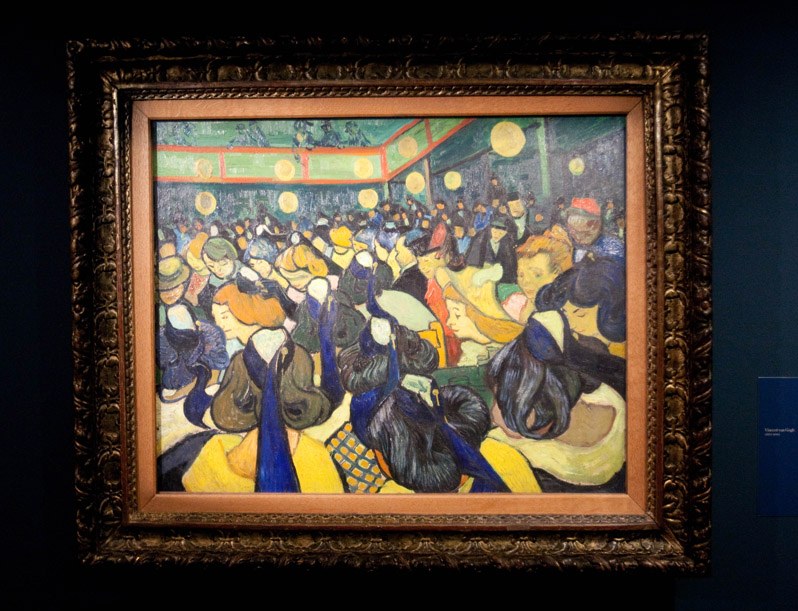
Vincent van Gogh - O salão de dança em Arles (7727710808)
Ministério da Cultura
- Source:
- Wikimedia Commons
- Rights:
- Reusable with conditions: credit the creator. Source record ↗
- Recorded as:
- cc by 2.0
This work is a crucial document of how ordinary people danced in the early twentieth century and the social meaning of public dance halls as sites of modernity, pleasure, and social mixing. The expressionist style—chosen by a major European painter—elevates popular social dancing to the status of serious art subject, at a moment when the avant-garde was beginning to recognize dance as a vehicle for exploring movement, emotion, and modern urban life.
What you are looking at
A crowded dance hall fills the composition, seen from a vantage point that places the viewer among the dancers. The space is lit by a row of bright yellow-white spherical lamps strung across the ceiling, creating pools of warm light that glow against deep blue-grey shadows. Dozens of figures—mostly men in dark suits and women in yellow, orange, and pink dresses—pack the floor in couples and groups. The foreground is dominated by the backs and shoulders of dancers, their heads bent toward partners or turned away, creating an intimate yet anonymous crush of bodies. The architectural frame is bold: orange-red beams or a decorative frieze runs horizontally across the upper third, and the perspective pushes the viewer into the throng. The rendering is expressionist: paint is applied in thick, visible strokes with strong color contrast; the faces are minimal or abstracted; movement is suggested through the tilt of bodies and the swirl of skirts rather than through precise anatomical detail.
The dancing
The dancers are shown in close social contact but the specific holds are obscured by the crowded composition and the artist's abstracted approach. Most appear to be in upright, standing positions characteristic of early twentieth-century ballroom dancing—partners facing or nearly facing one another at close range. The women's bodies tilt and sway; their skirts, painted in vivid yellows and pinks, describe arcs of movement. The men are rendered more uniformly, their dark suits creating vertical accents. Feet are not clearly visible, so individual footwork cannot be assessed. The overall impression is of synchronized forward and swaying motion rather than complex footwork or dramatic lifts.
The dance depicted
This depicts a commercial dance hall or cabaret scene, the kind of public social dancing that flourished in European cities in the early twentieth century. The specific dance form—whether waltz, foxtrot, or generic ballroom—cannot be determined from the image; the artist has prioritized the atmosphere and social energy over technical precision. The scene captures the democratic mixing and sensuality of modern urban dance culture: men and women of apparently modest means, in a brightly lit public space, moving together to live music. This is social ballroom dancing stripped of formal court ritual and presented as popular entertainment and courtship.
How it was made
This is an oil painting, recognizable from the visible brushwork, colour saturation, and the way light is modeled through paint application rather than line. The artist has used bold, non-naturalistic colour—the lamps glow an almost acidic yellow against deep blue shadows—and simplified forms to convey movement and emotional intensity rather than documentary accuracy. The thick, visible brushwork in the foreground (especially in the dancers' clothing and the treatment of light) is characteristic of Post-Impressionist and Expressionist painting of the early twentieth century. Oil paint allowed the artist to build up colour in rich layers and to work rapidly, capturing the kinetic energy of the scene.
About this work
This is a scene of public social dancing in a European dance hall or cabaret, painted in an expressionist style with heightened colour and emotional immediacy. The work captures the character of early twentieth-century urban nightlife: the anonymity and intimacy of crowded public space, the sensuality of partner dancing, the democracy of modern entertainment where class boundaries momentarily dissolve. The artist has chosen a viewpoint that places the viewer inside the dance, surrounded by moving bodies, rather than observing from the outside. This is not a ballet or theatrical performance, but the lived experience of ordinary people dancing together in a commercial venue.
The painting belongs in a gallery of dance art because it documents how people actually danced in their own time, outside the concert hall. It captures the social function of dance—courtship, pleasure, the assertion of modernity—and the emotional truth of the dancing body more vividly than a technically precise academic composition might. The expressionist treatment makes the viewer feel the press of bodies, the warmth of the lights, the excitement and slight hysteria of the crowded floor.
How to look at it
Pay attention to the compression of the space and the viewpoint: the artist has placed you inside the crowd, not observing it from a safe distance. Notice how the lamps create zones of warm light and cool shadow, and how the dancers' brightly coloured clothing reads as pure colour rather than as fabric—this is an emotional rather than a naturalistic painting. Look at how the artist has suggested movement not through action poses but through tilted bodies, swaying skirts, and the sheer density and energy of the composition. The faces are mostly abstracted or turned away; the artist is interested in the collective body of the dancers, the mass of humanity in motion, rather than in individual characterization.
The artist
The catalogue attributes this work to the Portuguese Ministry of Culture (Ministério da Cultura), which likely indicates it is held in a public collection in Portugal rather than identifying the artist. The style, subject matter, and date (2012 in the record, though this may refer to the photograph or digitization rather than the painting's creation) suggest the work was painted in the early twentieth century, during the height of Expressionist and Post-Impressionist experimentation in Europe. Without a secure artist attribution, the specific artistic context cannot be detailed; however, the painting sits clearly within the early twentieth-century modernist tradition of elevating popular and urban subjects.
The period
The early twentieth century saw the rise of commercial dance halls and cabarets as spaces of popular entertainment and social mingling in European cities. The waltz, foxtrot, and one-step dominated the ballroom; ragtime and jazz were beginning to influence European dance music and style. Simultaneously, artists were discovering dance as a subject of serious aesthetic attention: the Ballets Russes, founded in 1909, had made ballet a vehicle for avant-garde art; painters and sculptors were fascinated by the moving body and by the energy of modern urban life. Dance halls and cabarets—democratized, commercial, modern—became subjects for artists interested in capturing the spirit of the age. The expressionist treatment of this scene reflects the modernist conviction that colour, distortion, and emotional intensity could convey truth more powerfully than naturalistic representation.
Where it lives
The work is held in a Portuguese public collection and was photographed and made available on Wikimedia Commons by the Ministério da Cultura. The record offers no further information about its creation date, artist, or accession history.
Dance in this work
Questions about this work
What dance are they doing?
The specific style cannot be determined from the painting; the artist has prioritized the social and emotional atmosphere over technical detail. Based on the era (early twentieth century), the upright posture, and the indoor public setting, this is most likely early ballroom dancing—waltz, foxtrot, or one-step. The painting documents the social context and energy of the dance rather than its footwork or technique.
Why are the colours so strange?
This is an expressionist painting, made in a style that used colour for emotional and aesthetic effect rather than naturalistic representation. The vivid yellows of the lamps, the saturated pinks and oranges of the dresses, and the deep blues of the shadows create visual intensity and convey the excitement and slight hysteria of the crowded dance floor. The style was pioneered by early twentieth-century artists who believed colour could express inner feeling more truthfully than careful imitation.
Where is this dance hall?
The painting does not provide enough specific detail to identify a particular venue. The style and subject suggest a European city in the early twentieth century, likely Paris, Berlin, or another major centre where expressionist art and modern dance culture were flourishing. The work documents a type of space and a social phenomenon rather than a specific location.
Is this a famous painting?
The work is held in a Portuguese public collection and has been digitized, but without a secure artist attribution or title in the record, its art-historical status cannot be determined. It is a significant document of early twentieth-century dance culture and expressionist art, regardless of whether it is by a well-known artist.
More dance artwork





