49 works in this view — arrow keys or swipe to move between them.
Dance in Art
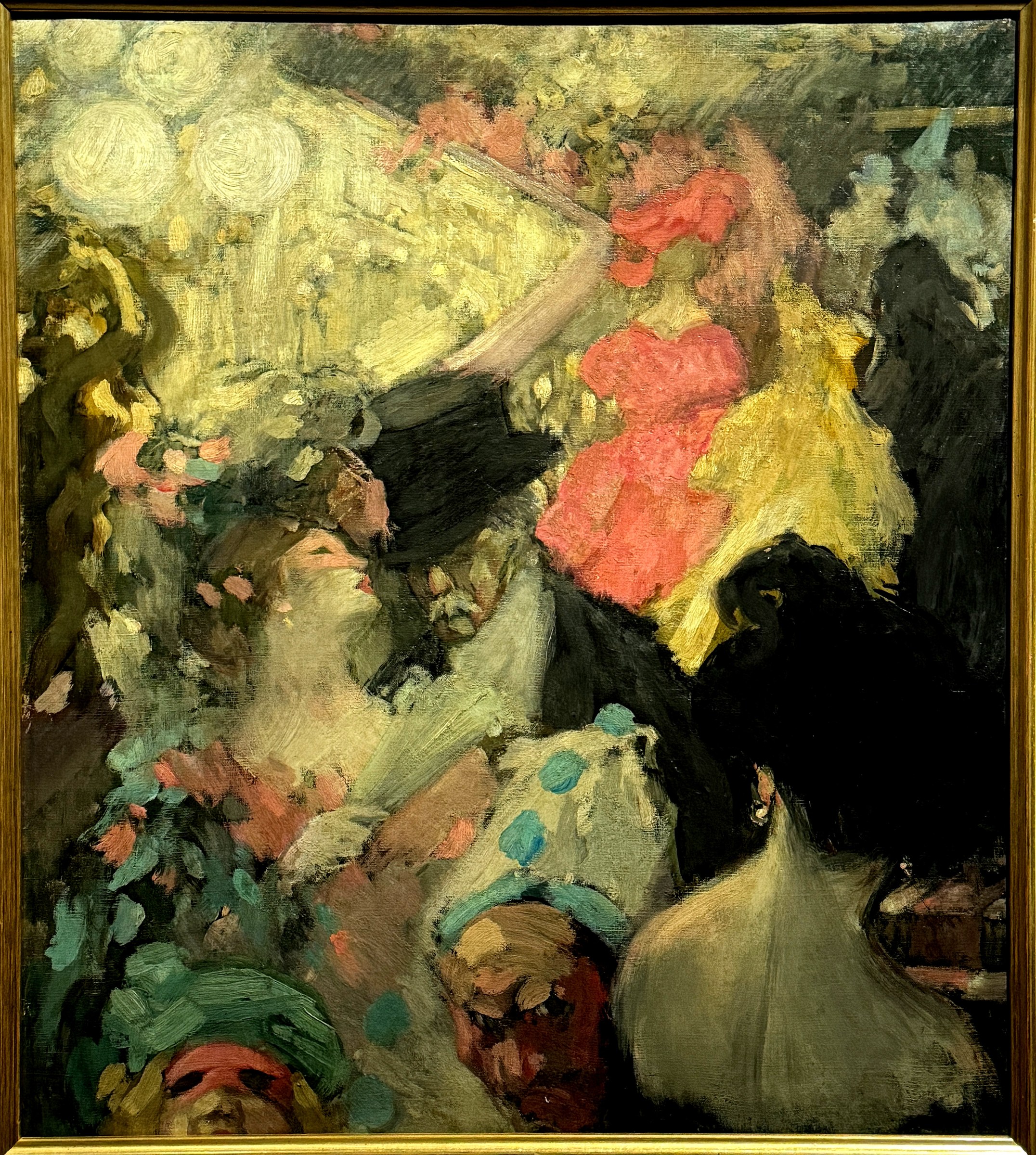
Budapest, Hungarian National Gallery, János Vaszary, masket ballroom dance
Dguendel
- Source:
- Wikimedia Commons
- Rights:
- Reusable with conditions: credit the creator. Source record ↗
- Recorded as:
- cc by 4.0
The painting documents how ballroom dance functioned as a marker of urban sophistication and social status in the early twentieth century, while showing how modernist artists transformed dance scenes into experiments in color, composition, and the representation of collective social experience. For dance historians, it offers visual evidence of the ballroom's role as a central institution of elite entertainment and courtship in this period.
What you are looking at
A crowded ballroom scene rendered in loose, expressive brushwork, dominated by warm yellows, greens, and flesh tones with accents of coral red. The composition is dense with overlapping figures in evening dress—women in pale gowns with short sleeves or bare shoulders, men in dark suits—arranged in a spiral or circular rhythm across the canvas. In the upper portion, two large glowing circles suggest hanging lights or chandeliers casting warm illumination over the scene. The figures press close together in animated conversation and movement; some are clearly paired and dancing, others stand in clusters. The paint is applied with visible gestural strokes, creating a sense of motion and social energy. The setting reads as an interior ballroom of the Belle Époque or early twentieth century, with suggestions of architectural elements (a beam or cornice) at the top right. The mood is one of sophisticated leisure and sensual pleasure—the dance floor as a space of flirtation and display.
The dancing
The dancers are rendered with loose, gestural bodies that suggest movement rather than anatomical precision. Several pairs are clearly in closed or semi-closed ballroom hold, with the woman's body angled into the man's frame. One woman in a striking coral-red dress stands prominently in the center-right, her posture upright and her gaze directed outward—she appears to be either about to dance or pausing mid-turn. The figures lack sharp definition; instead, their forms are built from overlapping strokes of color. Arms are raised, bodies incline toward one another. The compression of figures and the overlapping silhouettes suggest close partnering and the crowded intimacy of a fashionable ballroom.
The dance depicted
This is a masked ball or costume ball (masquerade) ballroom dance, as stated in the catalogue. The specific ballroom dances of the period—waltz, foxtrot, tango—would have been performed at such an event. The formal evening dress, the paired figures in closed holds, and the ballroom setting all point to international-standard or american-smooth ballroom forms. The loose handling and expressionist color prevent identification of a specific step or technique, but the composition emphasizes the social and sensual dimensions of ballroom dancing rather than technical virtuosity. The masquerade element (suggested by the title) adds a layer of anonymity and theatrical license to the scene.
How it was made
This appears to be an oil painting, worked with visible, confident brushstrokes that prioritize color harmony and compositional rhythm over representational detail. The artist has used a restricted palette of ochres, greens, reds, and flesh tones, applied wet-on-wet in places, creating passages where colors blend and forms dissolve into atmosphere. The technique allows for rapid execution and conveys immediacy and social energy. The style is consistent with early twentieth-century modernist or expressionist painting, in which ballroom scenes were popular subjects. The loose handling was suited to reproduction in books and journals and would have been legible to a broad audience familiar with contemporary art movements.
About this work
This painting depicts a fashionable masked ball in Budapest during the Belle Époque, capturing the energy and sensuality of formal ballroom dancing among the urban elite. The loose, coloristic technique and compressed composition convey the crowded intimacy and social performance of the ballroom rather than the technical execution of any single dance. It belongs to the early twentieth-century tradition of modern European artists finding subjects in contemporary leisure and urban social life—particularly the ballroom as a space where class, gender, and desire intersect. The work testifies to the centrality of ballroom dance in metropolitan social culture and to the artist's interest in rendering social gatherings through expressionist color and gestural form.
How to look at it
Attend to the composition's circular, spiral structure and how the overlapping figures create a sense of collective motion and pressure. Notice how the artist has used warm color and the glowing circles of light to convey the sensory experience of the ballroom—the heat, the crowding, the sexual tension—rather than depicting any individual step or technique. The loose brushwork and the dissolution of individual faces and bodies into the mass suggest that the subject is not virtuosity but rather the social and sensual spectacle of the ballroom itself.
The artist
János Vaszary (1867–1939) was a Hungarian painter associated with modernism and the artistic circles of Budapest and Vienna. He worked in a Post-Impressionist idiom, often depicting scenes of contemporary leisure, urban life, and social gatherings with an emphasis on color and light. His interest in ballroom and theatrical subjects reflects the cultural preoccupations of Central European modernism and the cosmopolitan ambitions of Budapest as a major imperial city. The loose, coloristic handling evident in this work was characteristic of his mature style.
The period
In the early twentieth century, particularly in the Austro-Hungarian Empire, the ballroom was at its cultural apex as a site of elite sociability, courtship, and the performance of social status. The waltz had dominated the nineteenth century; by 1907, the foxtrot and other American and Latin dances were beginning to enter European ballrooms, creating a period of stylistic ferment. The masked ball tradition (derived from Venetian carnival) retained aristocratic prestige and added an element of theatrical transgression—anonymity permitted social license. In art, modernist painters were beginning to treat contemporary social scenes—cafés, theaters, dance halls—as subjects worthy of formal experimentation, rejecting academic history painting in favor of the spaces where modern life actually unfolded.
Where it lives
The work is held in the Hungarian National Gallery, Budapest. It is a record photograph or museum documentation image from Wikimedia Commons, dated 2024 but depicting the 1907 painting.
Dance in this work
Questions about this work
What is a masked ball and why was it important in 1907?
A masked ball or masquerade is a formal dance where guests wear masks and often costumes, creating anonymity and theatrical freedom. In the early twentieth century, particularly in Vienna and Budapest, the masked ball was a prestigious social event that combined the glamour of the ballroom with the transgressive pleasure of the carnival tradition. The masks permitted social role-play and flirtation that would otherwise have been constrained by rigid etiquette.
What dances would have been performed at this event?
By 1907 in Budapest, the waltz was still dominant but the foxtrot, tango, and other ballroom forms were entering the repertoire, especially among younger dancers. The painting's loose handling makes it impossible to identify a specific dance, but the closed holds and upright postures suggest the formal ballroom dances of the period.
Why did modernist artists paint ballroom scenes?
Early twentieth-century modernist painters, particularly those in Central Europe, were interested in depicting contemporary leisure and urban social life as subjects worthy of formal experimentation. The ballroom offered a microcosm of modernity—electric light, anonymous crowds, the interplay of desire and social performance, rapid movement, and color. Artists could use these scenes to explore new techniques of composition, color, and the representation of collective experience.
More dance artwork





