49 works in this view — arrow keys or swipe to move between them.
Dance in Art
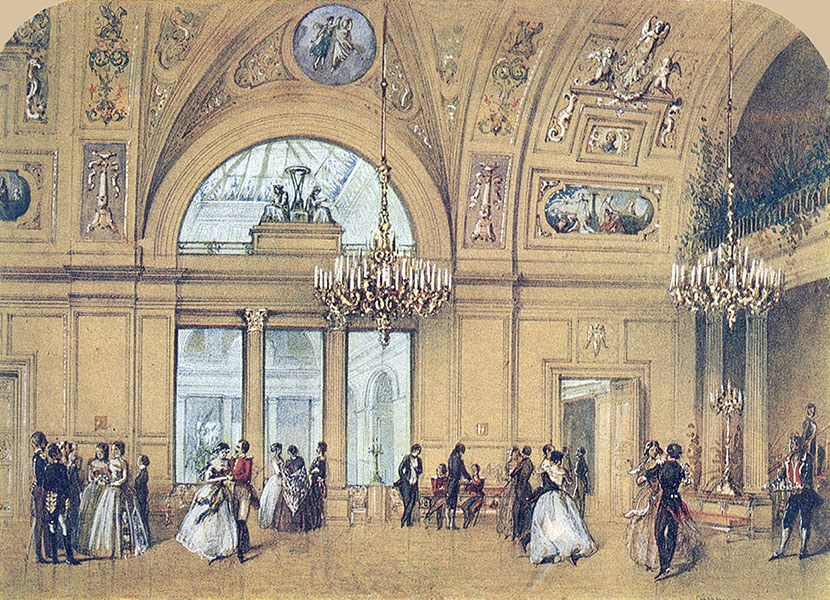
Ballroom at the Vonlyarlyarsky Mansion, St. Petersburg, 1852.label QS:Lru,"Зал в особняке Вонлярлярского."label QS:Len,"Ballroom at the Vonlyarlyarsky Mansion, St. Petersburg, 1852."
Joseph-Maria Charlemagne-Baudet
- Source:
- Wikimedia Commons
- Rights:
- Public domain — free to use, share and adapt.
- Recorded as:
- public_domain
This image is one of the most detailed surviving records of Russian ballroom life in the 1850s, showing the actual setting, dress codes, and social spacing in which quadrilles and waltzes were danced. It documents an entire cultural apparatus—the architecture, the lighting, the gender segregation, the formality—that shaped how dance functioned as courtship and social display in aristocratic society.
What you are looking at
A grand ballroom in a Russian aristocratic mansion, rendered in watercolor with meticulous architectural detail. The space is defined by soaring barrel-vaulted ceilings with ornamental stuccowork, classical medallions, and paired crystal chandeliers casting light across the polished floor. The walls are paneled in pale gold with tall arched windows opening onto a columned gallery; a massive doorway with sculptural decoration dominates the far wall. The floor is crowded with formally dressed guests in mid-1850s fashion: men in dark tailcoats and women in full-skirted white and pastel gowns, many with the characteristic bell-shaped silhouettes of the period. The gathering is neither formally arrayed nor actively dancing—figures cluster in conversational groups, stand singly, or move casually across the open floor. Several women's skirts and postures suggest they may be engaged in slow promenade or the opening phases of a dance, but the overall mood is social rather than kinetic.
The dancing
The dancers (if the gathering should be read as such) are vertical and upright, maintaining the formal carriage expected of aristocratic movement. No couple appears locked in a closed ballroom hold; instead, figures stand adjacent or at a distance, suggesting the protocols of formal introduction and assembly rather than active partnering. Arm positions are restrained, with hands visible at the sides or held before the body. The women's gowns dominate the composition—wide skirts with cinched waists create a silhouette that would constrain rapid footwork, and several skirts show the subtle folds and weight distribution of garments at rest or in very slow movement. Male figures are smaller and darker in tone, creating a visual hierarchy of display.
The dance depicted
This is a ballroom assembly rather than a dance performance in progress. The composition captures the social infrastructure of formal ball culture in mid-19th-century St. Petersburg, where the evening would unfold through a prescribed sequence of dances (quadrilles, waltzes, mazurkas, contredanses). No single dance style is clearly depicted because the artist has chosen to show the moment before or between dances—the milling and conversation that structured aristocratic courtship and social negotiation. The full skirts and upright carriage point toward historic-regency or historic-gilded-age forms (quadrille, cotillion, mazurka), but the image is more about the *ballroom as institution* than about the specific kinematics of any one dance.
How it was made
Watercolor on paper, executed with considerable architectural precision and a soft palette of golds, blues, and flesh tones. The medium allowed the artist to capture light effects—the glow of the chandeliers, the luminosity of the windows—and to work at speed, which is evident in the loose, summary treatment of the crowd itself. The figures are indicated rather than labored; faces are tiny and individual identity is sacrificed to the overall social composition. This technique suggests the work was made for a patron who valued the architectural grandeur and the evocation of a specific, recognizable room over psychological detail. Watercolor also implies a work intended for a private collection or a portfolio of architectural and social documentation rather than for public exhibition.
About this work
This is a documentary watercolor of St. Petersburg ballroom culture at its height, executed with the precision of an architectural record but animated by dozens of fashionable figures. It belongs in a dance gallery not because it shows choreography in motion, but because it records the *space and social apparatus in which dance happened*—the ballroom as an institution, the dress codes, the gender dynamics, the formal geometry of aristocratic assembly. For dancers and historians, the image is valuable as evidence of how ballroom culture was staged, how women's dress constrained and displayed the body, and how the evening was structured through phases of movement and stasis. The artist has frozen the transitional moment, the gathering before the music begins, which paradoxically tells us more about the social logic of the ball than a captured waltz would.
How to look at it
Look first at the architecture: the artist is making a claim about space and light, and the ballroom itself is the primary subject. Then track the crowd: notice how few figures are actually touching or in closed partnership. Many women stand alone or in small conversational clusters with other women; men are distributed separately. This spatial arrangement—the segregation, the waiting, the absence of active dance—is not accidental; it reflects the actual structure of the ball, which moved through phases. Notice also the constraint imposed by dress: the women's immense skirts, the corsetry implied by the silhouette, the way the bodies are vertical and centered. None of this allowed for the loose swinging hip action of modern social dance. Finally, observe how the watercolor technique—its speed, its summary treatment of faces and hands—sacrifices individual identity to collective atmosphere. The artist is interested in the *effect* of the ballroom, not in portraiture.
The artist
Joseph-Maria Charlemagne-Baudet (known dates and details scarce) was a watercolorist active in mid-19th-century Russia, specializing in architectural and social scenes. The precision of architectural rendering and the evidently commissioned nature of the work (a specific mansion, a specific moment) suggest he worked in the tradition of topographical and documentary watercolor, a genre that flourished among artists serving aristocratic patrons who wished to preserve records of their houses, gardens, and social occasions. The competence of the perspective and the care taken with decorative detail point to professional training and an established practice.
The period
The 1850s were the height of the Russian ballroom season in St. Petersburg. This was the era of the Romantic waltz and the quadrille as the twin pillars of formal social dance—both imported from Western Europe but absorbed into Russian aristocratic culture with local inflections. The dress depicted here is typical of the mid-19th century: women's skirts at their widest, requiring frames and crinolines, men in the dark tailcoat that had become the uniform of formal evening dress. The architectural style visible in the mansion—the neoclassical decoration, the gas chandeliers (which would have been novel)—places the work in the Biedermeier moment when Russian palaces were being updated with contemporary European luxury. This was also the period in which the mazurka was becoming distinctly associated with Russian national identity, though no mazurka is explicitly depicted here.
Where it lives
The work is housed in Wikimedia Commons. No collection or accession number is recorded. The title inscription and the specificity of 'Vonlyarlyarsky Mansion' suggest this was a commissioned work, possibly a record made for the family who owned the house, though that cannot be confirmed from available records.
Dance in this work
Questions about this work
Is anyone actually dancing in this picture?
Not in the active sense. The image captures the assembly before or between dances—the milling, conversation, and formation that preceded and followed the actual dancing of each set. This moment is itself part of the ballroom experience, and for historians it is often more revealing than a frozen moment of choreography, because it shows how the evening was *organized* and how gender, dress, and space structured social interaction.
What dances would have been performed at a ball like this?
The quadrille, the waltz, the mazurka, the contredanse, and the polka. The evening would have been strictly sequenced: a grand march to open, then alternating group dances (quadrilles) and partner dances (waltzes, mazurkas). The formality and the dress codes visible here would have been maintained throughout. No improvisation or informal dancing would have occurred; every dance and every figure was prescribed.
Why are the women's skirts so enormous?
In the 1850s, the crinoline—a framework of steel hoops—was worn under skirts to create the bell-shaped silhouette seen here. This was not merely aesthetic; it was a technology that displayed wealth (enormous quantities of fabric were required) and that enforced a particular bodily comportment: upright, centered, with movement confined to the vertical axis. It also ensured that women's bodies remained at a distance from their partners' bodies—a detail important to the social morality of the time.
Who painted this and why?
The artist is identified as Joseph-Maria Charlemagne-Baudet, about whom little is recorded beyond a few architectural and social watercolors. The work was almost certainly commissioned by the Vonlyarlyarsky family as a record of their mansion and their social standing. This kind of commissioned watercolor was common among Russian aristocrats in the 19th century; it served as both a portrait of the house and a document of the family's position in society.
More dance artwork





