49 works in this view — arrow keys or swipe to move between them.
Dance in Art
A Ballroom in the Year 1760 "Now let the youth to whose superior place It first belongs the splendid ball to grace, etc."label QS:Len,"A Ballroom in the Year 1760 "Now let the youth to whose superior place It first belongs the splendid ball to grace, etc.""
Abraham Solomon
- Source:
- Wikimedia Commons
- Rights:
- Public domain — free to use, share and adapt.
- Recorded as:
- public_domain
For historians of dance and manners, this work documents the precise choreography of Regency-era courtship ritual and shows how the *opening* of a ball—not the dance itself—was the moment of maximum social significance. For art historians and students of Victorian historical narrative, it exemplifies a mid-19th-century taste for reconstructing aristocratic life with archaeological attention to costume and setting, using dance and ballroom scenes as a vehicle for exploring codes of gender, rank, and desire.
What you are looking at
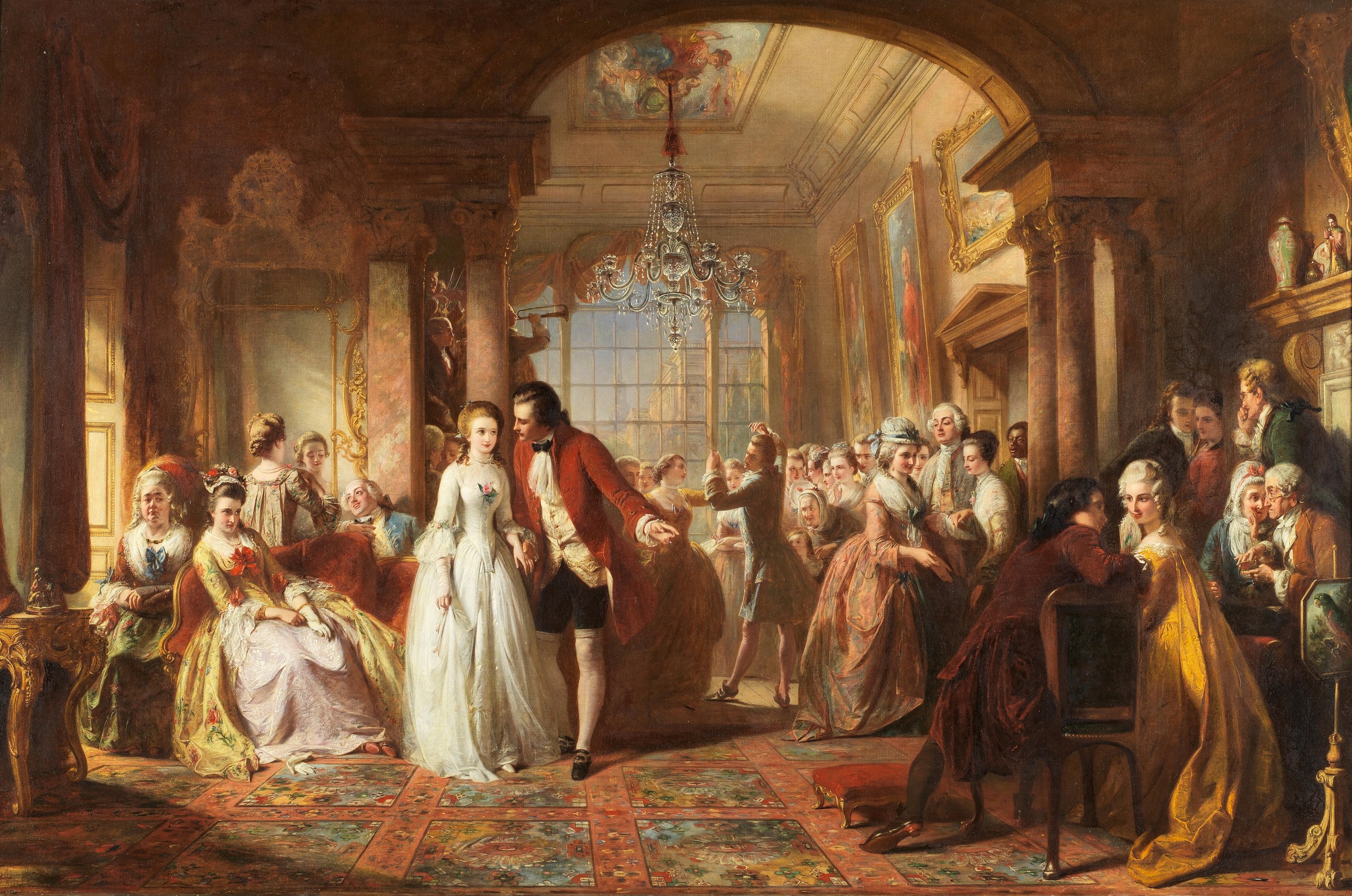
A grand ballroom scene set in the mid-eighteenth century, rendered in oils with warm, golden light flooding through tall windows on the right. The composition is densely populated: roughly thirty figures fill an elegant columned interior with classical decoration, painted ceiling panels, and a hanging crystal chandelier. In the foreground left, a woman in an elaborate gold-trimmed gown sits on an upholstered chair, observing the scene. Center stage, a young woman in an unadorned white gown stands upright, her posture formal and composed, while a man in deep red velvet coat and dark breeches addresses or presents her, with his hand extended toward her in gesture. Around them, onlookers in period dress—some seated, others standing in small groups—observe the moment. The figures wear the costume of the 1750s-60s: women in panniers, elaborate hairdressing, and rich silks; men in tailored coats, knee breeches, and buckled shoes. The setting is unmistakably aristocratic, the mood one of formal ceremony and social attention.
The dancing
The central male figure adopts a posture of courtly address: upright, one arm extended in an open gesture of presentation or invitation, the other hand gesturing toward the woman in white. She stands in nearly perfect verticality, arms at her sides in a formal pose that suggests she is being presented rather than actively dancing. Their relative positions and his gesture suggest the formal opening moment of a ball—the ritual of partner selection and salutation before dancing begins. The onlookers are distributed throughout the space, some seated in profile, others standing and turning to watch, their attention directed toward the central pair. The geometry suggests a hierarchical moment: the man acts, the woman receives and is observed.
The dance depicted
This depicts the opening ceremony of a formal 18th-century ballroom assembly, capturing the moment of invitation and acknowledgment rather than active dancing. The subtitle drawn from Soame Jenyns's *Art of Dancing* (1729) makes explicit that this represents the structured ritual of partner selection: 'Now let the youth to whose superior place / It first belongs the splendid ball to grace, / With humble bow and ready hand, prepare / Forth from the crowd to lead his chosen fair.' This is the formal moment before the dance itself—the bow, the extension of the hand, and the presentation of a young woman to the assembled company. While the actual dance that would follow is not depicted here, the choreography of social ritual is clearly the subject: the careful geometry of aristocratic courtship, the performance of rank and deference, and the ceremonial nature of partner selection in Regency-era society.
How it was made
This is an oil painting on canvas, executed with the careful finish and theatrical composition characteristic of Victorian narrative painting of the mid-19th century. The artist has used warm, raking light from the windows to model the figures and create depth, while maintaining meticulous detail in costume, architectural ornament, and the play of fabrics. The technique allows for subtle gradations of value and color, and for the rendering of gesture and facial expression across a crowded composition. This medium and scale suggest the work was exhibited and intended for a viewing public interested in historical scenes, literary narrative, and the visual reconstruction of aristocratic life.
About this work
Abraham Solomon's *A Ballroom in the Year 1760* is a Victorian-era oil painting that stages the formal opening moment of an 18th-century assembly—not dancing itself, but the choreography of aristocratic social ritual that precedes it. The scene is densely populated, theatrically lit, and meticulously costumed to evoke Regency-era elegance. It captures the moment when a young man of rank formally invites a young woman to dance, presenting her to the assembled company in a gesture governed by strict social convention.
The painting belongs to a tradition of Victorian historical genre painting that took scenes from recent past as subjects for moral and aesthetic reflection. By choosing the moment *before* the dance—the ritual of invitation and acknowledgment—Solomon captures something central to how ball culture worked: as a structure for courtship, for the display of rank and eligibility, and for the formalization of attraction within strict social codes. The subtitle from Jenyns makes this explicit and literary.
How to look at it
Attend to the moment of suspension frozen in the composition: the man's hand extended, the woman's upright posture, the direction of all eyes toward the central pair. This is not a moment of dynamic movement, but of ceremonial pause—the moment of public acknowledgment and invitation. Notice too the architectural framing: the columns and arches create a stage-like space that emphasizes the formal, performative nature of the ritual. The warm, theatrical light from the windows reinforces this sense of a staged moment, carefully composed and observed. The painting asks you to read gesture and posture as a language of rank, deference, and courtship.
The artist
Abraham Solomon (1823–1862) was a London-born painter specializing in narrative and genre scenes, often drawn from history and literature. He trained at the Royal Academy and was known for meticulous historical research, elaborate figure compositions, and a taste for scenes of social ceremony and domestic drama. His work exemplified the Victorian enthusiasm for literary subjects and historical reconstruction, and he was part of the narrative school of mid-19th-century British painting that placed emphasis on storytelling, period detail, and moral or sentimental content.
The period
Solomon painted this in 1848, during a period of intense Victorian nostalgia for aristocratic Regency-era manners and elegance. The 1820s-1830s had seen the rise of the Romantic movement and, in dance, the triumph of Romantic ballet—yet by mid-century, a distinct taste for the *social* dances and ceremonies of the previous era had emerged among artists and collectors. Ball culture and the rituals surrounding partner selection were subjects of fascination in both literature and visual art. At the same time, oil painting of historical and literary subjects was at its height as a vehicle for ambitious narrative and moral commentary in Britain.
Where it lives
The painting is held in Wikimedia Commons. It was executed as an oil painting in 1848 and reflects the Victorian practice of exhibiting narrative historical scenes in public galleries and institutions.
Dance in this work
Questions about this work
Is anyone actually dancing in this picture?
No. The painting captures the formal opening ritual of a ball—the moment when a man of rank invites a woman to dance—rather than the dance itself. This ceremonial moment, in which the man presents the woman to the assembled company, was itself a structured choreography governed by strict social convention and was understood as central to the social function of the ball.
What dance would have followed this moment?
In the 1760s, the ball would have proceeded through a series of formal dances—quadrilles, cotillions, and minuets were standard. The invitation shown here would have been followed by the man leading his partner into the first set, though Solomon has chosen not to depict that moment. The Jenyns poem cited in the subtitle refers to the formal ritual of invitation, not to any particular dance form.
Why did Solomon paint the moment before the dance rather than the dance itself?
By freezing this moment of presentation and invitation, Solomon captures what was understood as the most socially significant moment of the ball: the moment that determined partnerships, displayed rank and eligibility, and initiated the cascade of formal dances to follow. The invitation itself was a performance, a ritual with its own choreography. For a Victorian audience, this frozen moment of social ceremony may have held more narrative and moral interest than the dances that followed.
What is the literary source for the subtitle?
The subtitle is drawn from *The Art of Dancing* (1729) by Soame Jenyns, an 18th-century didactic poem about dance and manners. The quoted lines address the young man of superior rank who must 'lead his chosen fair' from the crowd, emphasizing the formal, hierarchical nature of partner selection and the ritual of the invitation. Solomon uses the poem to frame his painting as a visual commentary on the manners and morality of aristocratic courtship.
More dance artwork





