49 works in this view — arrow keys or swipe to move between them.
Dance in Art
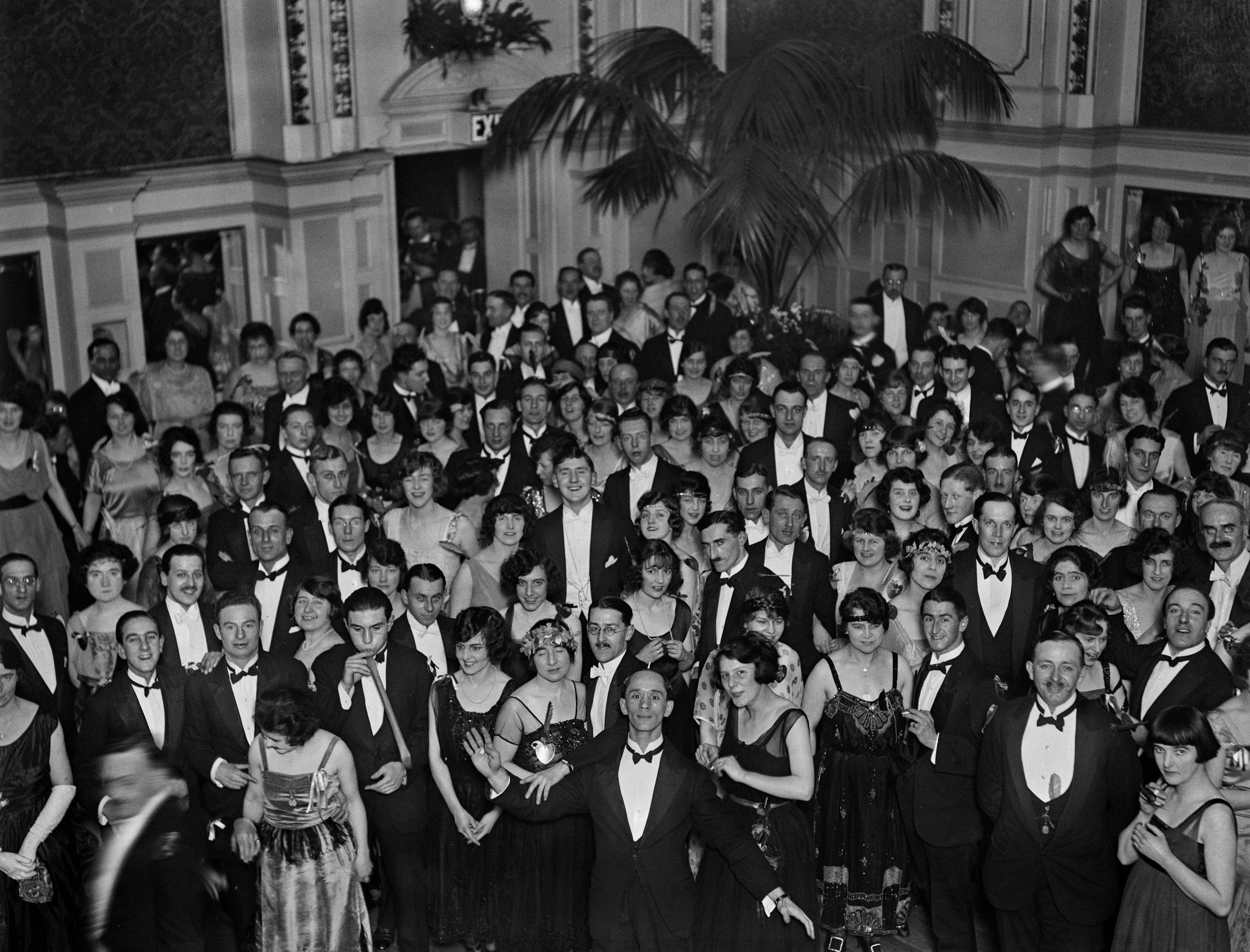
1920s Dancers Royal Palace Hotel - The Shining
Morey for Topical Press Agency
- Source:
- Wikimedia Commons
- Rights:
- Public domain — free to use, share and adapt.
- Recorded as:
- public_domain
For dance historians, this photograph documents the infrastructure and scale of early ballroom competitions and the role of professional teachers in formalizing the discipline. The presence of Santos Casani, a significant figure in ballroom dance pedagogy, and the formal competition context make this a primary source for understanding how ballroom dancing transitioned from social practice to codified competitive sport in the early twentieth century. The image has acquired additional cultural resonance through its appropriation in Stanley Kubrick's 'The Shining' (1980), making it both a historical document and an artifact of cinema.
What you are looking at
A crowded ballroom at the Empress Rooms, Royal Palace Hotel, Kensington, captures a moment during a St. Valentine's dance and ballroom dancing competition in 1921. The photograph shows approximately 100–150 people densely packed in formal evening dress: men in white-tie tuxedos with bow ties, women in beaded or sequined knee-length dresses typical of the early 1920s flapper era. The room's architecture is visible behind them—ornate white paneling, decorative trim, and a large potted palm or similar foliage rising from the floor. The lighting is even and clear, suggesting professional photography. In the center foreground stands a man in a light-coloured (possibly cream or ivory) jacket amid the crowd of darker suits—identified in the catalogue as Santos Casani (John Golman), the South African ballroom dancing teacher. The crowd is densely clustered, some figures overlapping, creating a sense of the social energy and formality of the event. This is a moment of gathering rather than a moment of active dancing; the figures stand or pose rather than mid-step, suggesting this may have been taken during an interval, a group photograph opportunity, or at the moment when competitors and guests assembled for documentation.
The dancing
The crowd presents a static, formal arrangement rather than active dance movement. Bodies are upright, standing close together in social proximity. Men hold themselves in an erect, dignified posture typical of formal evening wear of the period. Women stand with relaxed but controlled frames, many resting hands at their sides or on their companions' arms. No couple appears frozen mid-turn or in a recognizable closed dance hold. The density of the crowd and the frontal orientation of most figures toward the camera suggest this is a posed group photograph rather than a moment capturing the kinetics of ballroom dancing. The central figure in the light jacket stands out by contrast and position, marking him as a point of interest, possibly the dance master or a notable competitor.
The dance depicted
This photograph documents a ballroom dancing competition or social dance event, but it captures the gathering and assembly rather than the dancing itself. The catalogue identifies it as a St. Valentine's dance and ballroom dancing competition, and the formal dress—particularly the evening wear and the styling—places this firmly in the early 1920s competitive and social ballroom scene. Ballroom dancing at this date encompassed foxtrot, waltz, tango, and quickstep. The presence of Santos Casani, a prominent ballroom dance teacher of the period, suggests this was an important event, possibly a professional or semi-professional competition where instructors and their students gathered. However, the photograph does not show active dancing technique; it is a record of the event and its participants rather than a document of the dance itself.
How it was made
This is a black-and-white photograph credited to Morey for Topical Press Agency, indicating it was created as a news or documentary photograph for press circulation. The image is sharp and evenly lit, suggesting studio or professional event photography. The catalogue notes the photograph was 'notably retouched for the ending of The Shining,' implying later digital or darkroom manipulation for cinematic use. As a photograph produced by a press agency, this was intended for publication in newspapers or magazines to document the social and competitive ballroom scene of 1921. The scale and professionalism of the image—its technical clarity and compositional handling of a large crowd—indicate it was a significant commissioned work.
About this work
This is a press photograph of a formal ballroom dancing competition held at the Royal Palace Hotel in London in 1921, during the height of the Jazz Age and the early years of competitive ballroom dancing in Britain. It documents the social and competitive context of early twentieth-century ballroom culture, showing the formal evening wear, the scale of public interest in dancing competitions, and the presence of professional teachers like Santos Casani who shaped the emerging discipline. The photograph is historically valuable as a snapshot of a specific moment in the professionalization and institutionalization of ballroom dance in Britain, when competitions and social dancing events drew large crowds and were deemed newsworthy enough for press photography. It also serves as a record of the fashion, social customs, and architectural settings of upper-class social life in 1920s London.
How to look at it
This photograph should be read as a social document rather than a record of dance technique. Look at the formal architecture and the crowding of bodies to understand the scale and formality of the event. Notice the dress codes and fashion details—the precision of the men's formal wear, the beading and sequins of the women's dresses, the hairstyles—which date the image precisely and reveal the class and aspirations of the participants. The central figure in the light jacket, Santos Casani, is the focal point; his differentiation by dress and placement suggests his status as a teacher or honored guest. The photograph was taken during assembly or a pause, not during active dancing, so it is not a document of technique but of the social context and participants of competitive ballroom dancing. The fact that this mundane event photograph was later selected and retouched for use in a horror film points to the image's latent visual power—the formal dress, the crowding, and the black-and-white photography create an atmosphere of period formality and slight uncanniness when removed from its original context.
The artist
Morey was a photographer working for Topical Press Agency, a London-based news agency that produced photographs for press distribution during the early twentieth century. Topical Press Agency specialized in current events, social gatherings, and newsworthy occasions, employing staff and freelance photographers to document public events, competitions, and society gatherings. Morey's work on this ballroom competition exemplifies the agency's coverage of London's social and cultural life. The agency's photographs were distributed to newspapers and periodicals, making them widely circulated documents of their time.
The period
In 1921, ballroom dancing was in the midst of rapid transformation and professionalization in Britain and America. The 1920s saw the emergence of standardized ballroom dancing styles, the rise of dance competitions, and the establishment of professional teachers and dance organizations. The foxtrot, which had emerged around 1912, was becoming codified; the tango and waltz remained popular; quickstep was developing. Teachers like Santos Casani were instrumental in systematizing technique and establishing the professional standards that would lead, by the 1930s, to the formalization of what became International Standard ballroom dancing. The social context of 1921 was also one of post–World War I optimism and the rise of jazz-age culture, where dancing became both a popular entertainment and a subject of public scrutiny. Formal competitions like the one documented here were novel and newsworthy, attracting press attention and large crowds. The fashion visible in the photograph—women's beaded dresses, shortened hemlines, and bobbed hair (visible on some figures)—reflects the social liberation and style innovations of the flapper era.
Where it lives
The photograph is credited to Morey, working for Topical Press Agency, a London-based news agency. It was sourced from Wikimedia Commons, suggesting it has entered the public domain or is held in a collection with open-access licensing. The original holding institution is not recorded in the catalogue, but the press agency attribution and the newsworthy subject indicate this was produced and distributed as a journalistic photograph, likely appearing in British newspapers or magazines in 1921 or shortly after.
Dance in this work
Questions about this work
Is this photograph from The Shining?
No. This is a genuine press photograph of a 1921 ballroom dancing competition at the Royal Palace Hotel in London. However, the photograph was notably retouched and used as a reference or inspiration for the ending of Stanley Kubrick's 'The Shining' (1980), the famous horror film. Kubrick's team digitally manipulated this image, and frames from their version have circulated widely on the internet, sometimes creating confusion about the original.
Who was Santos Casani?
Santos Casani (also known as John Golman) was a South African ballroom dancing teacher who became a significant figure in the professionalization of ballroom dancing in Britain during the early twentieth century. He taught competitive ballroom technique and was prominent enough to be featured and identified in press photographs of major competitions. His presence at this 1921 competition indicates its importance and his status as a recognized teacher.
What dances were performed at this competition?
The catalogue identifies this as a ballroom dancing competition held in 1921. At that date, the primary competitive ballroom dances were the foxtrot, waltz, tango, and quickstep. The photograph does not show active dancing, so it is not possible to see which dances were performed or how they were executed.
Why does everyone look so formal?
This was a formal ballroom dancing competition and social event, requiring white-tie or black-tie evening dress. The formal dress code was not optional; it was part of the ritual and status of ballroom dancing in this era. The precision and uniformity of dress also reflects the aspirations of the participants to embody the refinement and respectability associated with ballroom dancing.
More dance artwork





