49 works in this view — arrow keys or swipe to move between them.
Dance in Art
Jitterbug dancers SLNSW FL9435364
Ivan
- Source:
- Wikimedia Commons
- Rights:
- Public domain — free to use, share and adapt.
- Recorded as:
- public_domain
Jitterbug was a defining dance of the 1940s, and this photograph captures its most spectacular element—the aerobic lift—at the moment of fullest extension. For dancers and historians, it documents the actual technique, partnership dynamics, and ballroom culture of the swing era, and provides evidence of how the style was performed and celebrated in Australia during this period.
What you are looking at
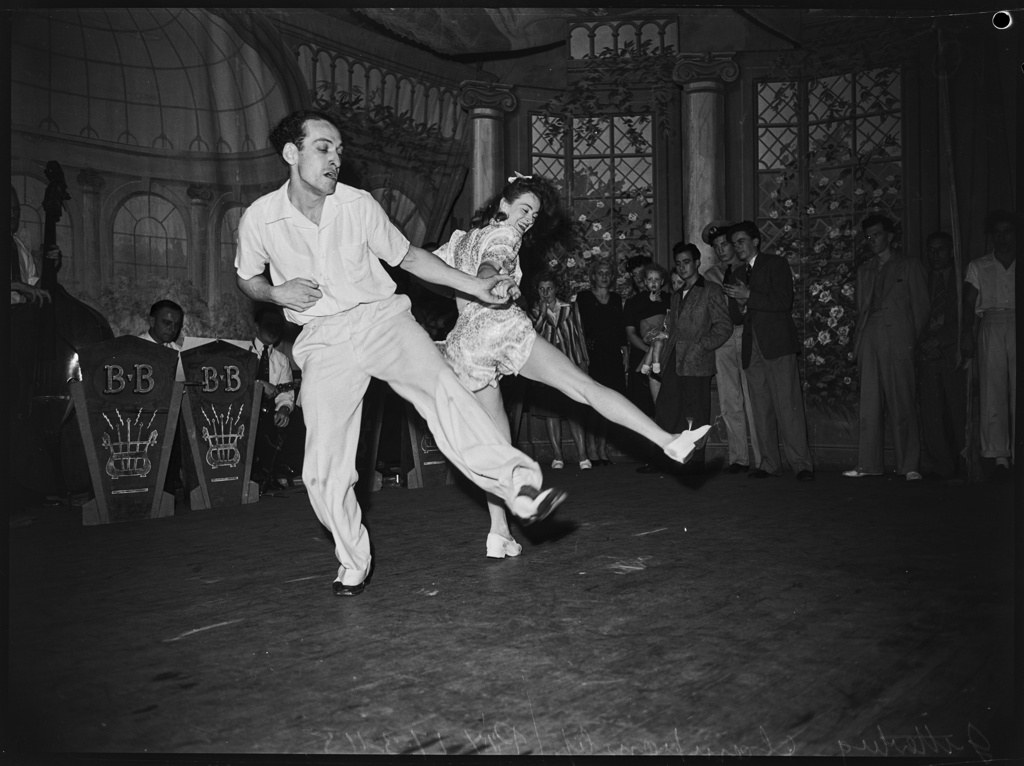
A ballroom dance scene photographed in black and white, set in an ornate interior with classical columns, arched windows with latticed panes, and decorative hanging fixtures. A male dancer in a white suit executes a dynamic swing move, his body angled sharply, one leg extended high and his partner lifted at an acute angle—her body nearly horizontal, one leg straight and raised. They are framed center-stage on a polished dance floor. Around them, an audience of formally dressed spectators—men in dark suits and women in 1940s dresses and hats—watches from the sides and background. The architectural setting appears to be a grand ballroom or pavilion. The composition captures the moment of highest extension in the lift, emphasizing the athleticism and theatricality of the dance.
The dancing
The male dancer wears a loose-fitting white suit and demonstrates a powerful, controlled frame—his body twisted, knees bent for leverage, both arms engaged to support and direct his partner. The female dancer, in a patterned dress, is held in a horizontal lift with her body fully extended, legs straight, creating a dramatic silhouette. The hold is a closed partnership position adapted for the dynamic aerial element of the swing. The gap between their bodies and the height of the lift are key to the vocabulary being performed here.
The dance depicted
This is jitterbug, specifically the acrobatic variation of swing dance that was at its peak in the 1940s. Jitterbug featured dynamic lifts, throws, and aerials performed to fast swing music, and was danced socially in dance halls and at public exhibitions. The image captures the aerobic, partner-dependent nature of the style—the male dancer leads a dramatic lift that demands both technical skill and trust. This was exhibition-level jitterbug, performed for an audience rather than in casual social dancing, as evidenced by the formal setting and spectators.
How it was made
This is a black and white photographic print from a vintage film negative, as stated in the catalogue record. The medium is film photography, which allowed the photographer to freeze this high-speed, dynamic movement at a moment of full extension. The technical quality and formal composition suggest this was a professional or journalistic documentation, likely taken at a public dance event or exhibition. The negative format and archive holding indicate this is part of a larger documentary record of social and entertainment life in postwar Australia.
About this work
This is a documentary photograph of jitterbug dancers performing at the Trocadero in Sydney in February 1948. It captures a pivotal moment in popular dance history—the aerobic, partner-dependent swing variation that dominated ballrooms in the 1940s. The image documents both the technical vocabulary of the dance (the dramatic lift) and its social context (the formal ballroom setting and audience), making it a primary source for understanding how swing was performed and valued in postwar Australian culture. The photograph is direct evidence of jitterbug as a public entertainment and social practice, not merely a historical footnote.
How to look at it
Attend to the geometry of the lift: the male dancer's twisted torso, bent knees, and locked arms create the structure that suspends his partner in a fully extended horizontal line. The photographer has caught the dance at the instant of maximum difficulty—when the partner is weightless and the leading dancer's control is most visible. Notice the audience's stillness and formal dress: this is not casual social dancing but a performance event, and the spectators' composed watching tells you this is exhibition jitterbug, not a working social dance floor.
The artist
The photographer is credited as "Ivan" in the catalogue record. No further biographical information is provided. The work is part of the State Library of New South Wales collection, suggesting it was either commissioned or collected as part of documentary record-keeping of Sydney's entertainment and social life.
The period
Jitterbug emerged in the United States in the late 1930s and became a dominant social and exhibition dance through the 1940s. It was danced to swing music, particularly big band jazz, and was associated with youth culture, energy, and modernity. In 1948, when this photograph was taken, swing was still popular but was beginning to give way to other styles; jitterbug exhibitions like this one at the Trocadero represent the tail end of swing's dominance as a participatory ballroom dance. The formal ballroom setting and audience composition reflect the respectability swing had achieved by this date—it was no longer marginalized as "low" entertainment but had become established as a legitimate public attraction.
Where it lives
The photograph is held by the State Library of New South Wales as part of their photographic collection (accession ON 388/Box 010/Item 042). It was taken from a vintage film negative, suggesting it is an original archival photograph rather than a reproduction. The holding context indicates it was collected as part of documentary record-keeping of Sydney's entertainment and cultural life.
Dance in this work
Questions about this work
What is jitterbug?
Jitterbug is an acrobatic style of swing dancing that emerged in the late 1930s and dominated 1940s ballrooms. It features dynamic lifts, throws, and fast footwork performed to swing music. Unlike slower swing dances, jitterbug emphasized aerial moves and partner aerobics, and was often performed as exhibition entertainment rather than purely social dancing.
Was jitterbug danced in Australia?
Yes. This photograph documents jitterbug being performed at the Trocadero in Sydney in 1948, showing that the style had reached Australia and was being performed in formal ballroom settings. Australian dance halls and entertainment venues embraced swing and jitterbug as part of postwar popular culture.
Why is the dancer lifted so high?
The lift is the signature move of exhibition jitterbug. It demonstrates the male dancer's strength and technical control, and the female dancer's trust and body awareness. Lifts were a key part of the spectacle and athleticism that made jitterbug exciting to watch, and they require partner skill at the level shown here—fully extended, balanced, and sustained.
What does the ballroom setting tell us?
By 1948, swing and jitterbug had achieved mainstream respectability and were performed in formal, architecturally impressive ballrooms for paying audiences. This is not street dance or underground entertainment—it is a public exhibition in an elegant venue, attended by formally dressed spectators. It shows how thoroughly swing had been absorbed into mainstream entertainment culture.
More dance artwork





