49 works in this view — arrow keys or swipe to move between them.
Dance in Art
Jitterbug dancing SLNSW FL9435363
Ivan
- Source:
- Wikimedia Commons
- Rights:
- Public domain — free to use, share and adapt.
- Recorded as:
- public_domain
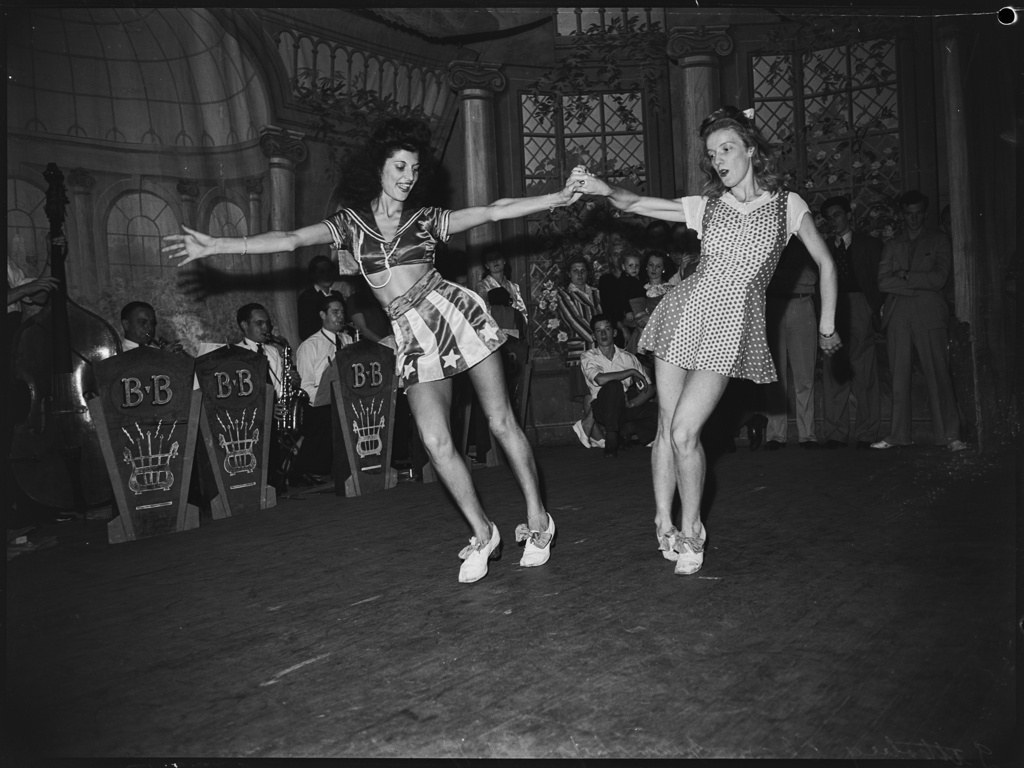
This is documentary evidence of jitterbug as a public competitive form, not a memory or a later recreation. It shows the actual bodies, spacing, frame, and costume of a working social swing dancer in real performance, which is rare in the historical record and invaluable for understanding how the dance was actually done and valued in its own time.
What you are looking at
A jitterbug competition in a grand ballroom, captured mid-performance in black-and-white photography. The dance floor is crowded with spectators lining the edges in formal dress—men in suits and women in 1940s dresses and hairstyles. In the center foreground, two couples are captured in energetic movement: the nearer couple shows a woman in a striped sailor-style dress with short dark hair mid-spin, her arm extended toward her male partner, while to her right another couple in similar dynamic poses suggests multiple pairs dancing simultaneously. The setting appears to be the Trocadero venue in Sydney, with architectural elements visible in the background—tall windows with lattice panes, classical columns, and decorative ceiling fixtures that suggest an upscale dance hall. The lighting is even, typical of documentary photography, and the crowd density indicates a popular public event rather than a private gathering.
The dancing
The dancers display the characteristic energetic, swinging frame of jitterbug: bodies held in close partnership but with dynamic separation and recovery, arms extended outward in momentum, knees bent in a ready athletic stance. The near woman's posture shows the typical female response position—weight shifted, skirt flaring from rapid turns, feet in light white shoes positioned for quick directional changes. Both couples show the rapid, syncopated footwork characteristic of swing dancing, with bodies rotating through the hips while maintaining upper-body connection to their partners. The positioning suggests multiple couples dancing in a competitive format, with judges or observers potentially in the background.
The dance depicted
This is jitterbug, the energetic swing dance that dominated 1940s ballrooms and became a symbol of youth culture and wartime social life. The photograph documents a competitive event at the Trocadero in Sydney in February 1948, capturing a style of social swing dancing that combined aerobic athleticism with partner improvisation. The dancers' dress and the event's scale indicate this was mainstream entertainment rather than underground or specialist practice—jitterbug had become respectable enough for public competitions in upscale venues. The particular energy and momentum frozen here suggest competition performance rather than casual social dancing, with the extended frames and visible effort typical of exhibition-level swing.
How it was made
This is a black-and-white gelatin silver print made from a vintage film negative, which indicates professional documentary or journalistic photography. The negative was held by the State Library of New South Wales and suggests this was either press photography or commissioned event documentation. The photographic medium captured motion in a way painting could not—the image freezes a split-second of movement, allowing us to see body positions and spacing that would blur or be lost in real time. The clarity and composition suggest a photographer positioned to document the event professionally, not a casual snapshot.
About this work
This photograph documents social swing dancing at a competitive level in post-war Sydney, capturing jitterbug as a mainstream ballroom activity rather than a fringe or underground practice. The 1948 date places it in the immediate postwar period when swing dancing had transitioned from wartime servicemen's culture to established public entertainment. The image is valuable precisely because it shows jitterbug not as historical artifact but as a living, competitive social form practiced in formal venues by both men and women in fashionable dress. It demonstrates how thoroughly swing had been absorbed into respectable ballroom culture in the British Commonwealth by the late 1940s.
How to look at it
Attend to the moment of separation and recovery in the couples' hold—the woman's extended arm and turned-out hip show the characteristic jitterbug break position where dancers separate briefly before returning to partnership. The bent knees and forward weight suggest the constant directional changes and quick footwork that defined the dance's athleticism. Notice how the photographers positioned the camera to show multiple couples simultaneously, suggesting this was a demonstration or competitive format where the audience's view mattered. The crowd in the background anchors this as a social event, not a trained theatrical performance.
The artist
Ivan was a photographer working for or contracted to the State Library of New South Wales, documenting public events and cultural life in Sydney in the 1940s. The professional quality and archival preservation suggest institutional commissioning rather than independent press photography, though the specific details of Ivan's practice and other work are not established here.
The period
By 1948, jitterbug and swing dancing had moved from wartime servicemen's culture into mainstream Australian ballroom life. The post-war period saw a stabilization of social dance forms and the rise of competitive ballroom culture as organized entertainment. Simultaneously, swing was beginning to be displaced by newer forms, making this photograph temporally significant—it captures swing at the moment of its peak social legitimacy before rock and roll and other styles reshaped youth dance. The formal venue and fashionable dress indicate that swing had become respectable middle-class entertainment rather than rebellious youth culture.
Where it lives
The photograph is held by the State Library of New South Wales (accession ON 388/Box 010/Item 042) and was sourced from Wikimedia Commons. It is a professional negative from the State Library's documentary photography collection, suggesting either commissioned event coverage or institutional acquisition from press archives.
Dance in this work
Questions about this work
What is jitterbug and why did people dance it?
Jitterbug is a partner swing dance that emerged from African American vernacular dance and became mainstream in American and Allied ballrooms during and after World War II. It combined improvised footwork with aerobic athleticism and was associated with youth, energy, and modernity. By 1948, it had become established competitive entertainment in formal venues.
Was this a professional or social dance?
This appears to be a competitive event—the formal setting, gathered spectators, and posed moment suggest exhibition dancing rather than casual social dancing. However, jitterbug remained a partner dance form, not a theatrical performance, so the distinction between 'professional' and 'social' is fluid. These were trained social dancers performing for an audience.
Why was jitterbug so controversial?
Jitterbug originated in African American dance culture and retained associations with racial non-segregation, youth rebellion, and sexual suggestiveness when adopted by white audiences. By 1948, though, the form had become respectable enough for public competitions in upscale ballrooms, though conservative critics still objected to its energy and body contact.
What does the dress tell us?
The dancers' fashionable 1940s clothing and the spectators' formal attire indicate this was middle-class entertainment in a respectable venue, not underground youth culture. The woman's sailor-style dress and heeled shoes were contemporary fashion, suggesting jitterbug competitions had become occasions for displaying style and social status.
More dance artwork





