49 works in this view — arrow keys or swipe to move between them.
Dance in Art
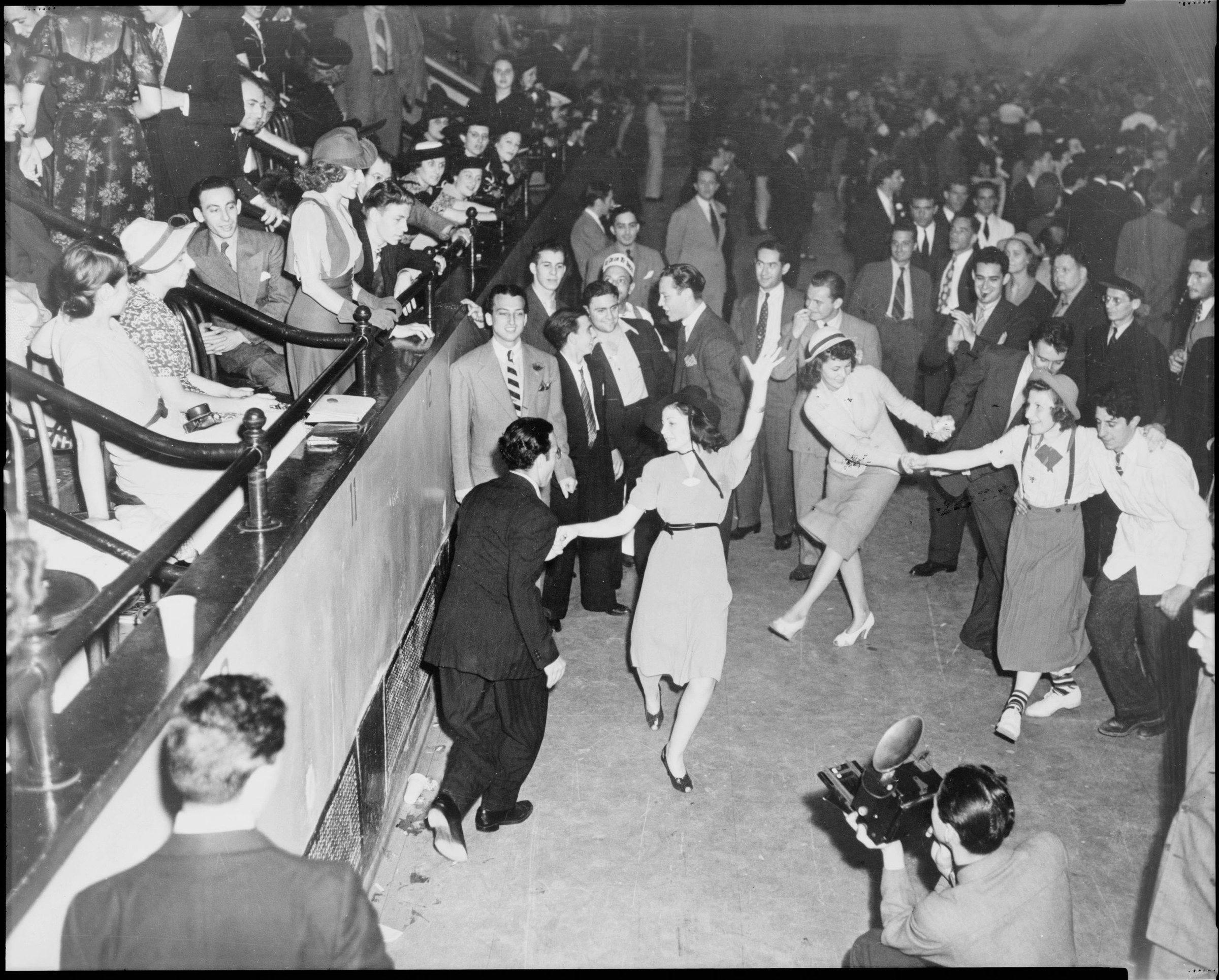
Jitterbug dancers NYWTS
New York World-Telegram and the Sun staff photographer: Fisher, Alan, photographer.
- Source:
- Wikimedia Commons
- Rights:
- Public domain — free to use, share and adapt.
- Recorded as:
- public_domain
Jitterbug was the dance of American youth in the late 1930s and early 1940s, and this photograph documents it as a mass public phenomenon rather than a marginal or subcultural practice. The image is evidence of how swing dancing was packaged and presented to the American public through press photography, and of how closely the emerging teenage consumer culture and popular dance were already intertwined. For historians of American dance, it is a crucial record of what jitterbug actually looked like in motion, how it was performed publicly, and what kind of audience and social status it commanded.
What you are looking at
A photograph captures a jitterbug dance competition or demonstration in what appears to be a large indoor venue, circa 1938. The dance floor occupies the center of the frame, surrounded on all sides by a dense crowd of spectators in suits, dresses, and hats typical of the late 1930s. On the left side, raised seating holds additional viewers, some leaning forward with interest. In the immediate foreground at bottom right, a photographer with a large format camera documents the event. Two couples are visible dancing on the floor itself—the dancers in motion, the women in light-colored dresses, the men in dark suits. The lighting is even and bright, suggesting indoor electric lighting rather than natural daylight. The scale of the crowd and the formal documentation by press photographers indicate this was a significant public event, not a casual social dance.
The dancing
The dancers visible in the center display the energetic, athletic frame characteristic of swing dancing: bodies held at angles, arms extended and bent, suggesting rapid movement and partnered rotation. The women's skirts are visible and appear to be caught mid-motion, swinging outward with the centrifugal force of the turns. The men are in standard dark suits without visible tailoring for dance. The dancers' posture is upright and springy rather than the held frame of ballroom; their weight appears to be on the balls of the feet, ready for rapid weight changes. The crowd presses close on all sides, creating the impression of contained, vigorous movement.
The dance depicted
This is jitterbug or swing dancing, the dominant partner dance of American youth culture in the late 1930s. Jitterbug emerged from the lindy hop and other swing styles and was danced to big band jazz and swing music. The image shows it as a public, competitive, and highly social phenomenon—the scale of the crowd and the press photography indicate jitterbug was newsworthy entertainment, not marginal practice. The athletic, improvisational style visible here, with emphasis on momentum and energy, is consistent with the swing vernacular of the period. The mixed-gender couples and the informality of dress (despite being indoors and formal) reflect jitterbug's origins in African American dance culture and its rapid adoption by white American youth.
How it was made
This is a black-and-white documentary photograph, likely taken with a large-format press camera of the 1930s era. The depth of field and the clarity across multiple planes of the crowd suggest a wide-angle lens and fast film or significant available light. The composition—with the action in the center and the crowd framing it—is typical of newspaper and magazine documentary photography of the period. As a photograph by a New York World-Telegram and Sun staff photographer, this was intended for newspaper or syndicated publication, which means it circulated to a broad public audience and was understood as evidence of a newsworthy social phenomenon rather than as an artistic object.
About this work
This is a documentary photograph of jitterbug dancers performing or competing at a public venue in New York, circa 1938. The image is a record of a specific moment in American popular dance culture: the emergence of swing dancing as a mass social phenomenon among young people, heavily documented by the press and invested with both cultural fascination and moral anxiety. The photograph shows jitterbug not as an intimate social dance but as a public spectacle—watched, photographed, and mediated for national consumption. It captures the dance at a moment of maximum visibility and institutional attention, before the Second World War would reshape American culture and popular dance practices.
How to look at it
Look first at the composition: the dance floor and dancers are centered, but nearly as much visual weight is given to the crowd surrounding them. This framing reflects the photograph's subject matter—the social phenomenon of jitterbug is as much about the watching and the crowds as it is about the dancing itself. Observe the posture and energy of the dancers visible in the center: the upright frame, the bent arms, the sense of rapid movement even in a still image. Notice the dress of the crowd—formal 1930s clothing, hats, the raised seating area on the left—which indicates this is a formal, public event, not a casual dance hall. The presence of the photographer in the foreground reminds us that we are looking at a photograph of a mediated event, a performance staged partly for the camera.
The artist
Alan Fisher was a staff photographer for the New York World-Telegram and the Sun, a newspaper and photo syndicate with a strong commitment to documentary photography and social reporting. The World-Telegram and Sun employed photographers to document American life and culture across the country, particularly during the Depression and war years. Fisher's work, like that of his colleagues, was intended for immediate publication in newspapers and magazines, which shaped both his compositional choices and his subject matter. The photograph reflects the news values and documentary conventions of 1930s American journalism.
The period
Jitterbug emerged in the mid-1930s as white American youth adopted and adapted swing styles from African American jazz culture. By 1938, swing dancing was a major social phenomenon, heavily covered by the press, and invested with cultural meaning that ranged from celebration of youthful energy to moral panic about the social consequences of mixed-race dance spaces and uninhibited youth behavior. Simultaneously, documentary and press photography was establishing itself as a major medium for social and cultural reporting. The scale and formality of this event—the large venue, the press photographers, the dense crowd—reflects jitterbug's status as not merely a dance style but a cultural flashpoint and a source of public fascination.
Where it lives
This photograph comes from the New York World-Telegram and the Sun photograph collection, a major archive of American documentary photography from the 1930s and 1940s. It is catalogued as a press photograph and was likely published in a newspaper or magazine syndicate during or shortly after its creation. The work is part of a broader documentary record of American culture and social life created by newspaper photographers in this period.
Dance in this work
Questions about this work
What exactly is jitterbug, and how is it different from lindy hop?
Jitterbug is a broad term for swing dancing that emerged in the mid-1930s and encompasses several related styles, including the lindy hop. Jitterbug tends to emphasize more athletic and acrobatic moves, more rapid weight changes, and is often performed to faster music than some lindy hop dancing. By the late 1930s, 'jitterbug' had become the popular term for swing dancing among American youth, while 'lindy hop' was sometimes used more specifically. This photograph shows the energetic, improvisational style that was called jitterbug in the press.
Who danced jitterbug, and where did it come from?
Jitterbug originated in African American jazz and swing culture in the early 1930s. By the mid-1930s, white American youth, particularly teenagers and young adults, had adopted swing dancing enthusiastically, and it became a mass social phenomenon. Jitterbug was danced in dance halls, at social events, and at public competitions like the one shown here. It was closely associated with big band jazz and with a new teenage consumer culture, which made it both celebrated and controversial.
Why was jitterbug so important in the 1930s?
Jitterbug was the dance of American youth culture in the late 1930s, and it carried enormous cultural weight. It was energetic, improvisational, and often involved interracial dance spaces, which made it both thrilling to young people and alarming to cultural conservatives. The scale of the crowds in photographs like this one shows how mainstream and widely celebrated swing dancing had become. Jitterbug was also one of the first dances to be strongly associated with a teenage consumer identity and with youth rebellion.
What does this photograph tell us about how jitterbug was presented to the public?
This photograph shows jitterbug as a public spectacle—packaged for press consumption and presented as newsworthy entertainment. The formal venue, the large crowd, the press photographers, and the staged quality of the scene all reflect how jitterbug had become a subject of mass media attention. Rather than showing casual social dancing, this image presents jitterbug as an event, a competition, and a cultural phenomenon worthy of documentation and circulation. It reflects both the popularity of the dance and the way the press shaped how Americans understood youth culture.
More dance artwork





