49 works in this view — arrow keys or swipe to move between them.
Dance in Art
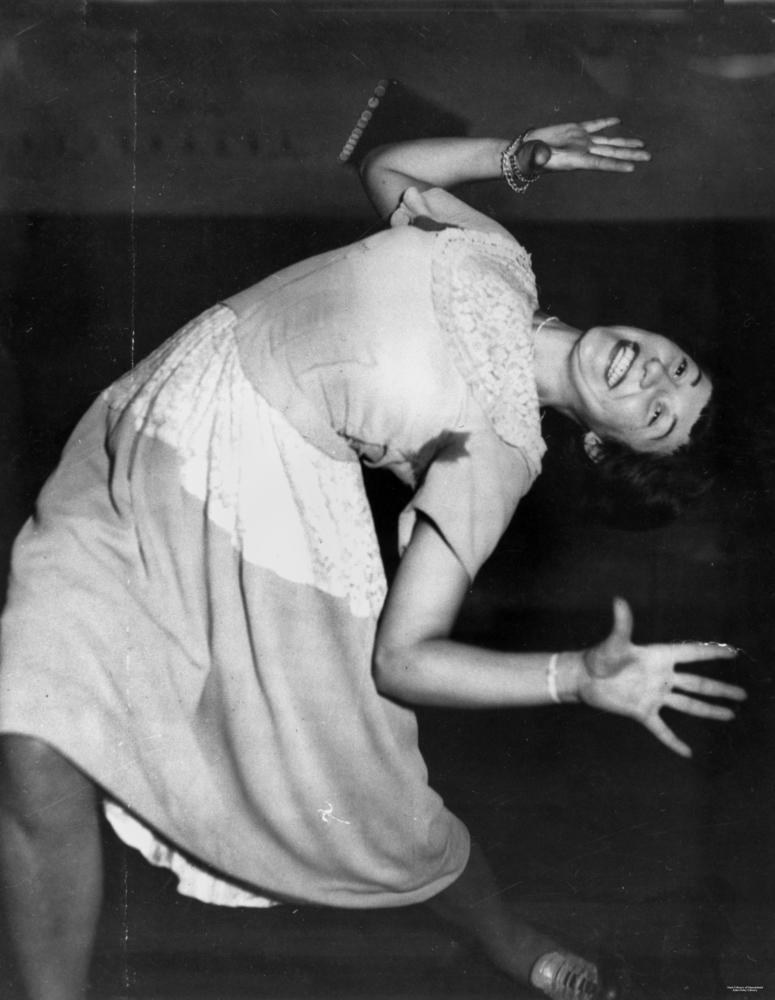
StateLibQld 1 183667 Lee Celledoni dancing the Jitterbug, 1947
Unknown artist
- Source:
- Wikimedia Commons
- Rights:
- Public domain — free to use, share and adapt.
- Recorded as:
- public_domain
Jitterbug competitive performance, especially at the level of a dancer recognized as 'best woman,' represented a rare moment when female swing dancers were documented as solo virtuosos rather than partners. The photograph captures the explosive athleticism and acrobatic innovation that characterized 1940s swing culture before rock and roll displaced it. For historians, it is visual evidence of how high the performance bar had risen for competitive jitterbug dancers by the late 1940s.
What you are looking at
A solo female dancer photographed against a dark background, captured mid-movement in a dynamic, energetic pose characteristic of 1940s swing dancing. She wears a light-colored dress with textured or patterned fabric on the bodice, and multiple bracelets on both wrists. Her body is thrown into a deep backward arch, with her head tilted back and her arms spread expressively—one raised high, the other extended outward at shoulder level. Her legs are bent and her weight appears to be on one foot, creating the impression of momentum and rotation. The photograph is a black-and-white studio portrait, sharply focused on the dancer's figure against an unlit backdrop that emphasizes her movement and theatrical presence.
The dancing
A single female dancer in a solo performance stance. The characteristic open position shows an exaggerated backward lean from the hips, with knees flexed and weight on one supporting leg—a hallmark of swing partnered recovery movements. Both arms are actively positioned, one high and one extended, creating an open frame and dynamic line typical of jitterbug aerials or breakaway recoveries. The head is thrown back in a moment of apparent weightlessness or recovery from a throw. The posture shows the kind of control and athleticism required for swing's acrobatic elements.
The dance depicted
This is a portrait of jitterbug, the energetic swing dance that dominated American dance floors from the late 1930s through the 1940s. The catalogue identifies the dancer as Lee Celledoni, described as the 'best woman jitterbug.' The pose captures a moment that would typically occur during a partnered swing sequence—likely a recovery from an aerial move or a breakaway moment—where the woman launches into space with explosive energy before being caught or returning to the man's frame. The exaggerated arch and open arms are characteristic of the showiest, most acrobatic variants of the dance that were performed in competition and exhibition.
How it was made
This is a black-and-white photograph, likely professional studio portraiture from 1947. The even lighting, dark seamless backdrop, and sharp focus indicate a trained photographer working with studio equipment. The composition is a typical dance portrait of the era—a single figure frozen mid-movement against a neutral field, intended to isolate the dancer's form and energy without distracting context. Such photographs were used for publicity, competition documentation, and performance promotion, and suggest that Celledoni's skill as a jitterbug dancer was significant enough to warrant professional photographic documentation.
About this work
This 1947 photograph documents Lee Celledoni at the height of competitive swing dancing in America. It captures a moment in a jitterbug performance or competition—a dynamic, athletic movement that was as much acrobatics as dance. Jitterbug was one of the most energetic and inventive of the American vernacular dances, born in the late 1930s from the fusion of Lindy Hop, tap, and African American swing culture. By the 1940s, competitive jitterbug had become a spectacle with aerial tricks, solo performances, and showcases like the one implied here. The photograph is a document of both a specific dancer's achievement and a pivotal moment in American social and performance dance, when swing dominated the culture and women dancers were celebrated as athletic performers in their own right.
How to look at it
The photograph captures the moment of maximum extension and risk in an aerial or breakaway move—when the dancer is committed to the movement and at her most vulnerable and most free. Notice how the arch of her body and the splayed arms create an impression of weightlessness and velocity, as if she is suspended mid-air or mid-turn. The dark background forces all attention onto her silhouette and the clarity of her line. This compositional choice was standard in dance portraiture of the era and emphasizes that the dancer, not the music, music, partnership, or environment, is the subject. The slight tilt of her head and the energy in her limbs convey not just physical technique but personality and joy in the movement—qualities that were as important to swing performance as technical precision.
The artist
The photographer is not recorded in the catalogue. Studio portraiture of dancers in the 1940s was a standard commercial practice in major American cities, and such photographs were typically uncredited. The work may have been commissioned by Celledoni, her dancing partner, a dance studio, or a competition organizer for publicity purposes.
The period
In 1947, swing dancing was at or just past its popular peak. The jitterbug had evolved from the Lindy Hop of the 1930s into a more acrobatic, exhibition-oriented form. Competitive swing dancing had become a spectacle in its own right, with championships, showcases, and traveling dance troupes. The Second World War had accelerated the spread of swing culture through military bases and USO shows. By the mid-1940s, jitterbug was a staple of dance halls, competitions, and theatrical performances. However, the cultural dominance of swing was already beginning to wane; rock and roll would emerge within a few years and would displace swing as the primary youth dance culture. This photograph thus captures swing culture at a moment of institutional recognition (competition, professional documentation) but before its decline in the broader cultural landscape.
Where it lives
The image comes from the State Library of Queensland and is indexed on Wikimedia Commons. It is a professional studio photograph from 1947, likely created for publicity or competition documentation. No further provenance information is recorded.
Dance in this work
Questions about this work
What is jitterbug and how does it differ from lindy hop?
Jitterbug evolved from Lindy Hop in the late 1930s and early 1940s, becoming more acrobatic and more oriented toward competition and exhibition. Where Lindy Hop emphasized partnered improvisation and social dancing, competitive jitterbug developed flashy aerials, throws, and solo tricks. By the mid-1940s, jitterbug was the preferred term for the most theatrical and athletic variants, often performed in competitions and stage shows. Both grew from the same swing culture and music, but jitterbug became the performance spectacle.
Why would a solo jitterbug portrait be valuable documentation?
Most social and even many competition photographs of swing dances show couples. A solo portrait of a woman identified as the 'best woman jitterbug' is rare evidence that women dancers were recognized as solo virtuosos, not just partners. It also documents the athleticism and technical achievement that competitive jitterbug demanded by the 1940s, which can be hard to visualize from text descriptions or from couples' photographs where the woman's role may be less visible.
What does the pose tell us about the dance?
The exaggerated arch, the explosive arm position, and the bent-knee stance all indicate a moment of acrobatic risk and recovery—likely the aftermath of a throw or aerial move. This was the spectacular side of competitive jitterbug, designed to thrill audiences. The ease and precision of the pose suggests it was a well-practiced, signature move rather than an improvised moment, and it tells us that by 1947, jitterbug champions were trained athletes, not casual social dancers.
More dance artwork





