49 works in this view — arrow keys or swipe to move between them.
Dance in Art
JitterbugFSA 1
Russell Lee
- Source:
- Wikimedia Commons
- Rights:
- Public domain — free to use, share and adapt.
- Recorded as:
- public_domain
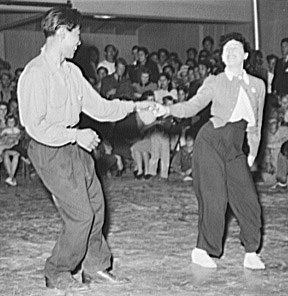
This photograph is essential evidence for understanding how jitterbug was actually danced outside of theatrical contexts, and for recognizing the FSA photographic archive as a major (and often overlooked) source for dance history. It shows the dance in the hands of ordinary people in a working-class community, during the exact moment of its cultural ascendancy. For historians of American social dance, vernacular movement, and the social history of the 1940s, this image is primary-source material.
What you are looking at
A black-and-white photograph captures a jitterbug contest in progress at an outdoor or semi-enclosed community gathering. Two couples occupy the center of the frame, locked in the vigorous, swinging partnered movement characteristic of the dance. The nearest couple dominates the composition: the man, in a light-colored shirt and dark trousers, holds his partner with one arm around her waist while their other arms are extended in the classic jitterbug frame. The woman, in a light blouse and dark skirt, leans back into the hold with her body angled away from her partner, her legs energetically extended. A second couple is visible just behind them, similarly engaged. The background shows a large crowd of spectators—men, women, and children in 1940s dress—seated on benches and standing, watching the dancers intently. The setting appears to be a community event space, consistent with the FSA (Farm Security Administration) context of the original caption. The photograph's grainy texture and high contrast are typical of documentary photography from this period.
The dancing
The lead couple is in a closed, dynamic hold with the man's right arm around the woman's waist and their left hands joined, raised to frame height—the standard jitterbug frame. The woman's weight is clearly thrown back, her body creating a marked angle from the man's torso, demonstrating the characteristic 'kick' or extension that defines the style. Her legs are visibly active, and the man's posture shows the muscular engagement needed to support the swing. Both dancers are upright and energetic rather than fluid; the frame is rigid and controlled. The second couple's partial visibility suggests the same basic hold and energy. The composition captures the moment of extension rather than a close connection—the hallmark of jitterbug's athletic, aerobic character.
The dance depicted
This is unambiguously jitterbug, the swing-era partner dance that emerged in African American communities in the 1930s and swept across American popular culture during the 1940s. The FSA context—a farm workers' community gathering in Yuma, Arizona—places this squarely in the wartime period when jitterbug became a marker of American youth culture and working-class recreation. The photograph documents the dance as it was actually danced in community settings rather than on stage: energetic, competitive, and social. The rigid frame and the woman's characteristic backward lean are textbook jitterbug technique. This image shows the dance at the moment of peak popularity, during the Second World War, when USO dances and community events made jitterbug the dominant partner dance of American youth.
How it was made
This is a black-and-white photograph, almost certainly taken with a 35mm press camera typical of FSA documentary work in the 1940s. The grainy texture, high contrast, and sharp focus on the dancers against the slightly softer background are consistent with fast film stock and natural or flash lighting. As a photograph rather than a drawing or painting, it captures actual movement frozen at a moment of peak extension—something that would have been nearly impossible to represent in other media without loss of immediacy. The documentary intention and the specificity of the caption suggest this was taken for the FSA's photographic archive, meaning it was intended for public circulation and government record rather than fine-art display. This establishes it as evidence rather than interpretation.
About this work
This is a documentary photograph of a jitterbug contest at a Farm Security Administration farm workers' community gathering in Yuma, Arizona, in 1942. It records the dance not as a theatrical spectacle but as a lived social practice in a working-class American community during the Second World War. The photograph is an artifact of the FSA's comprehensive visual documentation of American life during the Depression and wartime, a project that incidentally created a major archive of American vernacular culture—including dance. The image is valuable precisely because it does not aestheticize or perform the dance: it shows how jitterbug was actually executed by ordinary dancers in the moment when it was the dominant form of American youth recreation.
Jitterbug was a marker of modernity, youth, and racial integration in a segregated society. This photograph, taken by a white photographer documenting rural working-class life, captures that social significance in the body language of the dancers and the rapt attention of the crowd. It is neither a performance photograph nor a studio study, but a record of a community event—and that documentary status is what gives it historical weight.
How to look at it
The photograph freezes jitterbug at the moment of maximum extension and energy—the sharp backward lean of the woman and the straight-armed frame of both dancers. This is the visual signature of the style: the swing, the air steps, the vigorous athleticism. Look at the posture of the spectators in the background: the concentration and engagement suggest this is a genuine community competition, not a posed or staged event. The second couple in the background, partially visible, confirms that this is one moment in an ongoing event. Notice also the contrast between the dancers' intensity and the lightness of their dress—cotton shirts and simple skirts suited to Arizona heat, not stage costumes. This is how jitterbug lived in the world: as casual, energetic, competitive social dancing.
The artist
Russell Lee (1903–1986) was a prominent FSA photographer who documented American life during the Depression and the Second World War. He was known for his sympathetic, patient approach to documentary photography and his ability to capture moments of genuine human engagement rather than posed tableaux. His work on farming communities, urban neighborhoods, and social life provides some of the most vivid photographic records of American vernacular culture in the 1930s and 1940s. Lee was one of the FSA photographers who understood the camera as a tool for social witness rather than artistic expression, though his work is now recognized for its formal sophistication as well as its documentary value.
The period
Jitterbug exploded into mainstream American consciousness in the late 1930s and early 1940s, becoming the defining dance of the swing era. By 1942, when this photograph was taken, it had become the standard partner dance for American youth across class and regional lines, and—despite white anxiety about the dance's origins in African American culture—was actively promoted as an American cultural export during the war. The FSA's mission to document American life made dance a natural subject, though photographs of vernacular social dancing are less common in the archive than photographs of work, rural life, and urban social conditions. This photograph sits at the intersection of three historical currents: the consolidation of jitterbug as a national dance form; the FSA's comprehensive documentation of American social life; and the wartime moment when American popular culture was being actively shaped as propaganda and morale-building.
Where it lives
This photograph is held in the Wikimedia Commons and is sourced from the FSA/Office of War Information (OWI) Photograph Collection, a major archive of American documentary photography held at the Library of Congress. The original caption—'Jitterbug contest at the dance which closed the second annual field day at the FSA (Farm Security Administration) farm workers' community. Yuma, Arizona'—is part of the archival record and indicates the FSA's systematic documentation of community life among farm workers.
Dance in this work
Questions about this work
How do I know this is jitterbug and not just swing dancing?
Jitterbug is a specific swing-era partner dance characterized by a rigid frame (the dancers maintain straight arms and an angular hold), a marked backward lean by the follower, and energetic, athletic movement. This photograph shows all three markers. The FSA caption also explicitly identifies it as jitterbug, a common enough term in 1942 to describe what we might now call 'swing dancing' more broadly, though jitterbug properly refers to the more athletic and aerobic variant.
Who were the dancers in this photograph?
The FSA archive does not identify the individual dancers in this photograph, which is typical of documentary photography from the era. They were workers at the FSA farm workers' community in Yuma, Arizona, participating in a community gathering. The anonymity of the dancers is part of what makes this a document of vernacular culture rather than a record of celebrity or professional performance.
Why did the FSA photograph dance?
The FSA's mandate was comprehensive visual documentation of American life, and social recreation—including dance—was considered part of that record. Dance was seen as evidence of community, morale, and cultural vitality, especially important during the Depression and the Second World War when the government wanted to demonstrate that American workers and rural communities were resilient and engaged.
Was jitterbug actually danced this way in the 1940s?
Yes. This photograph is documentary evidence of how jitterbug was danced in ordinary community settings in 1942. The frame, the posture, and the energy visible here are consistent with descriptions and other documentation of jitterbug from the period. It shows the dance as ordinary people danced it, not as it was performed on stage or in exhibition.
More dance artwork





