49 works in this view — arrow keys or swipe to move between them.
Dance in Art
JitterbugElks 1
Esther Bubley
- Source:
- Wikimedia Commons
- Rights:
- Public domain — free to use, share and adapt.
- Recorded as:
- public_domain
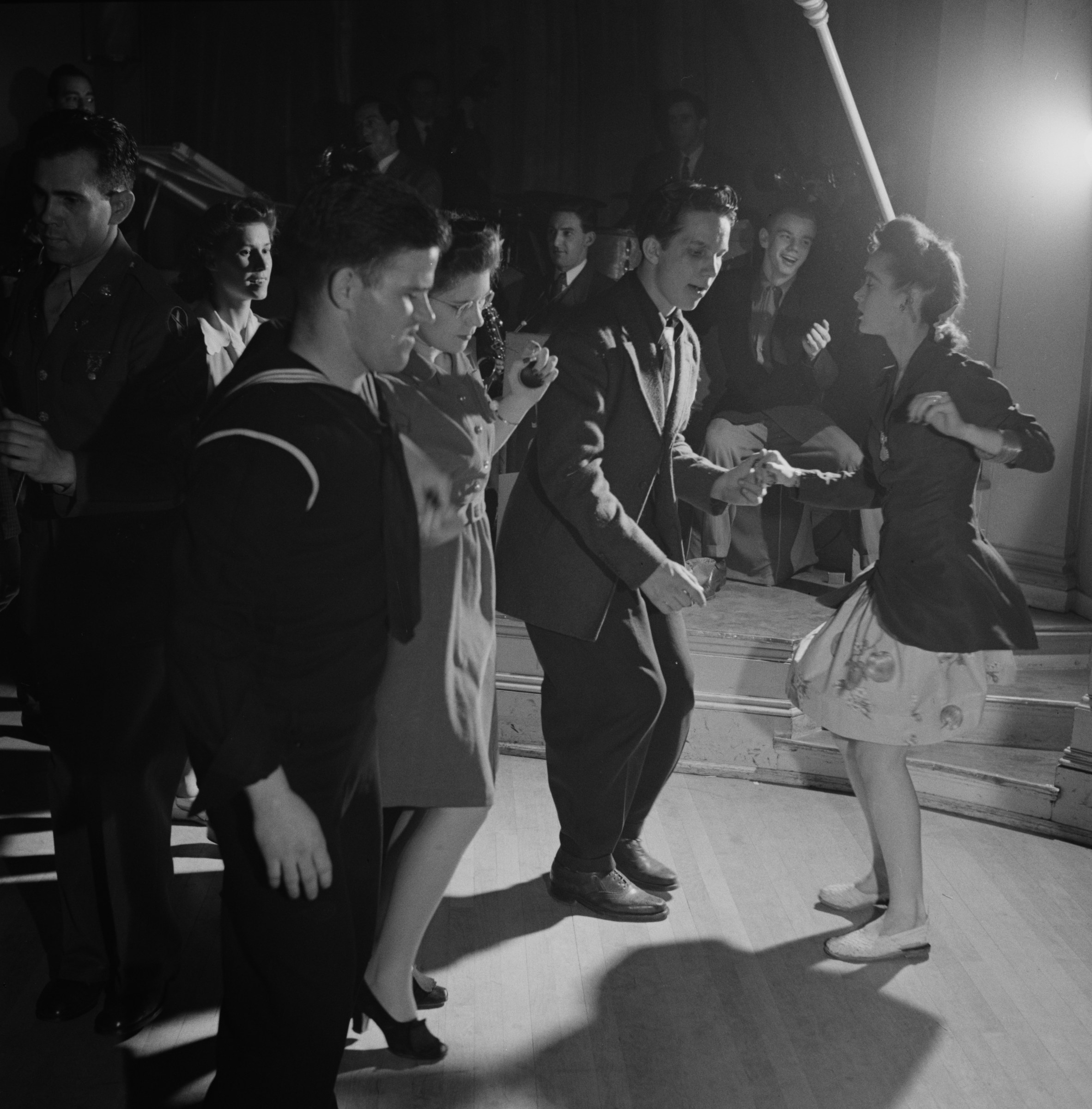
This image shows jitterbug as a lived social practice, not as a theatrical performance or instructional demonstration. It documents the relationship between dance, wartime social life, music, and gender dynamics at a specific historical moment. For historians of American dance and culture, it is evidence of the form's prevalence and the public anxiety it provoked.
What you are looking at
A crowded dance floor captured in dramatic black-and-white photography, with bright spotlighting creating strong shadows and high contrast. A mixed group of dancers fills the frame—men in suits and military uniforms, women in day dresses and skirts—arranged in loose pairs and clusters across a wooden floor. The nearest couple dominates the foreground: a man in a dark suit and a woman in a light-colored dress with a full skirt caught mid-spin, her body angled away from her partner. Behind them, other couples are visible at various stages of movement, some with arms raised, others in tighter frames. The composition emphasizes the energy and informality of the gathering; the dancers are shoulder-to-shoulder, creating a sense of social intimacy and spontaneous fun. A tall light stand rises from the upper right, evidence of documentary photography at work.
The dancing
The dancers are in open and semi-closed positions typical of swing dancing, with bodies rotated and weight shifted onto one leg. The woman in the foreground has her arm extended and torso twisted in a classic swing turn, her skirt flaring as evidence of the centrifugal force of the movement. Partners maintain loose hand contact rather than ballroom closed holds. The men's postures show the characteristic lean and spring action of swing lead; the women's responses include quick weight transfers and twists that suggest practiced engagement with the form. The density of figures and overlapping sightlines make precise footwork impossible to assess, but the arrested moment captures the flight and momentum characteristic of the style.
The dance depicted
This is jitterbug—the energetic, improvisational swing dance that dominated American social dancing in the 1940s. The original photograph caption explicitly identifies it as 'Jitterbugs at an Elk's Club dance,' and the visual evidence—the open positions, the woman's airborne turn, the men's dynamic lead postures, the informal social setting—confirms this. Jitterbug was danced to hot jazz and swing music in ballrooms, dance halls, and servicemen's clubs during the World War II era. The photograph captures not a staged performance but a genuine social dance event, with ordinary dancers of mixed ages and backgrounds. The caption's parenthetical remark that this was 'the cleanest dance in town' reflects the period moral panic about swing dancing, which some conservative observers condemned as sexually suggestive or unrefined.
How it was made
This is a black-and-white photograph, likely taken with available light supplemented by a portable spotlight visible in the frame. The high contrast and dramatic shadows are products of flash or flood lighting used in documentary photography of the 1940s. The photographer has frozen a fraction of a second of continuous motion, using the camera's shutter speed to arrest the swing movement at a moment of maximum extension—the woman's turn. The technical choice to light the dance floor from above creates a staged quality despite the documentary intention, making individual bodies legible within the crowd. This is professional documentary photography, the kind produced for publication in newspapers or magazines.
About this work
This is a photograph of American jitterbug dancers taken by Esther Bubley in April 1943 at an Elk's Club social dance in Washington, D.C. It documents the swing dancing that defined American popular culture during the Second World War—a moment when jitterbug was contested cultural terrain, celebrated by young dancers and musicians but viewed with suspicion by moral authorities who saw it as uncontrolled, sexualized, or lowbrow. The photograph captures the dance not as technique to be admired but as social pleasure: ordinary people moving together in a crowded room, lit by flash, caught mid-turn. It is a primary historical record of how the dance was actually performed in its moment of greatest popularity.
How to look at it
Watch the woman's body in the foreground: the angle of her torso, the extension of her arm, the lift and spread of her skirt all tell the story of a swing-out or similar turn executed with momentum and control. The photographer has frozen the moment at the apex of the movement, when the dancer is most extended and the viewer can most clearly see the dynamic geometry of swing. Notice how the crowd behind creates a sense of the dance as a social event rather than a performance—people are dancing for themselves and their partners, not for an audience. The harsh lighting and shadows are not artistic choice in the modern sense but practical documentary necessity, yet they intensify the sense of drama and energy in the scene.
The artist
Esther Bubley (1921–1998) was a documentary photographer who worked extensively for the U.S. Farm Security Administration and the Office of War Information during the 1940s. Her practice centered on American social life, vernacular culture, and ordinary people in everyday settings. She was trained to see and record cultural practice as it happened, without staging or heavy intervention. Her photographs of wartime Washington, D.C., including this dance image, are part of the FSA-OWI collection held by the Library of Congress and represent a crucial documentary archive of American life during this period.
The period
Jitterbug emerged in the 1930s from African American swing culture and became the dominant social dance of the 1940s, particularly among servicemen and young people. During World War II, swing dancing and jitterbug became a flashpoint in cultural debate: advocates celebrated it as energetic, modern, and democratic, while conservative critics condemned it as dangerous to social order and sexual morality. The dance was everywhere—in dance halls, on military bases, at USO clubs, and at social venues like the Elk's Club. Documentary photographers and journalists of the 1940s were intensely interested in recording American wartime culture, and images of swing dancing became visual shorthand for youthful vitality and social change. The photograph belongs to the same documentary moment that produced images of the home front, industrial production, and military life.
Where it lives
This photograph is held by the Library of Congress, Prints & Photographs Division, as part of the FSA-OWI (Farm Security Administration–Office of War Information) Collection. It was first published in April 1943, likely in a newspaper or periodical. The collection is a public archive of American documentary photography from the 1930s–1940s.
Dance in this work
Questions about this work
What is the 'Elk's Club' mentioned in the caption?
The Elks Club (Benevolent and Protective Order of the Elks) is a fraternal social organization with local lodges throughout the United States. These lodges operated dance halls and social venues. The Elk's Club dance was a community social event, not an exclusive or formal occasion, making it a typical venue for social swing dancing during the 1940s.
Why did the photographer note this was 'the cleanest dance in town'?
The phrase reflects period debates about swing dancing and jitterbug. Conservative critics condemned the style as sexually suggestive and morally questionable. By calling the Elk's Club dance 'the cleanest,' the caption defends it—suggesting that despite the energetic, uninhibited movement, this particular event was respectable and wholesome. It is evidence of how contested the dance was culturally.
Is jitterbug the same as lindy hop?
Jitterbug and lindy hop are related but not identical. Lindy hop is a specific, technically refined form of swing dancing with a distinct eight-count pattern and aerial tricks. Jitterbug is a broader, more informal term for energetic swing dancing, particularly among servicemen and dancers in social venues. What Bubley photographed is jitterbug—vigorous, improvisational, social swing dance, not the codified lindy hop of competition or performance.
How can you tell this is jitterbug and not another form of swing?
The photograph's own caption identifies it as jitterbug. Visually, the open positions, the dynamic turns, the loose hand contact, and the woman's airborne quality in the turn are all consistent with jitterbug as it was danced socially in the 1940s. The setting—a social dance hall rather than a performance stage—and the informal dress also support this identification.
More dance artwork





