49 works in this view — arrow keys or swipe to move between them.
Dance in Art
Tang dancer
Unknown authorUnknown author
- Source:
- Wikimedia Commons
- Rights:
- Public domain — free to use, share and adapt.
- Recorded as:
- public_domain
This is a direct record of professional court dance practice from the 7th–10th century, one of the earliest surviving visual documents of Asian dance technique. It challenges narratives of European dance history as primary and shows a sophisticated, virtuosic dance tradition in its prime.
What you are looking at
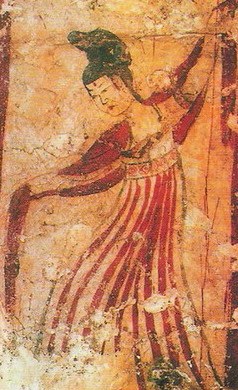
A single female figure dominates this faded fresco-like composition, depicted mid-movement against a warm ochre ground with geometric linear divisions suggesting architectural framing. She wears a fitted upper garment and a voluminous skirt with pronounced vertical pleating or fluting, rendered in deep red-orange tones. Her head is tilted back with an expression of animation or abandon, her dark hair styled in an elaborate upswept arrangement. Her arms are raised and extended, the right arm bent at the elbow with the hand raised near her head, the left arm extended more fully. The pose conveys dynamic motion—this is a moment of rotation or spiral, captured mid-turn. The entire image has the weathered, ochre-toned appearance of an ancient wall painting, with visible surface damage and loss throughout.
The dancing
A single dancer with raised arms, elbows slightly bent, executing what appears to be a rotational movement or twirl. Her weight appears shifted, weight forward through the torso with an elegant backward head tilt suggesting a moment of spin or pivot. The raised-arm frame is open and expansive rather than closed, with the arms elevated but not rigidly straight. The pleated skirt would respond dynamically to such rotation, fanning outward. The posture conveys suppleness, control, and a moment of deliberate theatrical display rather than casual movement.
The dance depicted
This appears to document a courtly or entertainment dance of the Tang Dynasty (618–907 CE), likely a female solo performer of the type depicted in contemporaneous sculpture and tomb art. The raised-arm frame, rotational posture, and elaborate pleated skirt costume are consistent with the court dances recorded in Tang sources and tomb figurines—particularly the so-called 'hu ji' (whirling dances) that incorporated spinning and turning movements with expressive upper-body gestures. The backward-tilted head and extended arms suggest a moment of virtuoso turning, central to these dances. Without written documentation of the specific dance form alongside the image, the identification rests on costume typology and movement vocabulary visible in the archaeological record.
How it was made
This is a mural fragment, likely a portion of a larger tomb or temple wall painting from the Tang Dynasty period, executed in pigment on plaster. The technique is fresco or fresco-secco: pigments applied to prepared plaster, allowing pigmentation to bond chemically with the surface. The warm ochre tonality and visible losses and surface degradation are consistent with earthen pigments (ochres, reds) that have survived over more than a millennium. The preservation suggests long burial in a sealed context such as a tomb, which is typical for Tang Dynasty dance documentation—performers and performances were recorded in elite funerary art to ensure continuation in the afterlife.
About this work
This fresco fragment documents a female court dancer of the Tang Dynasty, one of the great flourishing periods for dance in Chinese history. The figure captures a moment of rotational movement—a turn or whirl—with arms raised in the open, expressive frame characteristic of Tang courtly entertainment dances. The elaborate pleated skirt, upswept hairstyle, and dynamic posture identify her as a professional or elite performer, likely recorded in a tomb or temple context. The work belongs to a body of visual documentation that is among our oldest evidence for Chinese court dance practice and technique.
Tang Dynasty murals depicting dancers are rare surviving documents. Most of our knowledge of these dances comes from tomb figurines and brief textual references; this fresco offers direct evidence of movement, costume, and the moment-by-moment choices dancers made in performance. It is one of only a handful of such large-scale painted records and reveals a sophisticated dance vocabulary emphasizing turns, raised-arm frames, and expressive upper-body control—a far cry from Western assumptions about early Asian dance as primarily stationary or symmetrical.
How to look at it
Attend to the moment the artist chose: not the beginning or end of the turn, but the middle—the point of greatest torsion and dynamic energy. The backward tilt of the head is crucial; it is not incidental but rather the counterweight and expressive core of the movement, indicating the dancer's awareness of the spectator and the theatrical intention of the pose. Notice how the raised arms are not symmetrical or static, but appear caught in the act of adjusting balance during rotation. The pleated skirt, hanging from the hips, would naturally splay and rise as the dancer spins; the artist has understood this and rendered it as active drapery rather than decorative geometry.
The period
The Tang Dynasty (618–907 CE) was a golden age for dance in China, when court entertainment reached extraordinary sophistication and foreign—particularly Central Asian—dance styles were adopted, adapted, and synthesized with indigenous traditions. Court orchestras and dance ensembles were enormous; emperors sponsored competitions and commissioned performances. Dances were categorized formally (like 'hu ji,' whirling dances of Central Asian origin, and 'jiao di,' Chinese courtly dances), and professional male and female dancers held positions of influence and artistic prestige. This period coincided with the flourishing of tomb figurines depicting musicians and dancers, and with the creation of elaborate murals in elite tombs, designed to continue pleasures in the afterlife. By the 8th and 9th centuries, Tang dance vocabulary had exerted enormous influence across East Asia, including on Korean and Japanese court dance.
In art, Tang Dynasty painting was naturalistic and dynamically composed, with attention to the human figure in movement. The surviving record—tomb figurines, murals, and textual references—suggests that dance was understood as a subject worthy of careful representation, not mere decoration. This fresco sits within a visual tradition of documenting performance as a record of elite cultural achievement.
Where it lives
The work is held in a public collection or archive (source listed as Wikimedia Commons). It is a fragment of a larger mural composition, typical of Tang Dynasty tomb or temple decoration. The precise tomb, temple, or archaeological context is not recorded in the catalogue.
Dance in this work
Questions about this work
What dance is this?
The specific dance form cannot be named with certainty from the image alone. However, the raised-arm frame, rotational posture, and elaborate costume are consistent with Tang Dynasty court dances known as 'hu ji' (Central Asian whirling dances) or similar courtly solo forms. The image documents movement vocabulary—turning, raised arms, expressive upper-body work—but without accompanying text or broader context, precise identification remains uncertain.
Why is the image so faded and damaged?
This is a wall painting from the Tang Dynasty (618–907 CE)—over 1,300 years old. It survives because it was sealed in a tomb, protecting it from weathering and light. However, pigments have faded over time, and plaster has flaked and cracked due to shifting soil, moisture, and the fragility of ancient materials. The warm ochre tones and visible losses are characteristic of Tang Dynasty murals in their current state.
How do we know this was a professional dancer?
The elaborate costume—the fitted upper garment and voluminous pleated skirt in expensive dyed fabric—along with the upswept hairstyle and the virtuosic pose indicate an elite or professional performer. Commoners would not have been depicted in tombs in this level of detail, nor would they have worn such costly garments. The care taken in depicting her movement and dress marks her as a person of artistic status.
What was Tang Dynasty dance like?
Tang court dance was highly sophisticated, influenced by Central Asian, Indian, and indigenous Chinese traditions. Dancers trained extensively and held prestigious positions. Dances emphasized turning, lifted arm frames, expressive upper-body work, and virtuosic footwork. Both male and female professional dancers performed solo and in ensembles. Many dances were narrative or dramatic, and costume was elaborate and formal.
More dance artwork





