49 works in this view — arrow keys or swipe to move between them.
Dance in Art
Tang Painting (9833564964)
Gary Todd from Xinzheng, China
- Source:
- Wikimedia Commons
- Rights:
- Public domain — free to use, share and adapt.
- Recorded as:
- cc0
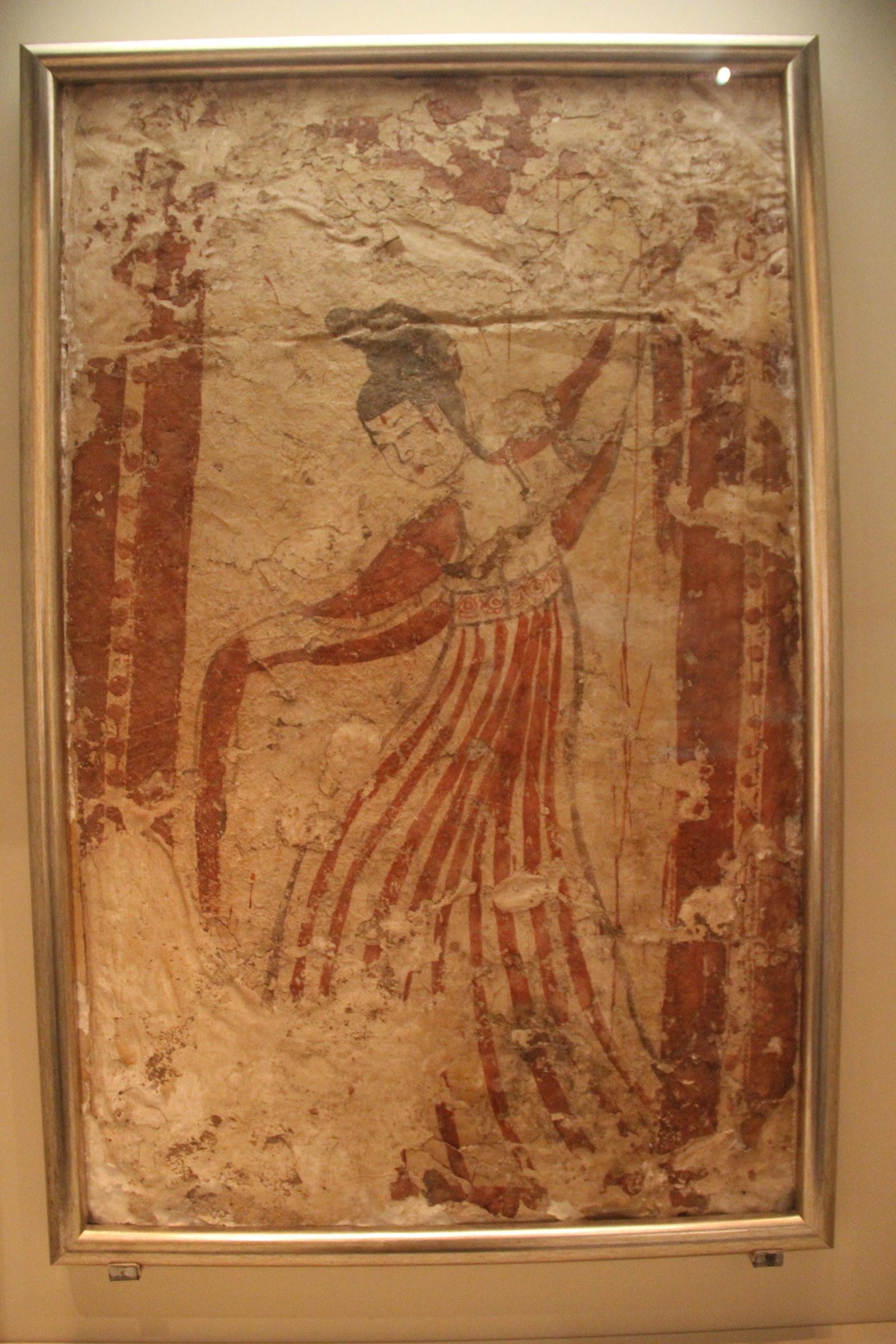
Surviving images of pre-modern Asian dance are rare and fragmentary; this fresco is among the few direct records of Tang court dance in the moment of performance. It shows that staff or wand work, fluid arm movement, and tailored skirts were central to elite Chinese dance as early as the 7th century—a direct visual counterpoint to surviving literary descriptions and a foundation for understanding later traditions.
What you are looking at
A female dancer stands in a shallow interior space defined by vertical architectural elements—columns or pilasters rendered in ochre and rust tones. She wears a pleated skirt that falls in vertical ribbed folds to her ankles, a fitted bodice, and an ornamental belt. Her pose is animated: the torso twists, one arm extends forward with a long staff or implement, the other rises. Her head tilts back. The palette is entirely warm—terracotta, cream, ochre—with the frescoed surface itself fragmentary, showing the characteristic cracks and losses of ancient wall painting. Small figures appear in the background, partially effaced. The composition freezes a moment of solo performance or demonstration within what appears to be an interior court or ceremonial space.
The dancing
A single female figure dominates; her frame is upright but mobile, with clear torsional articulation between shoulders and hips. The extended forward arm and raised opposite arm suggest either a staff-based movement or an asymmetrical arm pattern. The position of the legs is not fully legible due to the skirt's drape, but the weight appears distributed and the posture energized rather than static. No partner is visible; this is a solo act. The figure's elongated proportions and refined posture suggest trained, courtly movement rather than vernacular gesture.
The dance depicted
This appears to document Tang Dynasty court dance or entertainment, consistent with the stated date of 658 CE and Xi'an provenance. The staff or wand in the dancer's hand suggests either a prop dance (a recognized form in Chinese court tradition) or a musical/rhythmic implement. The formal interior setting, refined dress, and solitary performance context all point to elite court entertainment rather than folk or ritual dance. The specific style of movement—the torsion, the asymmetrical arm use—echoes descriptions of Tang court dance as fluid, complex, and heavily gestural, though the image alone cannot isolate a named repertoire.
How it was made
This is a fresco or wall painting, executed directly on plaster in a limited warm palette characteristic of Tang tomb and domestic decoration. The artist worked wet, placing pigment into prepared plaster; the technique required speed and confidence, permitting little revision. The fragmentary state—visible cracks, pigment loss, exposed plaster—is consistent with age and burial. Fresco was the dominant technique for large-scale figural art in this period and region, accessible to imperial and aristocratic patrons. The style and condition suggest this is a photograph of an excavated archaeological artifact rather than a modern artwork, despite the 2011 date in the catalogue.
About this work
This work documents a moment of elite dance performance in 7th-century China, preserved in the durable medium of wall painting. It shows a solo female dancer in a formal interior, holding a staff or wand, dressed in courtly fashion with a distinctive pleated skirt. The image is fragmentary and damaged, as expected for an ancient fresco; the photograph itself dates to 2011, but the artwork it records is approximately 1,350 years old. For historians of Asian dance and of courtly performance, this work is primary evidence: it shows how Tang dancers stood, how they held implements, how their costume functioned in movement, and what the aesthetic of elite court dance emphasized—fluidity, torsional articulation, asymmetry, and poise.
How to look at it
Attend to the dancer's posture and the direction of her gaze and gestures: the backward tilt of the head, the forward extension of the staff, and the twist of the torso all suggest a moment mid-movement, not a static pose. Note the vertical pleats of the skirt—they are not merely decorative but functional, permitting the range of hip and leg movement visible here. The architectural frame—the columns flanking the figure—suggests an interior court or pavilion, reinforcing that this is elite, not folk, performance. The fragmentary surface itself is part of the work's meaning: we are looking at evidence, not at a finished artwork meant for easy viewing.
The artist
The fresco is anonymous, as was typical for decorative and functional art in imperial and aristocratic contexts in Tang China. It was executed by a professional workshop, likely attached to a court, noble household, or elite tomb. The artist's skill is evident in the confident line work, the coherent spatial composition despite the shallow architectural frame, and the naturalistic rendering of the human figure in motion. Such artists were valued craftspeople but rarely named or documented individually.
The period
The Tang Dynasty (618–907 CE) was a period of extraordinary cultural flourishing in which dance, music, and spectacle were central to court life and imperial pageantry. Documentary sources from the period describe an elaborate repertoire of court dances, some inherited from earlier dynasties, others newly composed. Female dancers—both slave and free—performed regularly for the emperor and nobility. The visual arts of the period, particularly figural painting in tombs and palaces, reflect this cultural investment; dancers appear frequently in surviving murals, often in domestic or ceremonial settings. This fresco belongs to a large body of Tang decorative art that gives us otherwise inaccessible detail about costume, posture, and performance context.
Where it lives
The fresco is held in the National Museum of China as part of the permanent exhibition 'China through the Ages.' It was excavated from a Tang-period tomb in Xi'an and has been documented and conserved as a museum object. The photograph was made by Gary Todd, a photographer who has documented museum collections in Xinzheng and Xi'an and contributed images to Wikimedia Commons for public research use.
Dance in this work
Questions about this work
Is this a painting or an archaeological artifact?
It is an archaeological artifact—a wall fresco from a Tang Dynasty tomb—that has been photographed by a modern documentarian. The artwork itself dates to circa 658 CE; the photograph dates to 2011. What you are seeing is evidence of ancient dance, captured in a durable medium and preserved through burial, now recorded in digital form.
What is the dancer holding?
The implement in the dancer's hand appears to be a staff or wand, likely used as a prop or rhythm instrument in court performance. Prop dances using staffs, ribbons, and other objects are documented in Tang sources and appear in other surviving murals of the period. Its exact function is not specified in available records.
How do we know this depicts dance and not just a standing figure?
The pose itself—the torsion of the torso, the extended arm, the raised opposite arm, the backward tilt of the head—reads as mid-movement, not static stance. The fresco comes from a tomb decorated with scenes of courtly life and entertainment, a context in which dance was regularly depicted. The refined costume and interior setting also support a performance interpretation.
Could this be from a later period, not 658 CE?
The fresco style, pigment, and iconography are consistent with 7th-century Tang work, and the tomb context and excavation documentation support the dating. However, without access to the original artifact and its full archaeological record, absolute certainty is not possible. The date should be treated as the best available evidence.
More dance artwork





