49 works in this view — arrow keys or swipe to move between them.
Dance in Art
Korean dance-Mugo-01
Unknown court painters
- Source:
- Wikimedia Commons
- Rights:
- Public domain — free to use, share and adapt.
- Recorded as:
- public_domain
Mugo is one of the few Korean court dances to survive into the modern era, and visual documentation from the late Joseon or early modern period is rare. This painting is evidence of how the form was taught, remembered, and valued in a royal context—not as entertainment or spectacle but as synchronized, drum-centered ritual. For anyone studying Korean dance history, East Asian court music traditions, or the relationship between visual documentation and the preservation of performance practice, this work is primary source material.
What you are looking at
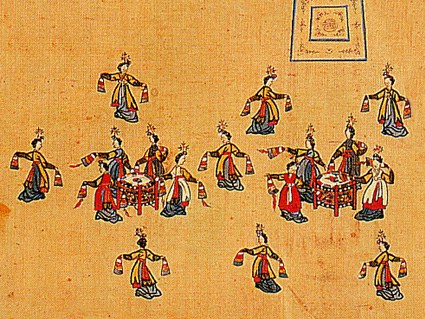
A gold-ground composition depicting a formal court dance gathering arranged in a loose, symmetrical pattern across the picture plane. At the center stand two groups of figures in elaborate red silk robes with blue-and-gold patterned upper garments, their postures suggesting musical accompaniment or ritual formality. Surrounding them in a scattered formation are individual dancers wearing similar court dress, each holding what appears to be a large barrel drum positioned horizontally before the body. The figures are rendered in profile or three-quarter view, their bodies erect and formal, arms extended or positioned to engage with the drums. The composition has the character of a formal court record: every figure is legible, positioned with deliberate spacing, and rendered in the bright mineral pigments typical of late Joseon court painting. The gold background is unmodulated, creating a timeless, ceremonial space rather than a naturalistic setting.
The dancing
The dancers adopt a remarkably uniform posture throughout: standing upright with the barrel drum (mugo) held at waist height, the body squared to the viewer, the arms positioned to strike or support the instrument. There is no dynamic lean, no bent knee, no suggestion of weight shift—the stance is formal and static, more ceremonial than kinetic. The grouped figures at center may indicate a moment of unified rhythm or a pause between sequences. The consistency of posture across all twenty or more dancers suggests this is a synchronized court performance rather than an improvised or virtuosic display, and the artist has prioritized legibility and order over the illusion of movement.
The dance depicted
This is mugo (무고), the Korean court drum dance, documented here in what the catalogue identifies as a record of a royal feast during King Gojong's reign (likely late 19th century, though dated 1902 here). Mugo is a processional or stationary performance art in which dancers, usually men, manipulate and strike large standing drums in rhythmic patterns while maintaining formal court bearing. The dress—red silk robes, blue-and-gold patterned upper garments, and formal headgear—marks these as court musicians or ritual performers of high status. The uniform distribution of figures and the emphasis on the drum itself over individual virtuosity tells us that mugo valued collective rhythm, formal propriety, and the integration of music-making with courtly display over solo expressiveness.
How it was made
This appears to be a gouache or mineral pigment on paper or silk, characteristic of late Joseon court painting. The technique is essentially graphic—flat color fields with dark outline, minimal modeling or atmospheric perspective, and a gold ground that flattens space and asserts the work's ceremonial rather than naturalistic intent. This method of painting was well suited to official court documentation: it could reproduce the exact dress, regalia, and arrangement of performers with clarity and precision, making it a reliable record as well as an artwork. The work's origin in a court context (implied by the title's reference to 'Gojong Imjin Jinyeon Dobyeong'—a painted screen for a royal feast) suggests it was made for royal archives or display within the palace, not for commercial circulation.
About this work
This painting documents mugo, the formal Korean court drum dance, as it was performed at a royal banquet during King Gojong's reign. It is not a single frozen moment but a systematic record of the dance's structure: twenty or more dancers arranged in a formal, symmetrical composition, each holding a barrel drum and maintaining the upright, controlled posture that characterized the form. The painting prioritizes clarity and documentation over dynamic movement—it shows us what mugo looked like, how many dancers participated, what they wore, and how they related to the instrument and to one another. For historians and dancers, it is visual testimony to a court dance practice that combined music-making, processional order, and formal ritual in a single performance. The work belongs in a dance archive because it is among the oldest visual records of a named Korean court dance form, and because it captures not just the aesthetic but the ceremonial and structural logic of the tradition.
How to look at it
Attend to the repetition and symmetry: the artist has chosen to show mugo not as a moment of dynamic action but as a formal arrangement. Notice how every figure echoes every other—the same drum height, the same body angle, the same relationship to the ground. This is not naturalism but diagrammatic clarity: the painting is telling you that mugo is an ordered, collective practice in which the individual dancer serves a larger rhythmic or ceremonial function. Look at the centered group: these may be the lead performers or the moment of unified strike. The gold ground signals that this is not a everyday scene but a timeless, ceremonial record—the space of the court itself.
The artist
The work is attributed to unknown court painters (複數), which is typical of official Korean court painting of the period. Such works were often collaborative products of the royal painting bureau (도화서), made to official specification for record-keeping rather than signed as individual artistic statements. The style—the precise rendering of dress and regalia, the gold ground, the systematic arrangement—is consistent with the documentary and commemorative painting tradition of the late Joseon court.
The period
This painting dates to a transitional moment in Korean history: King Gojong's reign (1863–1907) coincided with Korea's opening to foreign contact, modernization pressures, and ultimately Japanese colonization. Court rituals and performances were being actively documented and preserved during this period, partly as a response to rapid change. Mugo itself is believed to have originated in the 15th century and was performed at state occasions and festivals throughout the Joseon period. By the late 19th century, court dances were becoming antiquarian subjects—preserved, recorded, and celebrated partly because their world was changing. This painting is thus both a living record of contemporary court practice and an early act of cultural preservation.
Where it lives
The work is identified in the catalogue as part of 'Gojong Imjin Jinyeon Dobyeong' (고종 임진 진연 도병풍), a painted screen folder recording a royal court feast during King Gojong's reign. The source is listed as Wikimedia Commons, and no holding collection is specified in the record. The title's reference to 'Imjin year' (1902) suggests this documentation was made shortly after the event, or that 'Imjin' may refer to the lunar calendar date rather than the Western year.
Dance in this work
Questions about this work
What is mugo and why is it important to Korean dance?
Mugo is a court drum dance that dates to at least the 15th century and was performed at royal feasts, festivals, and state occasions throughout the Joseon dynasty and beyond. It combines synchronized drumming with formal, processional movement, and represents one of the few Korean court dances to survive into modern times. This painting is one of the earliest visual records of the form in action, showing how it was structured, dressed, and valued in a royal context.
How many dancers performed mugo?
This painting shows approximately twenty dancers, though the number may have varied depending on the occasion. What matters here is that mugo is inherently a group form—the individual dancer's role is to contribute to a larger synchronized rhythm rather than to display individual virtuosity. The repetitive arrangement in the painting emphasizes this collective character.
What are the drums the dancers are holding?
These are large barrel drums called mugo (무고), which give the dance its name. The drums appear to be held upright at waist height and struck with beaters or hands. The integration of music-making and dance movement—where the dancer and musician are one person—is central to mugo's structure and meaning.
Why was this painting made and what was it used for?
This is a court documentary painting, made to record an official royal feast and its performances. Such works were part of the royal archive and served both commemorative and administrative functions—they were records of what happened, how the court dressed, and how ceremonies were conducted. In this case, the painting is also evidence that mugo was considered important enough to document and preserve in a formal, official context.
More dance artwork





