49 works in this view — arrow keys or swipe to move between them.
Dance in Art
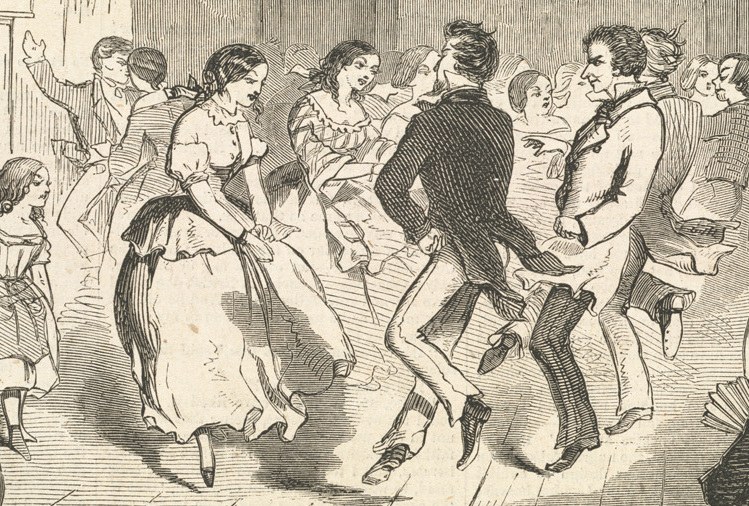
The dance after the husking (cropped)
BPL
- Source:
- Wikimedia Commons
- Rights:
- Public domain — free to use, share and adapt.
- Recorded as:
- public_domain
This image is one of the few detailed visual records of American folk dancing in the 19th century, documenting a specific tradition (the husking dance) that would otherwise be known only through fragmented written references. It shows a dance form driven by community participation and courtship rather than professional performance, preserving details of dress, grouping, and movement quality that illuminate how ordinary people understood dance as social practice. For artists, Homer's solution to depicting rapid movement through line and composition—the swirling skirts, the dynamic angles, the sense of contagious motion—represents a sophisticated approach to visualizing dance.
What you are looking at
A wood engraving capturing a boisterous social gathering, likely rural American, centered on a country dance. The scene is densely populated with figures in 19th-century dress: women in full skirts and fitted bodices, men in coats and trousers. In the foreground, a couple in the midst of energetic movement commands attention—the woman's skirt billows outward, caught mid-spin, while her partner leans into the dance with visible momentum. The composition swarms with onlookers: some clapping, some conversing, children watching from the periphery. The setting appears to be indoors, suggested by the vertical hatching in the background that indicates walls. The overall mood is one of uninhibited celebration, with bodies at various angles suggesting the vigorous, improvisational quality of the moment.
The dancing
The central couple moves in what appears to be a swing or rotational figure—the man's body angles forward dynamically while the woman's weight is lifted and turned. Their hands are linked or nearly linked, and the woman's skirt creates a distinctive cone shape characteristic of rapid rotation. Surrounding dancers and spectators are scattered throughout the composition, some in conversational pairs, others in motion, creating a sense of ongoing activity rather than formal arrangement. The figures' postures—leaning, reaching, gesturing—convey spontaneous social interaction rather than trained positioning. No clear ballroom hold is visible; the movement appears looser and more vernacular.
The dance depicted
This depicts American country dancing, specifically the social form known as a husking dance—a rural gathering tradition, often held after corn harvesting, that combined work, courtship, and celebration. The title anchors this reading: 'The dance after the husking' refers to the social dance that followed the communal husking bee. The style shown is consistent with American folk-regional dance of the period: vigorous, partner-based, with rotational figures and full-bodied engagement. The dress and setting confirm a rural American context, likely mid-19th century. This was social dance rather than theatrical performance, danced by ordinary people in domestic or work-related settings.
How it was made
This is a wood engraving, a relief printing process that creates bold lines and strong tonal contrasts through parallel hatching. Wood engraving allowed fine detail and intricate linework while remaining economical to reproduce—crucial for mass circulation via periodicals. The artist (signed W.H., identified as Winslow Homer) worked in a linear, descriptive style well-suited to the medium, using close parallel lines to suggest shadow and fabric texture, especially visible in the women's skirts and the background. The technique's reliance on line over tone shapes how the movement is conveyed: through gesture, overlapping figures, and the dynamic diagonal lines of the bodies themselves rather than through modeling or color.
About this work
This wood engraving documents a moment of American rural social dancing in the mid-19th century, capturing the informal, high-energy atmosphere of a husking dance—the celebration that followed communal corn harvesting. Published in Harper's Weekly in 1858, it functioned as journalistic illustration, bringing scenes of American rural life to a broad urban readership. The work sits at the intersection of social documentation and artistic observation, showing how wood engraving could convey movement, spontaneity, and cultural specificity. For dance historians, it is valuable evidence of how ordinary Americans danced together outside theatrical contexts—the forms, energy, and social meanings of vernacular dance largely lost to written record.
How to look at it
Attend to the moment of rotation captured in the central couple: the woman's skirt forms a perfect cone, indicating the full velocity of a spin, while the man's body angle suggests the drive that propels it. This is not a posed moment but an arrested instant of kinetic energy. Notice also the formal constraint Homer worked within: the wood engraving's reliance on parallel lines means that movement is conveyed not through blur or distortion but through the integrity of the individual figures and their angles relative to one another. The surrounding spectators—clapping, watching, conversing—frame this moment as social rather than spectacular, a shared activity rather than a performance. The composition's crowding and overlapping figures convey the press of bodies in a room, the informality of domestic space, and the participatory nature of folk dance.
The artist
Winslow Homer (1836–1910) was one of the foremost American illustrators and painters of the 19th century. He began his career as a wood engraver and illustrator for Harper's Weekly during and after the Civil War, where he documented American life with directness and social sensitivity. His early work combined journalistic immediacy with careful observation of human gesture and social interaction. Homer later became known for his oil paintings of nature and maritime subjects, but his illustrated journalism established his reputation for capturing authentic American scenes—rural labor, social gathering, and domestic life—with both empathy and formal sophistication. This husking dance drawing is characteristic of his Harper's period: socially engaged, technically skilled, and attentive to the specificity of American regional culture.
The period
In 1858, when this engraving was published, American folk dance existed in a state of rapid transformation. Ballroom dancing—waltz, polka, quadrille—was spreading through urban and rural society, reshaping older forms of partner dancing. Yet rural husking dances and other work-related social dances remained vital in agricultural communities, still serving their historic functions of courtship and community bonding. In visual art, wood engraving was the dominant medium for periodical illustration; photography existed but was not yet practical for journalistic reproduction. Homer's generation of illustrators documented American life with unprecedented reach and frequency through such images, making wood-engraved periodical illustration the primary visual record of 19th-century social practice for most Americans.
Where it lives
The work is held in the Boston Public Library's Print Department, part of the Winslow Homer Collection. It is cataloged as a periodical illustration published in Harper's Weekly, Volume II, November 13, 1858, page 729. This context as mass-circulation journalism distinguishes its original function and audience from fine-art prints; it was made to inform and entertain a broad readership about American life, not to serve as a collector's object.
Dance in this work
Questions about this work
What is a husking dance?
A husking dance was a social gathering held after a communal corn husking—a necessary agricultural labor. The work was often made festive and competitive, and afterward, the gathered community (neighbors, family, young people seeking courtship) would dance together into the evening. These dances were thus tied to seasonal work, to courtship opportunity, and to community cohesion, and they represent a form of social dance distinct from ballroom dancing or theatrical performance.
Who was Winslow Homer?
Winslow Homer (1836–1910) was a major American artist who began as a wood engraver and illustrator for Harper's Weekly during the Civil War era. He is best known today for his later oil paintings of nature, hunting, and maritime subjects, but he was equally important as a social documentarian, using illustration to capture American life—labor, leisure, rural and urban scenes, and social interaction—with directness and formal sophistication.
How does a wood engraving convey movement?
Wood engraving relies on line rather than tone or color. Movement is suggested through the angle and overlap of figures, through the direction of hatching lines that follow form, and through the artist's choice of which instant to freeze. Here, Homer captures the woman at the apex of her spin, her skirt fully extended, which reads as movement to the viewer. The dynamic diagonals of the bodies and the surrounding gestures of onlookers amplify the sense of action.
Why is this image important for dance history?
Before film and photography, dance was largely invisible to the historical record—it existed in memory, description, and notation, but not in detailed visual documentation. Wood-engraved illustrations like this one are among the few reliable visual records of how ordinary people danced in the 19th century. This image preserves details of costume, grouping, movement quality, and social context that would otherwise be lost.
More dance artwork





