49 works in this view — arrow keys or swipe to move between them.
Dance in Art
Ballet Dancers title QS:P1476,en:"Ballet Dancers "label QS:Len,"Ballet Dancers "
Edgar Degas
- Source:
- Wikimedia Commons
- Rights:
- Public domain — free to use, share and adapt.
- Recorded as:
- public_domain
Degas's ballet paintings fundamentally changed how art represented dance by making the rehearsal and the training studio the equal of the stage performance. This image documents not an idealized or narrative moment but the actual physical discipline of classical ballet, providing a historical record of training methods and body culture in the late nineteenth century. For dancers and historians, it offers evidence of how ballet technique was practiced, taught, and understood in the professional context of the period.
What you are looking at
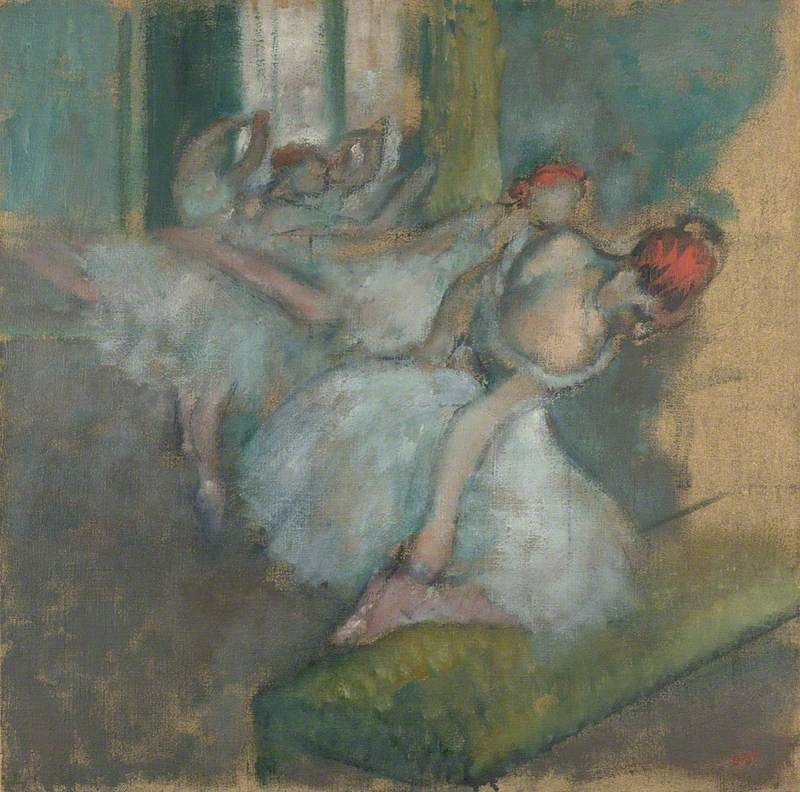
Three ballet dancers occupy a studio or rehearsal space defined by muted greens, grays, and warm ochres. The composition is intimate and informal—this is a moment of work rather than performance. The nearest dancer, wearing a pale blue tutu and pointe shoes, is captured mid-movement with her body angled away from the viewer, her left leg extended in a controlled line. Behind her, two more dancers in similar costumes are positioned at different depths, creating a sense of spatial recession. The light is soft and diffused, characteristic of interior studio conditions. Degas has rendered the figures with his characteristic impressionistic technique, using loose brushwork and layered color to suggest form and movement rather than define it precisely. The palette—cool blues and greens set against warm earth tones—creates an atmosphere of quiet concentration. There is no stage, no audience, no decoration: this is the dancer's working life stripped of theatrical artifice.
The dancing
All three dancers are en pointe, their bodies in various attitudes of extension and control. The foreground dancer demonstrates a turned-out line from hip to ankle, with her supporting leg engaged and her torso held upright with the characteristic ballet carriage. Her arms are held in a soft, preparatory position rather than in a formal pose—suggesting a moment between movements rather than a held position. The figures behind her echo these lines without duplicating them, creating a sense of sequential movement or a study of similar positions from different angles. The dancers occupy the same horizontal plane but are arranged to suggest depth through overlapping and size variation. Each figure demonstrates proper turnout and weight distribution, evidence of technical understanding on Degas's part.
The dance depicted
This is almost certainly a rehearsal scene of ballet training or choreography work, most likely from the Paris Opéra Ballet tradition that Degas documented obsessively throughout his career. The casual arrangement, the simple studio setting without theatrical props, and the informal quality of the poses all indicate this is not a finished choreographic phrase but rather a working moment—dancers holding positions, awaiting correction, or moving through a combination. The presence of multiple dancers in similar technical positions suggests instruction or group rehearsal. The dance style is unambiguously classical ballet, identifiable through the pointe work, the turned-out positions, the arm carriage, and the overall body alignment. This is not Romantic ballet with its emphasis on otherworldly extension and narrative pantomime, but rather the more grounded, technically rigorous classical training of the late nineteenth century.
How it was made
This is an oil painting on canvas (or possibly panel; the catalogue record does not specify). Degas's technique here is characteristically impressionistic—he builds form through color and loose brushwork rather than through line or precise detail. The paint is applied in layers, with thinner glazes of green and blue-gray creating atmospheric depth and the softer rendering of the background figures. His palette is restrained and naturalistic for an interior scene, avoiding the bright local colors that would dominate a theatrical representation. The technique allowed Degas to capture the fleeting quality of movement and the informal, unguarded moments of studio work. The impressionistic approach was suited to his subject: these dancers are not posed formally for portraiture but caught in the midst of their labor, and the broken brushwork and soft focus convey that spontaneity and the transience of the moment.
About this work
This is a ballet rehearsal scene by Edgar Degas, one of the artist's many studies of the Paris Opéra Ballet in the 1880s. Three dancers en pointe are arranged in a shallow studio space, their bodies demonstrating classical technique in the informal setting of work rather than performance. The painting exemplifies Degas's lifelong fascination with the behind-the-scenes reality of professional dance: not the glamour of the stage but the disciplined, repetitive labor of training and rehearsal. The work belongs to a large body of late nineteenth-century imagery that shifted artistic attention from the finished theatrical spectacle to the working body in its quotidian context. For Degas, the ballet studio was not merely subject matter but a space of formal investigation—the play of light on moving bodies, the geometry of turned-out limbs, the relationship between multiple figures in shallow space.
How to look at it
Attend to the relationship between the three dancers: they are neither arranged in a formal line nor in a narrative progression, but rather distributed across the space in a way that suggests ongoing work rather than a pose. Notice how Degas has frozen a moment in which the dancers are holding positions, awaiting a correction or a signal to continue—there is a quality of suspension here. Observe the soft, diffused lighting and the muted color palette: these are the conditions of an interior studio, not the dramatic lighting of a stage. The loose brushwork and the sense of forms emerging from color rather than line is characteristic of Degas's late style and conveys the transience of the moment being depicted.
The artist
Edgar Degas (1834–1917) was obsessed with the Paris Opéra Ballet from the 1860s onward, producing over a thousand drawings, pastels, and paintings of dancers. He had privileged access to the studios and rehearsals through his connections, and he used this access to create an intimate archive of ballet life. Unlike most artistic representations of dance, which emphasized narrative, spectacle, or ethereal fantasy, Degas focused on the body in motion and at rest, on the geometry of trained limbs, and on the unglamorous reality of professional work. His ballet paintings and pastels constitute one of the most sustained investigations of movement in art history, and they established conventions for depicting dance that persist today.
The period
The 1880s in Paris saw ballet transition from the Romantic era toward more technically rigorous classical training and choreography. The Paris Opéra Ballet was the center of this development, and dancers were becoming increasingly professionalized, with more demanding technical training. Degas's work documenting this transition is historically valuable because it shows not the finished aesthetic—the tutus, the pointe work, the ethereal lines—but the labor that produced it. In the broader context of visual art, Degas was part of the Impressionist movement's turn toward modern subjects and informal composition, though his approach to movement and his interest in the human body aligned him also with academic traditions of figure study.
Where it lives
The work is recorded as being in the collection of Wikimedia Commons, which suggests it is in a public collection (though the specific holding is not identified in the catalogue record). The source indicates it is accessible as a digital image; the original medium and location require further research.
Dance in this work
Questions about this work
How do I know this is a rehearsal and not a performance?
The setting gives it away: there is no stage, no scenery, no theatrical lighting, no audience. The space is a plain studio with muted walls. The dancers' poses are informal and varied rather than synchronized or narrative. Degas is showing us the working life of dancers, not the finished spectacle.
What style of ballet is this?
This is classical ballet training of the late nineteenth century, identifiable through the pointe work, the turned-out positions, and the body carriage. It is more technically austere than Romantic ballet, which emphasized ethereal fantasy. The dancers are demonstrating the physical discipline of classical training rather than performing a narrative or character role.
Why was Degas so interested in painting ballet?
Degas saw the ballet studio as a space of formal investigation: the interplay of light and form, the geometry of the moving body, the relationship between multiple figures in space. He also had access to the Paris Opéra Ballet and used that privilege to create an intimate archive of professional dance. For Degas, ballet was as much a subject of visual and kinetic inquiry as it was a social institution.
What does the painting tell us about how ballet was trained in the 1880s?
It shows dancers working en pointe in a simple studio setting, without elaborate apparatus or theatrical props. The focus is on the disciplined extension of the body and the maintenance of classical positions. The informal arrangement suggests that training involved sustained work on positions and technique rather than the running-through of choreographed sequences—work that was repetitive, demanding, and invisible to the public.
More dance artwork





