49 works in this view — arrow keys or swipe to move between them.
Dance in Art
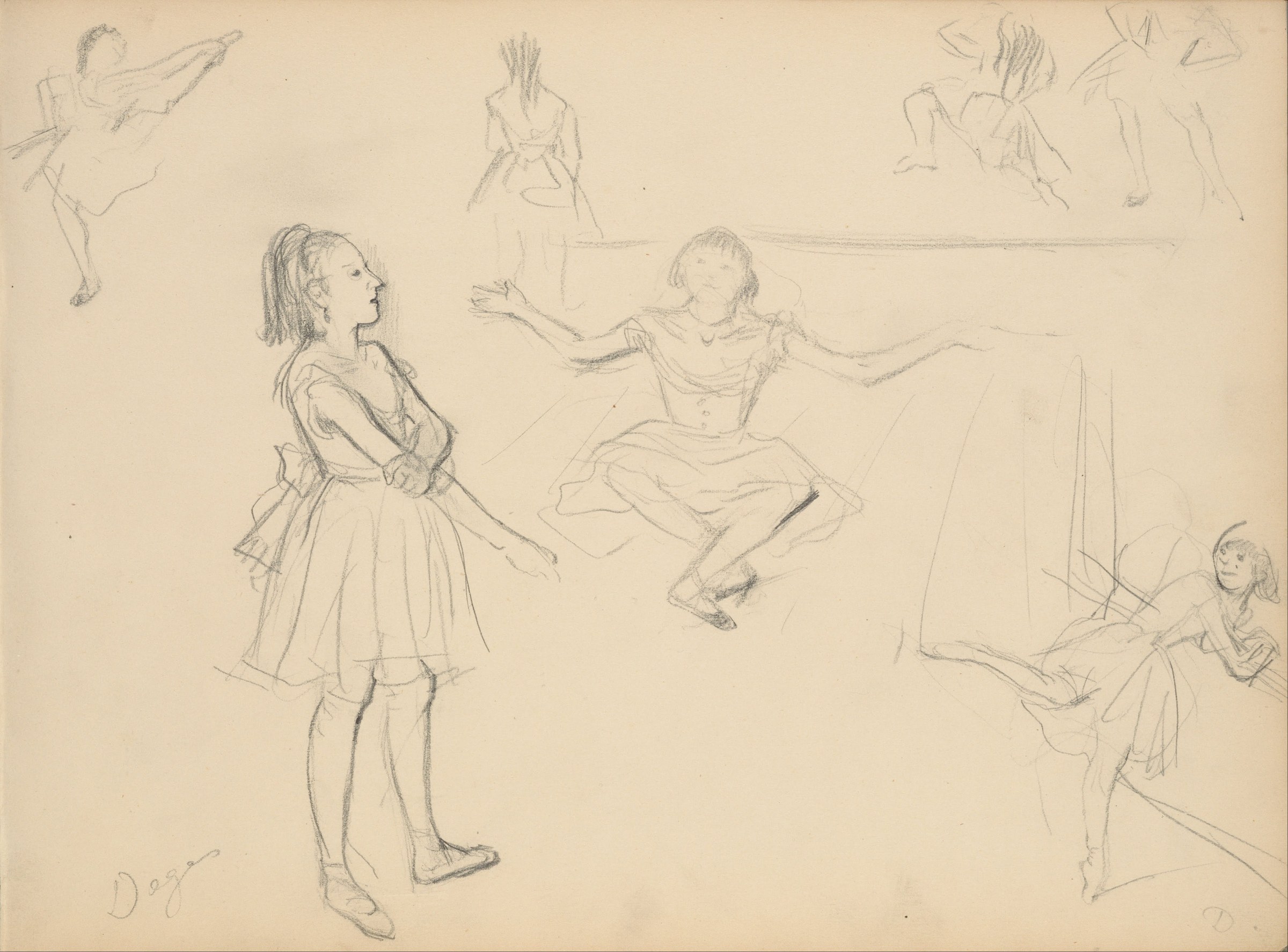
Ballet Dancers Rehearsingtitle QS:P1476,en:"Ballet Dancers Rehearsing"label QS:Len,"Ballet Dancers Rehearsing"
Edgar Degas
- Source:
- Wikimedia Commons
- Rights:
- Public domain — free to use, share and adapt.
- Recorded as:
- public_domain
This is a primary document of ballet pedagogy and practice in the nineteenth century, showing the studio rather than the stage. The rapid, unselfconscious sketches reveal how a trained observer understood the ballet body and captured its positions—what mattered to the artist, what details were essential, how movement was translated into form. For historians of dance, these are among the most direct records of how dancers actually trained and related to one another during rehearsal, unmediated by the conventions of performance or exhibition.
What you are looking at
This is a sheet of study sketches in pencil or graphite, apparently documenting a ballet rehearsal or class. The dominant figure is a young dancer in a simple dress with a full skirt, standing in profile at left-center, her posture upright and formal. She faces toward a second figure seated on what appears to be a low bench or stool, a young dancer in lighter clothing with arms extended in an open, gestural pose. Smaller, more lightly sketched figures occupy the upper margins and right edge of the sheet: one or two standing figures in the top center, at least two additional dancers rendered as rapid notations upper right and right side, and a partly erased or less finished figure lower right. The style is characteristic of working sketches made from life—economical, unselfconscious, with emphasis on posture and the relationship between bodies rather than detail. The paper is aged cream or tan. No setting is indicated; the focus is entirely on the dancers themselves and their positions in space.
The dancing
The principal figures show classical ballet training and studio decorum. The standing dancer at left presents the formal, elongated line typical of nineteenth-century ballet—head turned, body upright, arms at her sides with one hand visible; her weight appears settled and controlled. The seated dancer's extended arms and open frame suggest she is demonstrating or being corrected, a common moment in rehearsal. The sketches around the margins suggest rapid notational work, capturing multiple attempts at a single position or documenting different dancers' approaches to the same movement. No partnering or supported movement is shown; the emphasis is on individual carriage and arm placement.
The dance depicted
This is unquestionably a ballet study, most likely a rehearsal or class documentation. The formal dress, the studio postures, and the pedagogical framing—one figure apparently correcting or advising another—indicate theatrical ballet training in the mid-to-late nineteenth century. The absence of pointe shoes in the visible details and the relatively conservative poses suggest this may capture work in soft slippers during a rehearsal or correction session rather than performance technique. The rapid marginal sketches indicate the artist was collecting notes on multiple dancers or variations, a practice consistent with an artist documenting a live rehearsal in a ballet studio.
How it was made
Pencil or graphite on paper. The technique is that of a working sketchbook rather than a finished study: lines are economical and exploratory, with significant areas left blank or barely indicated. The seated figure is more fully rendered; the peripheral sketches are abbreviated almost to notation. This appears to be a sheet torn from a larger sketchbook or assembled from multiple drawing sessions, which accounts for the varying degrees of finish and the density of marks. The medium allowed rapid capture of transient poses and easy correction, essential for documenting movement in a live studio setting.
About this work
This is a documentary sketch of a ballet rehearsal, likely from a Paris studio in the 1870s. It records not a moment of performance but the pedagogical practices of classical ballet: the formal postures, the relationship between student and instructor or between dancers, the repetition and notation of positions. The sheet exemplifies the nineteenth-century artist's engagement with dance as a subject of study and visual interest—not the spectacle of the stage, but the daily work of technique and training. The informal, notebook character of the work makes it valuable as evidence of how dancers actually trained and how artists witnessed and recorded that training.
How to look at it
These sketches reward close attention to posture and position rather than dramatic action. The artist has frozen moments of stillness or held poses—not leaps or turns, but the foundational carriage and alignment that defined classical ballet training. Look at how the standing dancer's head and spine align, how the seated dancer's arms are held in relation to her torso, how economy of line suggests weight and balance. The marginal sketches show the artist working through variations—the same position or similar positions rendered multiple times as if testing the form. The viewer is witnessing not a performance but a conversation between artist and studio, between observation and notation.
The artist
Edgar Degas (1834–1917) was obsessed with dance, particularly ballet, from the 1860s until his death. He attended rehearsals and performances in Paris, frequently gaining access to backstage and studio spaces where few artists were permitted. Unlike his contemporaries, Degas was not interested in the idealized moment of performance but in the quotidian work of ballet: dancers stretching, waiting, being corrected, performing the unglamorous labor of training. His dance works span paintings, pastels, drawings, monotypes, and sculptures; this sketch sheet represents his most basic documentary mode—the private notation of form and posture observed directly. Degas's systematic study of ballet made him perhaps the first major artist to treat dance as a subject worthy of sustained, analytical attention.
The period
The 1870s saw the decline of Romantic ballet and the rise of a more technically demanding, secular ballet practice centered in Paris and Russia. The French tradition was codifying technique, developing new vocabulary, and making ballet training increasingly systematic and formalized. At the same time, Degas and other Impressionist painters were turning away from grand historical and mythological subjects toward modern subjects observed directly in contemporary Paris—theaters, racecourses, cafés, studios. Ballet, as both a site of modernity and a subject requiring sustained looking, became central to Degas's practice. His rehearsal sketches coincide with a moment when ballet was being rationalized and professionalized, and when artists were beginning to look at the body in motion as a subject of aesthetic and scientific interest.
Where it lives
The source record identifies this as a work by Degas from 1877, held in an unspecified collection and accessed via Wikimedia Commons. The sketch-sheet format and pencil medium suggest it was originally part of a larger sketchbook, either bound or later disbound. The age of the paper and the style are consistent with mid-to-late nineteenth-century materials.
Dance in this work
Questions about this work
Is this a finished artwork or a preliminary sketch?
It is a working sketch—a studio notation rather than a finished exhibition piece. The varying degrees of completion, the marginal studies, and the pencil medium all indicate this was made as a record of observation, not as a work intended for sale or display. For Degas, however, such sketches were foundational; they fed into his more elaborate paintings and pastels.
How do we know this depicts a rehearsal rather than a performance?
The setting is clearly indoors and informal; there are no stage lights, curtains, or audience. The postures are those of training and correction—one figure appears to be instructing the other. There is no scenery, costume, or theatrical apparatus. The subject is the everyday work of ballet, not the spectacle of performance.
What does this tell us about how ballet was taught in the 1870s?
The sketches show formal, upright carriage as fundamental; dancers held themselves with elongated spine and controlled arm placement even at rest. The apparent instructor-student relationship suggests direct correction and demonstration. The focus on individual posture rather than group formations indicates that technique and line were the primary concerns of training.
More dance artwork





