49 works in this view — arrow keys or swipe to move between them.
Dance in Art
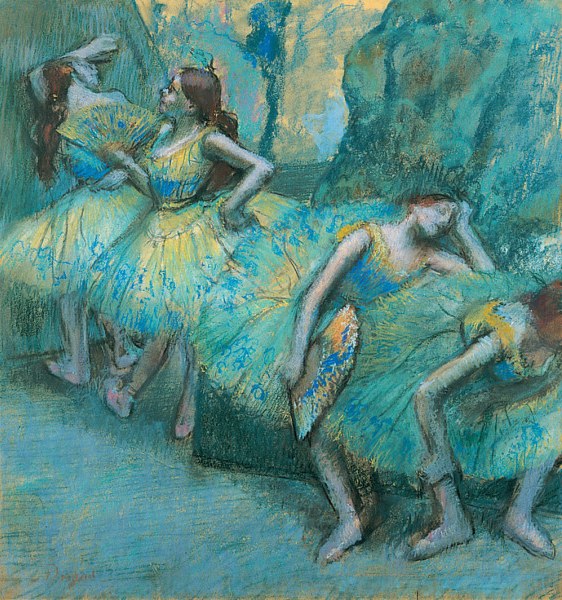
Edgar Degas - Ballet Dancers in the Wings
Edgar Degas
- Source:
- Wikimedia Commons
- Rights:
- Public domain — free to use, share and adapt.
- Recorded as:
- public_domain
Degas was the first major artist to treat the ballet studio as a subject worthy of serious aesthetic attention, and he did so across decades and hundreds of works. This study shows why: the rehearsal studio is where the grammar of movement is learned and invented, and it is more visually and emotionally complex than any stage spectacle. For dancers and historians, Degas's work is primary-source documentation of late-19th-century ballet practice and training.
What you are looking at
A studio or rehearsal space rendered in soft blues and greens, with four young ballet dancers in practice clothes and tutus. The composition captures a moment of instruction or informal choreography: two dancers in the middle distance engage in an exchange or lift, one wearing a pale yellow tutu and looking toward her partner, while a third dancer in a darker blue tutu bends forward in the left foreground, her posture suggesting attention or anticipation. A fourth figure sits or rests at the right edge. The palette is dominated by cool tones—turquoise, blue-green, and grey—with warm ochre and yellow accents in the tutus. The floor is sketched with directional marks suggesting movement or spatial depth. Degas has captured the dancers in an unglamorous moment, away from the stage lights, where the body is engaged in work rather than display.
The dancing
The dancer at left bends sharply forward from the hips, her weight on one leg, her torso parallel to the ground—a posture of attention or physical stretch. The pair in the center appear to be in close contact, one reaching or leaning toward the other with arm extended. The seated or resting figure at right has the relaxed posture of someone between efforts. The dancers' bodies show the articulation expected of trained ballet dancers: long lines, articulated limbs, and precise weight distribution. Degas renders them without the pointed elongation of academic nudes, showing actual bodies in actual effort.
The dance depicted
This is a rehearsal scene of professional ballet dancers, likely from the Paris Opéra where Degas had privileged access in the 1880s–1890s. The dancers wear the practice tutus and soft pointe shoes of the period. The composition suggests instruction or informal choreography-making rather than a formal performance—the moment is one of exchange and trial rather than the finished spectacle. The presence of multiple figures in different states of engagement suggests the rhythmic, social reality of the studio rather than a single dramatic event.
How it was made
This work is executed in pastel on paper, a medium Degas favored for his later ballet studies because it allowed rapid notation, translucent layering, and the soft atmospheric effects visible here. The handling is loose and gestural—the forms are suggested rather than meticulously defined, and the colors are built in layers so that earlier strokes show through. Pastel was also more portable than oil paint, allowing Degas to work in the studio environment itself. The technique conveys immediacy and the transience of the moment, appropriate to a subject that is itself ephemeral movement.
About this work
This is a pastel study from Degas's decades-long engagement with ballet—a practice that yielded over 1,500 works in various media. Unlike his finished paintings of performance, this work documents the rehearsal studio: the place where dance is made, not where it is consumed. The composition and technique show Degas's commitment to capturing the unstaged, unglamorous reality of dancers' bodies at work. This belongs in a gallery about dance because it expands what 'dance imagery' means beyond spectacle to include labor, instruction, and the quotidian moments that constitute a dancer's life.
How to look at it
Attend first to the postures: what is each body doing, and what does that tell you about the stage of learning or instruction? The sharp bend of the left figure suggests a stretch or a correction being demonstrated. Notice how Degas has framed the moment to include waiting and inattention alongside active movement—this is not a performance frozen at its climax, but a continuous, unspectacular process. The cool color palette and loose handling create an atmosphere of concentration rather than drama; you are watching work, not spectacle.
The artist
Edgar Degas (1834–1917) was a French painter and printmaker of the Impressionist circle who became obsessed with ballet after gaining access to the Paris Opéra in the 1870s. He drew and painted dancers compulsively for four decades, developing an unsentimental eye for their bodies in motion, at rest, and in pain. Unlike his contemporaries, Degas did not glamorize ballet; he showed the strain, the concentration, the awkwardness, the youth. He worked across multiple media—oil, pastel, monotype, etching—and his ballet works were central to his reputation by the 1890s.
The period
This work dates to 1890, a moment when French academic ballet was at a technical and aesthetic peak but also under pressure from new aesthetic movements. The Romantic ballet had largely given way to the spectacle-driven choreography of the Opéra, with emphasis on virtuosity and visual sensation. Simultaneously, artists and writers were becoming interested in the 'behind-the-scenes' reality of theatrical life—a shift from Romantic idealization toward Realist documentation. Degas's rehearsal scenes are part of this broader artistic interest in labor, authenticity, and the gap between public spectacle and private work.
Where it lives
The work is documented in Wikimedia Commons. The holding collection and accession details are not recorded in the catalogue.
Dance in this work
Questions about this work
Is this a finished painting or a study?
It is a pastel on paper, which in Degas's practice was often both: a finished work in its own right and a study for larger compositions. Pastel allowed him to work quickly and to layer translucent color, so these works have the immediacy of sketches but the visual presence of finished art. By the 1890s, Degas exhibited and sold pastels alongside his paintings.
How did Degas get access to the ballet studio?
Degas had connections to the Paris Opéra through family and social networks, and he was also a subscriber and regular patron. The Opéra was a public institution, and artists with the right introductions could gain access to rehearsals. Degas leveraged this privilege obsessively, visiting the studio regularly over decades to draw from life.
Why are the dancers' bodies so ungraceful in Degas's work?
Degas was committed to drawing from life in the studio rather than idealized nudes in the academic tradition. He showed dancers stretching, resting, concentrating, and correcting—states in which the body is functional rather than decorative. This was radical at the time; it treated dancers as workers rather than as objects of beauty.
What is the setting—is this the Opéra itself?
It is almost certainly a studio at the Paris Opéra, though Degas does not specify. The pale walls, the floor markings, and the informal grouping of dancers in practice clothes and tutus are consistent with the rehearsal studios documented in photographs and other sources from the period.
More dance artwork





