49 works in this view — arrow keys or swipe to move between them.
Dance in Art
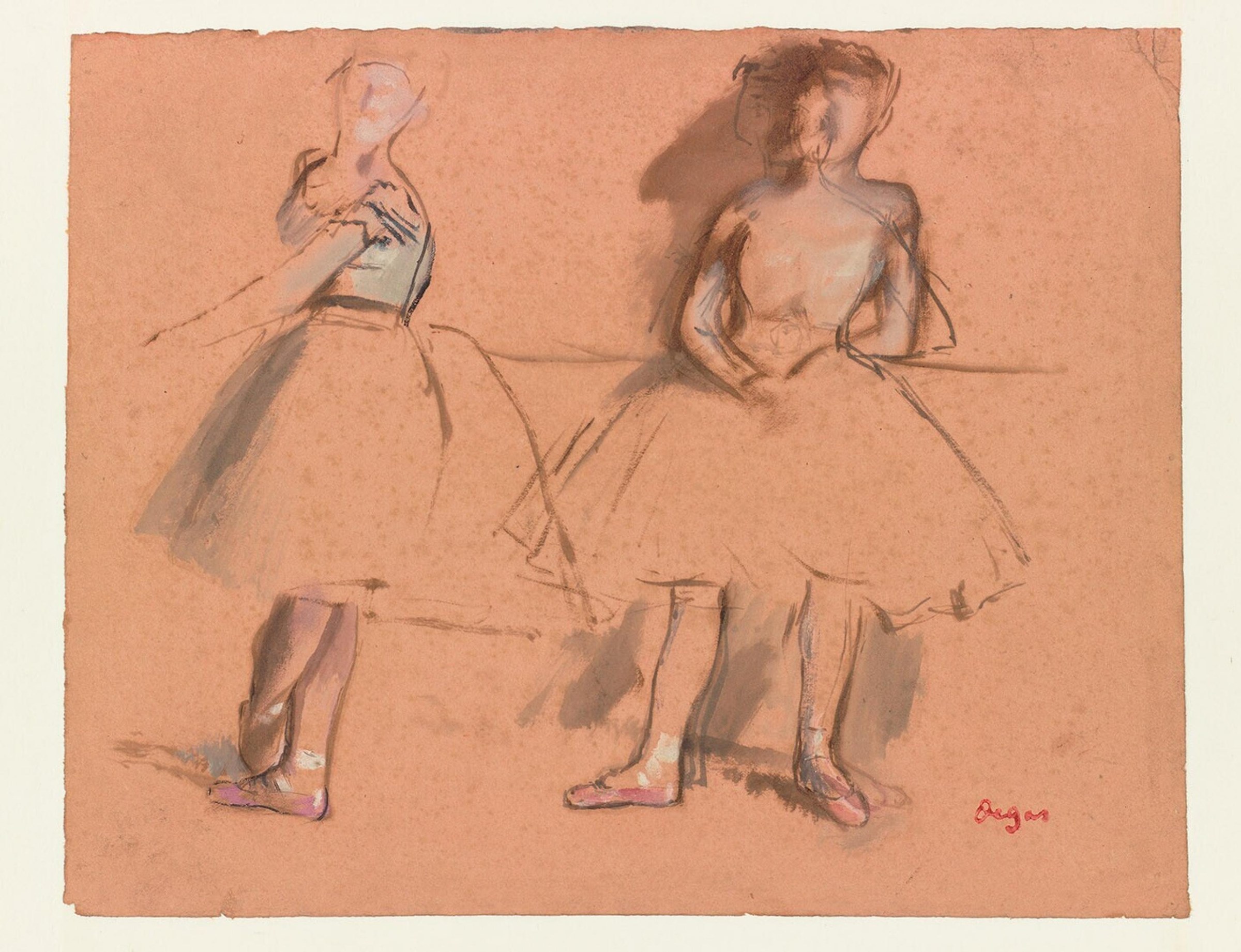
Degas - Two Ballet Dancers at the Barre, circa 1872
Edgar Degas
- Source:
- Wikimedia Commons
- Rights:
- Reusable with conditions: credit the creator; share any adaptation under the same license. Source record ↗
- Recorded as:
- cc by-sa 4.0
This work documents how classical ballet was actually taught and trained in the late nineteenth century, at a moment when ballet was undergoing rapid professionalization and codification. The barre—the apparatus at the center of ballet pedagogy—is rarely the subject of finished art; this study captures the unglamorous, technical foundation of the art form, offering historians direct visual evidence of studio practice and student training that written records often overlook. For dancers, the work serves as historical confirmation of the continuity of barre method across more than 150 years.
What you are looking at
Two young female dancers are shown in profile against a warm terracotta ground. Both wear pale practice tutus—short, gathered skirts—and pink ballet slippers. The figure on the left stands at the barre, her right arm extended upward in an arc while her left hand rests on or near the barre itself; her posture is upright and engaged. The figure on the right stands away from the barre in a similar pose, her body turned slightly, arms positioned in a classical frame. The drawing is executed in charcoal or pastel with loose, gestural handling—the bodies are rendered with soft modeling and shadow, while the tutus and legs are sketched with fluid, economical lines. The artist has paid particular attention to the dancers' feet and the delicate arch of their slippers. Both figures show the characteristic proportions and bearing of young ballet students, their heads tilted back slightly in the composed, lifted carriage of classical training.
The dancing
Both dancers display the vertical alignment and lifted torso typical of classical ballet instruction. The left figure maintains contact with the barre—the standard support for training exercises—while her arm traces a soft arc overhead, consistent with port de bras or arm port work. The right figure's stance suggests she is either performing the same movement away from the barre or has just released from it; her arms frame her body in the formal geometry of classical positioning. Their slender frames, upright spines, and the careful placement of their feet suggest trained young dancers rather than beginners. The poses are static and held, not captured mid-movement—a moment of balance and control rather than dynamic action.
The dance depicted
This is a depiction of ballet training, specifically the barre work that forms the foundation of classical ballet pedagogy. The barre—visible as a horizontal line—is the wooden rail used in studio practice to provide balance and reference for the dancer's body alignment while executing basic positions and movements (tendus, dégagés, port de bras). The work belongs to the tradition of Romantic and Classical ballet as practiced in the late nineteenth century. The formal dress—tutus and soft slippers—and the young age of the students confirm this as professional or serious amateur training rather than social dancing. The artist has chosen to document a moment of technical work rather than theatrical performance.
How it was made
The work is executed in charcoal and pastel on tan paper, a medium particularly suited to figure study. The terracotta-toned paper serves as the dominant mid-tone, allowing the artist to work both lighter (with chalk or white pastel highlights on the dancers' bodies) and darker (with charcoal line and shadow). This technique—drawing rather than painting—implies a studio sketch or study, likely made directly from observation of dancers in a rehearsal or class setting. The loose, gestural handling and the artist's confident shorthand for fabric and form suggest professional practice rather than a finished exhibition work, though the composition and attention to physiognomy indicate careful study. Such sketches circulated among artists and dance professionals as documents of contemporary practice.
About this work
This is a studio drawing of two young ballet dancers during training, probably made in the 1870s in Paris. It records a moment of barre work—one of the fundamental components of classical ballet instruction—rendered with the immediacy and economy of a professional study. The work is unsigned in this image, but the confident handling, the accurate observation of ballet anatomy and posture, and the paper support all point to an artist with direct access to dance studios and a sustained interest in choreographic subjects. The drawing belongs to a substantial body of dance studies and finished works produced during this period as ballet moved from court entertainment to professional theatrical and pedagogical practice.
How to look at it
Attend to the barre itself—the horizontal line that anchors the left figure and defines the space as a studio rather than a stage. Notice how the artist uses the dancer's extended arm to establish the vertical axis of the body; the arm is not decorative but structural, a check on alignment and balance. The two figures, posed similarly but in different spatial relationships to the barre, illustrate the progression of a training exercise—the dancer on the left supported by the barre, the one on the right learning to hold the same position independently. The loose handling of the tutus and the careful rendering of the feet show where the artist's attention was focused: on the actual material and weight of the body, not on prettiness. The poses are unglamorous; these are working dancers, not idealized figures.
The artist
The signature visible on the work ('Degas' in red script at lower right) identifies this as the work of Edgar Degas (1834–1917), the French Impressionist painter best known for his paintings and prints of Parisian ballet, theater, and modern life. Degas made dance one of the central subjects of his career, producing hundreds of paintings, pastels, prints, and drawings of dancers in rehearsal, performance, and training between the 1860s and his death. He had regular access to the Opéra and its ballet studios, and he cultivated close relationships with dancers and ballet masters. His dance studies range from finished salon paintings to rapid notebook sketches; this work belongs to the intermediate category—more finished than notation but more direct than a public work. His interest was never in idealized or romantic representations of ballet but in the actual bodies, gestures, and labor of dancers at work.
The period
In the 1870s, classical ballet was consolidated into a standard pedagogy and vocabulary. The barre method, systematized by Carlo Blasis and his successors, had become the foundation of professional training across Europe. This formalization coincided with a shift from aristocratic court dance to bourgeois theatrical entertainment and professional schools. French ballet was at the height of its influence, and Paris was the undisputed capital of dance. Simultaneously, artists including Degas and his contemporaries were developing new ways to represent modern movement and the human body in action—responding to photography, to scientific study of locomotion, and to the social worlds of performance. Degas's dance subjects were part of this broader investigation into how to represent the modern body in motion and at rest.
Where it lives
This drawing entered the Wikimedia Commons collection as a public-domain image. The original holding institution is not recorded in the available catalogue information. The work's presence in multiple museum and library collections reflects Degas's sustained reputation and the systematic acquisition of his studies by nineteenth-century collectors and institutions.
Dance in this work
Questions about this work
What is the barre and why is it important in ballet?
The barre is a wooden rail fixed to the studio wall at approximately waist height, used by dancers during training to provide physical support and a reference point for alignment while executing foundational exercises. Students begin every classical ballet class at the barre, working through positions and movements that develop strength, flexibility, and the proper use of turnout. Even professional dancers continue to use the barre in daily classes throughout their careers. In this drawing, the barre is visible as a horizontal line supporting the left dancer's hand.
How do we know this is a serious work and not just a quick sketch?
The composition is deliberate: two dancers posed to show both the supported and unsupported execution of the same movement, allowing instruction or comparison. The artist has carefully observed and recorded the dancers' actual proportions, the drape and construction of the tutus, and the precise placement of the feet and arms. While the technique is loose and gestural—appropriate to a studio study—the knowledge it displays is professional and exact. The work documents a specific pedagogical moment with the precision of an artist trained to see.
Why would an artist make so many studies of dancers in training rather than focusing on performances?
Training studies offered direct access to the moving body without the constraints of theatrical costume, stage lighting, or narrative. The repetition of basic movements in a studio made it possible to observe the mechanics of the body at work. For an artist interested in modern movement and the actual labor of professional dancers—rather than the fantasy of ballet as spectacle—rehearsal and class were richer subjects than performance. Such studies also circulated among dance professionals as technical references.
More dance artwork





