49 works in this view — arrow keys or swipe to move between them.
Dance in Art
Degas - Ballet Dancers Rehearsing, 95.GD.35.12
Edgar Degas
- Source:
- Wikimedia Commons
- Rights:
- Public domain — free to use, share and adapt.
- Recorded as:
- public_domain
For dance historians, this sheet documents the actual physical practice of classical ballet training at a moment when choreography and technique were becoming standardized across Europe. For artists, it shows an influential master's method of understanding human movement—the choice to study not finished positions but transitional moments, rest, and the subtle asymmetries of rehearsal. The work is also valuable evidence of the gender dynamics and teaching practices of 19th-century ballet, visible in which figures receive attention and which are left schematic.
What you are looking at
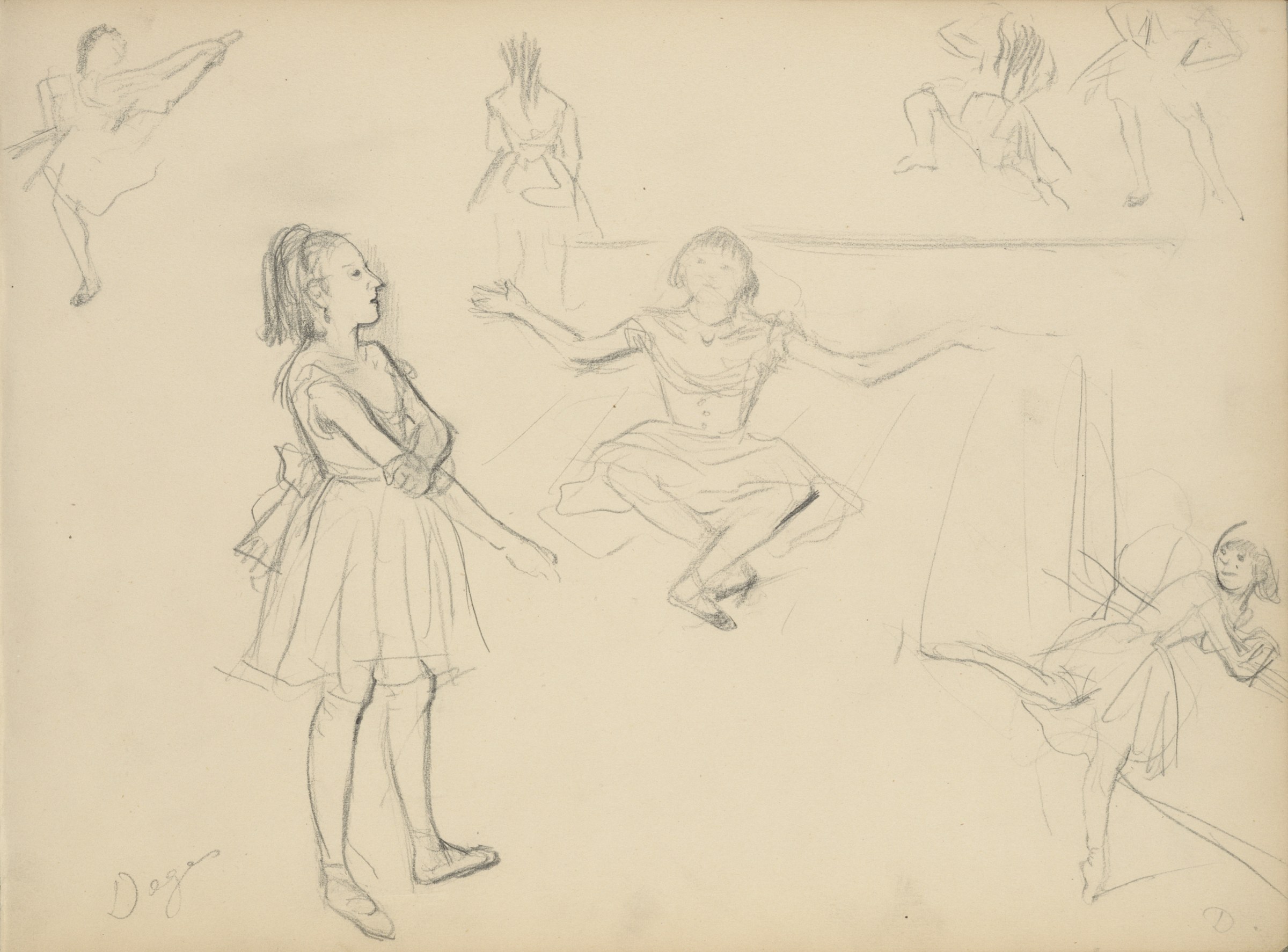
This sheet of sketches captures a rehearsal or study session for ballet dancers, rendered in graphite pencil on cream paper. The composition distributes multiple figure studies across the page—some highly finished, others barely indicated. The focal point is a young dancer in the lower left, seen in profile, wearing a simple dress with a full skirt and what appear to be flat ballet slippers; she stands with her weight shifted, one arm extended as if listening to instruction or awaiting correction. To her right, a male dancer sits on what may be a bench or low platform, knees bent and arms gesturing outward in an open, expansive posture. In the upper portion of the sheet, smaller, more rapidly sketched figures appear in various attitudes—leaping, turning, posed with arms aloft—suggesting quick notational studies of movement possibilities or remembered positions. The drawing style varies from careful modeling of the standing girl's face and torso to schematic linear notation for the background figures. The paper is aged to a warm cream, and the pencil work shows both confident contour drawing and softer passages of shading that define form without heavy outline.
The dancing
The most resolved figure stands in a typical academic pose: upright, weight centered, with the characteristic turned-out stance and controlled arm carriage of ballet training. The seated male dancer shows a more relaxed, open frame—thighs parallel to the ground, arms spread wide—suggesting either a moment of rest or a specific movement phrase. His posture is notably less constrained than the standing girl's. The smaller figures in the background are indicated with light, gestural lines that suggest the energy and variety of rehearsal: one figure appears to leap, another to turn. The artist has clearly studied how the body shifts weight and opens in space, with particular attention to the relationship between the torso and the extended limbs.
The dance depicted
This is a working sketch of classical ballet in a training or rehearsal context, likely from the late 19th century based on the dress and the classical positions recorded. The figures demonstrate the fundamental postures of academic ballet training—the turned-out legs, the held carriage of the upper body, the precise arm positions. The seated figure's relaxed gesture suggests a break in rehearsal or a teaching moment, which was common in ballet studios of the period. The variety of poses indicates the artist's interest in capturing not a single choreographed sequence but rather the range of attitudes and movements that constitute ballet practice. The emphasis on the preparatory and transitional moments between formal positions is characteristic of how dancers and choreographers worked during this era.
How it was made
This is a graphite pencil sketch on laid paper, a standard medium for studio studies and rehearsal notes throughout the 19th century. The technique is economical: the artist uses light outlines for initial placement, builds form with careful shading on the most important figures, and leaves background figures as quick notational sketches. This approach—careful where it matters most, rapid elsewhere—is typical of an artist working from life in a rehearsal space, where sustained poses were brief and the priority was capturing the essential character of movement and position rather than finished detail. The medium allowed for easy revision and layering, making it ideal for the exploratory work of understanding dance as form.
About this work
This is a study sheet documenting a ballet rehearsal, a genre of drawing that flourished in the 19th century as choreography became increasingly systematized and dancers required more detailed instruction. The work captures the pedagogical moment—the transmission of classical technique through demonstration, correction, and repetition. The careful rendering of one figure's pose alongside the shorthand notation of others reveals the hierarchy of attention in a teaching space: some movements are worth detailed study, others merely suggested. The work belongs to the long tradition of artists attending dance as a subject of formal inquiry, documenting not performance but the labor and discipline beneath performance. It also speaks to the gendering of dance in this period: the standing woman is carefully studied, the male dancer more quickly rendered, perhaps reflecting the different demands placed on different bodies in the ballet hierarchy of the era.
How to look at it
Study the contrast between the two main figures: the standing woman is shown with careful attention to her posture, face, and the fall of her skirt, suggesting either a key position or a teaching moment; the seated man is rendered more loosely, his gesture more abandoned. Consider why the artist made this choice. Notice how the smaller figures at the top of the sheet—indicated with almost calligraphic lines—suggest movement and energy without form: these are notes on what is possible in the body, what the eye remembers of a leap or turn. The sketches are not attempts at finished representation but rather a record of looking, of the artist's eye tracking the body as it moves, rests, and is corrected.
The artist
Edgar Degas (1834–1917) was obsessed with ballet as a subject across five decades, producing paintings, pastels, prints, and thousands of drawings of dancers in performance, rehearsal, and training. He attended the Paris Opéra regularly and had direct access to rehearsal spaces, allowing him to sketch dancers in unguarded moments. His approach was never documentary in the sense of faithful reportage; rather, he used dance as a vehicle to explore problems of composition, perspective, and the moving figure that were central to modernism. His many studies of dancers—particularly young women in training—made ballet imagery synonymous with avant-garde art practice, influencing how subsequent artists understood both dance and the body in motion. His work is distinguished by acute observation of the body in asymmetrical, often ungainly attitudes that contradicted academic ideals of grace.
The period
The late 19th century saw ballet firmly established as a form of formal training and professional practice, with standardized technique codified in textbooks and schools. This was also the period of Romantic and Classical ballet's dominance in Europe, when the Opéra was the center of dance authority and innovation. Simultaneously, artists including Degas were developing new visual languages to capture movement—photography was emerging, but the camera's limitations meant that drawn and painted studies remained the primary means by which artists understood and recorded the moving body. The emphasis on rehearsal and training rather than performance reflected a new interest in dance as labor and pedagogy rather than solely as spectacle.
Where it lives
The work comes from the Getty Museum collection (accession 95.GD.35.12). It is one of thousands of Degas dance studies held in public and private collections, most of which have remained in the condition of working sketches—preliminary investigations rather than works conceived as finished art.
Dance in this work
Questions about this work
Is this a finished artwork or a study?
This is a working study sheet, a rehearsal note. Degas produced vast numbers of such sketches, often never exhibiting them; they were the foundation of his practice, the raw material from which larger paintings and pastels were developed. The varying degrees of finish—one figure carefully modeled, others barely indicated—are typical of a study sheet rather than a work intended for public display.
Could Degas actually draw dancers this accurately from life?
Yes, and remarkably so. He had regular access to the Opéra's rehearsal spaces and spent countless hours there. His hand was extremely quick, and he developed a shorthand for capturing the essential character of a pose or movement. The careful studies were often made from models in his studio, but the lighter sketches and compositional notes came directly from observation during rehearsals.
Why are some figures finished and others not?
In a study sheet, the artist prioritizes according to what needs investigation. The standing dancer is carefully rendered because her pose and the relationship between her body and her dress require detailed study; the smaller figures are shorthand notes on movement and composition, explored in less detail because their primary purpose is to suggest energy and variety rather than to be resolved as forms.
What does this tell us about ballet training in the 1890s?
The work documents the formal, controlled posture of classical training—the turned-out legs and held carriage of the upper body characteristic of the academic tradition. The presence of both male and female dancers suggests mixed rehearsals, though the careful attention to the female figure and the more casual treatment of the male dancer may reflect the hierarchies of the Opéra at the time, where female dancers were the primary focus of choreography and training.
More dance artwork





