49 works in this view — arrow keys or swipe to move between them.
Dance in Art
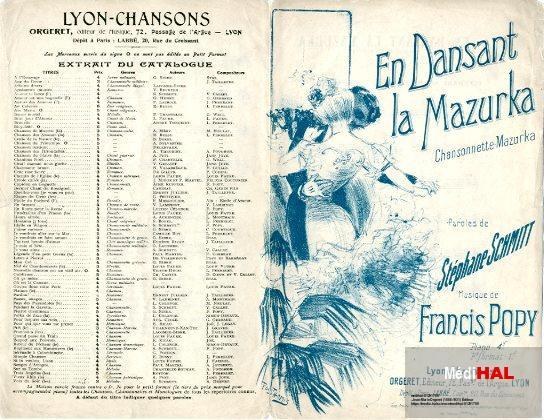
En dansant la Mazurka - chansonnette mazurka -illustration Léon Pousthomis- (MédiHAL 1291709)
Éliane Daphy / Institut Interdisciplinaire d'Anthropologie du Contemporain / National Center for Scientific Research
- Source:
- Wikimedia Commons
- Rights:
- Public domain — free to use, share and adapt.
- Recorded as:
- public_domain
The mazurka was one of the most important social dances of the 19th century, and this poster is evidence of how it remained a subject of popular entertainment and cultural interest well into the 20th century. The image shows the dance as it was experienced by ordinary urban society—not in the refined space of court or elite ballroom, but as a music-hall attraction packaged and sold. For dance history, it documents the mazurka's aesthetic in motion: the specific posture, the turn, the embrace between partners that defined the dance in this period.
What you are looking at
This is a music-hall poster for a mazurka song, printed in Lyon around 1903. The composition is dominated by a large blue lithographic illustration of a couple dancing, rendered in a loose, gestural style typical of Belle Époque entertainment advertising. The man, in dark formal dress, holds the woman in a close ballroom frame; she wears a pale dress with a full skirt caught mid-spin, the fabric billowing dynamically around her legs. Their bodies lean together in the characteristic incline of the mazurka hold. The illustration is unsigned but credited to Léon Pousthomis. Below the dancing couple, the title reads "En Dansant la Mazurka" in flowing script, with further publication details: lyrics by Stéphane Schmitt, music by Francis Popy, published by Orgeret of Lyon. At the lower right, a publisher's mark indicates the work was engraved and printed by Crevel. The verso of the poster includes a dense printed catalogue of Lyon-Chansons (Lyon songs), suggesting this was a promotional piece for a music publisher's broader catalog. The paper is aged cream-colored, with foxing and creasing consistent with display and storage over more than a century.
The dancing
The couple is shown in a standard ballroom closed position, with the man's right arm around the woman's waist and their outside hands joined. The woman's body is angled slightly away and upward, her weight on one foot as her skirt flares outward—a captured moment of a turning step. The man leans into the turn, his posture supporting her movement. The artist has rendered the embrace with anatomical plausibility; the proportions and the distribution of weight suggest someone who understood partner dance, even if the style is sketchy and expressive rather than precise.
The dance depicted
This is unambiguously a mazurka, one of the most fashionable ballroom dances of the 19th and early 20th centuries. The mazurka originated in Poland and became a staple of European salon and ballroom dancing from the 1830s onward. The poster documents it as a subject for popular song and entertainment in a provincial French city. The title "En Dansant la Mazurka" (Dancing the Mazurka) and the incipit noted in the catalogue record—"I love dancing madly"—anchor the work in the tradition of leisure-class courtship dances, where dancing was as much a social ritual as a musical one. The image captures the mazurka's characteristic turned-out posture and rotational movement.
How it was made
This is a color lithograph, identifiable from the soft edges, the characteristic color layering, and the printer's mark (Crevel). Lithography allowed rapid, inexpensive reproduction of vivid images in multiple colors, making it the standard medium for Belle Époque posters and entertainment advertising. The technique's tonal range and ease of revision made it ideal for promotional work intended for public display and wide circulation. This poster would have been printed in significant quantity for display in theaters, concert halls, cafés, and music shops across Lyon.
About this work
This is a Belle Époque music-hall poster advertising a mazurka song published in Lyon around 1903. It documents the mazurka as a living ballroom dance at the turn of the 20th century, at a moment when printed music and illustrated sheet music were the primary means by which popular songs and dance crazes spread through urban society. The work is neither fine art nor documentary: it is a commercial artifact made to sell a commodity (a song), yet it captures the mazurka with enough specificity—the closed hold, the turned-out frame, the woman's spiral turn—that a dancer of the period would recognize it. It belongs in a dance gallery because it shows how the dance was visualized and consumed by its own audience, and because the poster itself is an object through which dance was disseminated and made fashionable.
How to look at it
Attend to the captured moment: the woman mid-turn, her weight lifted and her skirt flying, the man's body molded to support that spiral motion. This is not a static pose but a slice of movement, which was precisely what lithographic artists of this period excelled at suggesting. Notice also how the artist has emphasized the ballroom frame—the close hold, the turned-out posture—which were the mazurka's visual signature. The loose, energetic line work conveys the vitality of the dance without requiring photographic detail; the stylization is part of how entertainment culture visualized pleasure and movement.
The artist
Léon Pousthomis (active late 19th and early 20th century) was a lithographic illustrator working in the Belle Époque tradition. Little is recorded of his life, but his signature on entertainment and music-hall posters places him among the commercial artists who shaped the visual language of Lyon's café and theater culture. His work is characterized by quick, gestural line work and a focus on capturing movement and social pleasure rather than anatomical precision.
The period
The 1890s and early 1900s saw the mazurka decline gradually from its peak popularity (1860s–1880s) but remain a fixture of ballroom dancing and popular entertainment. Waltz and two-step were becoming more dominant, yet the mazurka retained enough cultural currency to be marketed as a song subject in 1903. The poster's publication by a provincial printer (Orgeret in Lyon) rather than a Paris music house reflects the distribution of entertainment culture beyond the capital. This was also the era of color lithographic entertainment posters, when Belle Époque visual culture was at its height—a period that valued vivid imagery, legible design, and the combination of typography and illustration to catch the eye and sell a product.
Where it lives
This poster is catalogued in the Wikimedia Commons and derives from the BNF (Bibliothèque Nationale de France) deposit collection. It is classified as part of Lyon-Chansons, a series of popular songs and their promotional materials printed in Lyon. The verso includes a printed catalogue of other songs in the publisher's catalog, indicating this was both a standalone promotional object and part of a larger print series.
Dance in this work
Questions about this work
What is a mazurka and why was it popular?
The mazurka is a Polish dance in triple meter that became one of the dominant social ballroom dances of the 19th century. It was fashionable among both aristocratic and middle-class dancers because it combined elegance with a degree of freedom of expression—dancers could add their own flourishes and turns. It remained popular into the early 20th century, even as waltz and two-step gained ground.
How do we know this is a mazurka and not another ballroom dance?
The title explicitly states "En Dansant la Mazurka," and the image shows the characteristic ballroom mazurka hold and posture: a closed frame with turned-out legs and rotational movement. The woman's spiral turn and lifted carriage are typical of how the mazurka was performed in this period.
What was Orgeret?
Orgeret was a music publisher based in Lyon. This poster is one of their promotional objects, printed to advertise the song and drive sales of sheet music. The verso of the poster lists other songs they published, indicating it functioned as both advertisement and catalog.
Why was this printed on the back of a catalog?
This was a practical use of printing press capacity: the publisher could print the catalog on one side and use the reverse side for a promotional poster for a featured or new song. It was economical and ensured that anyone with a catalog in hand also saw the poster.
More dance artwork





