49 works in this view — arrow keys or swipe to move between them.
Dance in Art
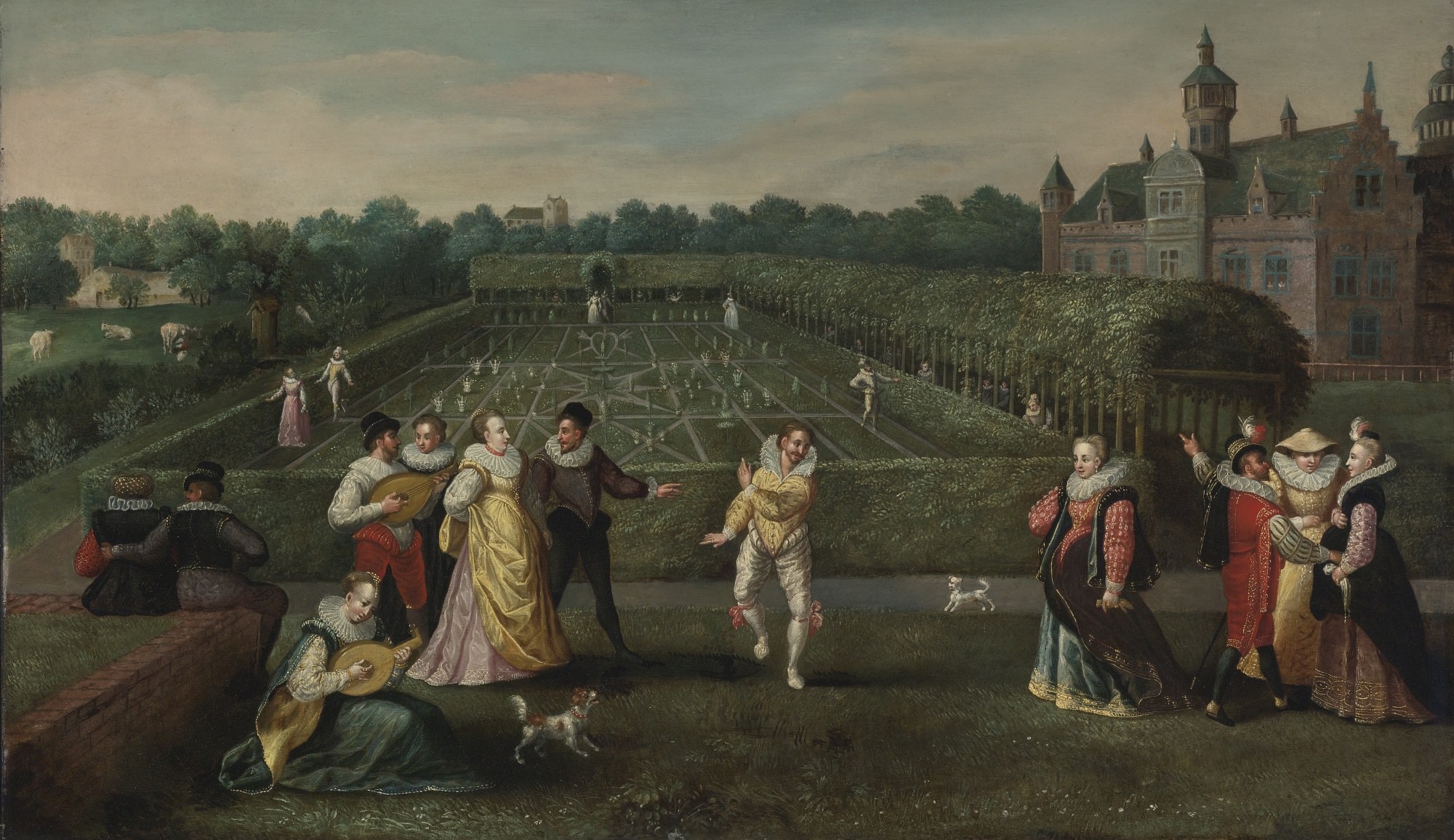
Courtiers strolling in a garden
Hieronymous Francken I
- Source:
- Wikimedia Commons
- Rights:
- Public domain — free to use, share and adapt.
- Recorded as:
- public_domain
For historians of Renaissance social dance and court culture, this work is invaluable as documentary evidence: it shows the actual settings where court dances were performed, the costume conventions, the informal social movement that framed formal dance, and the integration of music and dance in aristocratic leisure. It reveals that dancing was embedded in broader social performance rather than isolated as spectacle or profession.
What you are looking at
A formal garden party in a Flemish Renaissance or early Baroque palace grounds. The composition is dominated by a geometric parterre garden with hedge-lined beds stretching into the distance. In the foreground, two groups of courtiers occupy the lawn: on the left, musicians and dancers in elaborate dress; on the right, a larger assembly of elegantly clothed figures. The architecture of a substantial brick palace with towers and multiple chimneys rises beyond the garden walls. The light is soft and even, typical of northern European painting, casting no sharp shadows. The palette is restrained—earth tones, greens, and muted silk colors—with the brightest accents in the figures' clothing. The scene conveys leisured aristocratic life: music-making, social movement, and promenade rather than structured entertainment.
The dancing
The figures are distributed in loose groups rather than formal ensembles. Several courtiers hold lutes or similar stringed instruments. The dancing or moving figures are shown in upright postures with relaxed, social bearing rather than technical precision; their arms hang naturally or gesture toward companions. Children appear among the adults. The women wear high-waisted gowns with elaborate collars and sleeves in pale silks and brocades; the men wear tunics, hose, and decorative cloaks. The overall impression is of conversational social movement—strolling, pausing, interacting in pairs and small groups—rather than coordinated ensemble dancing or theatrical performance.
The dance depicted
This appears to document the informal social dancing and music-making of the aristocracy during the Renaissance or early Baroque period—most likely the early 17th century based on costume. The style is neither a specific choreographed dance form nor theatrical ballet, but rather the kind of courtly social movement that accompanied lute music in noble gardens. Figures may be executing pavan, galliard, or other court dances of the period, but the painting does not freeze a recognizable moment of technical execution. Instead it records the social context in which dance occurred: as one element of courtyard leisure alongside music, conversation, and display of costly dress.
How it was made
Oil on panel, likely from the Northern Renaissance tradition as practiced in Flanders. The technique allows fine detail in the rendering of dress, architecture, and landscape recession. The broad view and careful composition suggest this is a formal commission, possibly for a noble family; such works circulated among the elite as status objects and records of courtly life. The systematic rendering of the garden and architecture implies the work was commissioned to commemorate or celebrate a specific estate and its social world, not to capture an actual fleeting moment.
About this work
A painting of courtly leisure in an aristocratic garden, showing figures in Renaissance dress engaged in social promenade, music-making, and informal dancing. The work documents the social context of Renaissance court dance—the gardens, the dress, the informal groupings—rather than the technical execution of a specific dance form. It belongs in a dance archive as evidence of how dancing functioned in courtly life: as one performance within a larger display of wealth, taste, and social sophistication. The painting captures the world that produced the formal court dances of the period, the settings in which they were practiced, and their social meaning.
How to look at it
Attend first to the garden itself: the perspective lines of the hedged beds draw the eye inward and establish the formality of the space. Then observe the distribution of figures and their relationships: notice how the painting captures not a moment of synchronized group dance but the varied movements of individuals and small groups in conversation and social exchange. Look at the costume detail—lutes, collars, the height of heels—for evidence of the period. The artist chose not to freeze a dramatic moment of technical execution but rather to document the leisured, social quality of courtly movement and music-making.
The artist
Hieronymous Francken I (c. 1540–1610) was a leading Flemish painter of courtly life, garden scenes, and palace interiors. The Francken workshop was famous for detailed, panoramic views of aristocratic leisure and festivities that combined landscape, architecture, and numerous figures. These works were highly valued by European nobility as records and celebrations of courtly culture. Francken's compositions typically combine careful perspective and architectural detail with an encyclopedic attention to costume, occupation, and social hierarchy.
The period
Early 17th-century court culture was reaching an apex of formalization in both dance and visual representation. Court dances like the pavan and galliard had been codified in dance treatises. The fashion for garden design—geometric parterres as settings for social performance—was at its height. Painting these scenes served to immortalize and celebrate aristocratic identity and leisure. At the same time, the social dances shown here existed alongside professional theatrical dance developing in court spectacles and ballet de cour.
Where it lives
The work is held in Wikimedia Commons and appears to be in a major Northern European collection, though the record does not specify location. It is a formal oil painting on panel, typical of early 17th-century Flemish court painting created for elite patrons.
Dance in this work
Questions about this work
Are these people actually dancing, or just standing around?
Both. Some figures appear to be in movement—stepping, turning—while others are standing in conversation or holding instruments. The painting documents the social context of dance rather than a single choreographed performance. In court culture, dancing emerged from and was interspersed with music, conversation, and promenade, so the lack of synchronized ensemble movement is historically accurate for this period and setting.
What dances might these people be doing?
Given the early 17th-century date and aristocratic setting, they are most likely performing pavan, galliard, courante, or other dances documented in period dance treatises. The upright posture and social groupings are consistent with these forms, but the painting does not show enough technical detail to identify specific steps or hold.
Why is the garden so important to this scene?
The geometric parterre garden was central to Renaissance aristocratic display and social performance. It showed wealth and refinement, allowed the display of elaborate dress, and provided a stage for music and dance. Painting the palace and garden alongside the figures demonstrated that the owner possessed both the physical space and the culture to conduct courtly leisure.
What do the musical instruments tell us?
The presence of lutes and other stringed instruments confirms that music and dance were inseparable in court culture. Music governed the tempo and style of movement, and skilled courtiers were expected to both play and dance. The instruments visible in the painting underscore that this was a culture of refined, educated performance.
More dance artwork





