49 works in this view — arrow keys or swipe to move between them.
Dance in Art
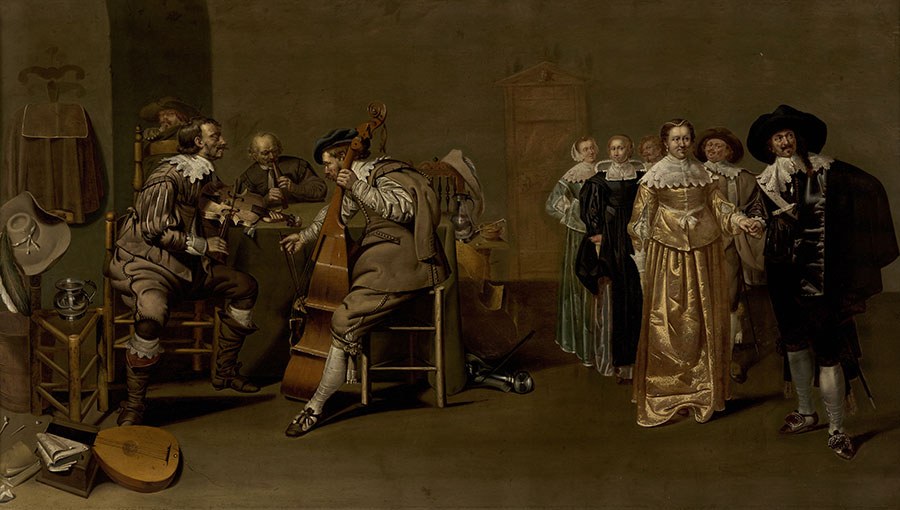
The Cotillionlabel QS:Len,"The Cotillion"label QS:Les,"El cotillón"label QS:Lpt,"O Cotilhão"
Jacob Duck
- Source:
- Wikimedia Commons
- Rights:
- Public domain — free to use, share and adapt.
- Recorded as:
- public_domain
The cotillion was a foundational ballroom form whose structure and conventions shaped ballroom dancing for centuries; this image preserves visual evidence of how it was socially performed and framed. For historians of 17th-century urban life and gender, the work documents the participation of women in formal mixed-gender social gatherings and the role of professional musicians in enabling such events.
What you are looking at
A formal gathering depicted in a muted golden-brown palette, divided into two distinct spatial zones. On the left, three men in earth-toned doublets and breeches sit playing musical instruments—a lute, a cello, and a stringed instrument—while a fourth stands among them gesturing. On the right, a group of approximately eight figures in formal court dress stands in a loose line: the central figure is a woman in a long gold damask gown with elaborate white lace collar, flanked by men in dark silks and a figure in a wide-brimmed hat. The composition suggests a moment of assembled formality rather than active dancing—the standing group appears to be observing or waiting, while the seated musicians provide accompaniment. The setting is sparse, with plain walls and minimal architectural detail, giving the scene an intimate chamber-like quality despite the number of participants. The lighting is diffused, creating soft shadows that emphasize the rich textures of the fabrics and the careful arrangement of the figures.
The dancing
The bodies are generally upright and composed, with little sense of active motion. The standing figures on the right maintain formal postures with arms at their sides or held with restrained gestures; several face partly toward the musicians. The seated musicians are engaged with their instruments in a static performance posture. The central woman's skirt hangs heavily to the floor, and her upper body is held in the formal alignment typical of court dress. There is no visible footwork or dynamic weight shift; instead, the arrangement suggests a pause between moments rather than movement itself.
The dance depicted
The title identifies this as a cotillion, a formal quadrille-based social dance that emerged in 18th-century France and became a central feature of European ballroom culture, particularly in the 17th and 18th centuries. However, the image does not clearly depict active dancing—no couples are shown in characteristic holds or closed positions, and no footwork is evident. The scene may represent a moment of assembly or preparation before the cotillion begins, or a stylized artistic convention in which the dance is represented by the formal gathering itself rather than by bodies in motion. The live musicians on the left would have provided the essential accompaniment for such a dance.
How it was made
Based on the image characteristics, this appears to be an oil painting on canvas, though the record does not confirm the medium. The technique uses thin glazes and a restrained palette to create a sense of architectural space and formal arrangement, with careful attention to the textures of silk, lace, and damask. The composition is linear and organized, suggesting either a preparatory sketch for a more elaborate work or a finished piece in its own right. The flat, narrative quality—the clear spatial separation between musicians and dancers—suggests influence from Dutch or Flemish interior painting traditions of the 17th century.
About this work
This work documents the social context of the cotillion in early modern Europe, capturing not the movement itself but the formal occasion and material conditions of courtly dance. The presence of professional musicians, the careful dress, and the architectural setting all situate the cotillion within aristocratic or upper-middle-class life. The painting serves as historical evidence of how dance functioned as ritual and social display rather than as continuous bodily motion—the dance is assembled, witnessed, and framed by dress and musical accompaniment as much as by the movements of the dancers themselves.
The work belongs to a tradition of documenting courtly and ballroom social life through painting. Artists like Jacob Duck were deeply invested in capturing the material culture of urban sophistication—the instruments, fabrics, postures, and spatial arrangements that signaled refinement and social standing. For dance historians, such works are invaluable precisely because they show dance embedded in its actual social and economic contexts: who danced, in what spaces, with what accompaniment, and in what dress.
How to look at it
Observe the spatial division between the working musicians and the formally dressed standing group—this separation is not accidental but documents how dance was framed as a coordinated event requiring both performers and accompanists. Note the careful rendering of the woman's gown and the men's formal dress: the investment in depicting textile and tailoring suggests that dress itself was central to the meaning of the occasion. Pay attention to the lack of dynamic gesture or active footwork; the formality here is one of assembly and presentation, which may represent either a moment of pause or a convention in which the dance is represented through social arrangement rather than bodily motion.
The artist
Jacob Duck (c. 1600–1667) was a Dutch Golden Age painter specializing in scenes of military life, leisure, and urban social gatherings. He worked primarily in Utrecht and Amsterdam, creating detailed interior and exterior scenes that document the material culture and social practices of the Dutch merchant and professional classes. Duck's practice emphasized the accurate rendering of textiles, instruments, and spatial relationships, making his work valuable as historical documentation. He worked in oil on canvas and panel, producing works for a market of wealthy urban patrons interested in scenes of contemporary life.
The period
The cotillion emerged in France in the mid-18th century but likely had antecedent forms in the 17th century; this work may document an earlier form of the same social gathering. The 17th century saw the professionalization of music and dance in urban contexts across Europe, with dancing masters publishing manuals and musicians establishing themselves as essential participants in courtly and merchant-class social life. Dutch and Flemish art of this period frequently depicted social gatherings, musical performances, and courtship rituals as markers of urban sophistication and leisure. The formal dress visible here—the damask gown, the fine silks, the lace collars—indicates a scene of considerable expense and formality, accessible to professional and merchant-class audiences rather than the highest aristocracy.
Where it lives
The work is attributed to Jacob Duck and dated to 1650, according to the catalogue record. The source is listed as Wikimedia Commons; no holding institution is recorded in the catalogue.
Dance in this work
Questions about this work
Is anyone actually dancing in this painting?
Not visibly. The figures on the right are standing in formal postures, and no couples are shown in the holds, footwork, or dynamic configurations characteristic of active dancing. The work may represent a moment of assembly, a preparatory moment, or an artistic convention in which the social gathering itself stands for the dance.
Why are the musicians separated from the other figures?
The spatial separation reflects the actual social and functional division of labor in formal dancing: musicians were professionals hired to provide accompaniment, often positioned apart from or elevated above the dancing space. This layout documents the infrastructure required for organized ballroom dancing.
What does this tell us about who danced the cotillion?
The formal dress, the number and gender mix of participants, and the investment in professional musicians suggest that the cotillion was a social form accessible to wealthy urban professionals and merchants rather than only the highest aristocracy. The presence of women indicates mixed-gender social dancing, an important feature of early modern urban social life.
Why is so much detail given to the clothing?
In 17th-century art, the accurate rendering of expensive textiles—damask, silk, lace—was itself a demonstration of the artist's skill and a marker of the painting's value. More importantly for historians, these details document what people wore to formal occasions and thus the material investments required to participate in courtly social life.
More dance artwork





