49 works in this view — arrow keys or swipe to move between them.
Dance in Art
Edouard Toudouze (1848-1907) -
Édouard Toudouze
- Source:
- Wikimedia Commons
- Rights:
- Public domain — free to use, share and adapt.
- Recorded as:
- public_domain
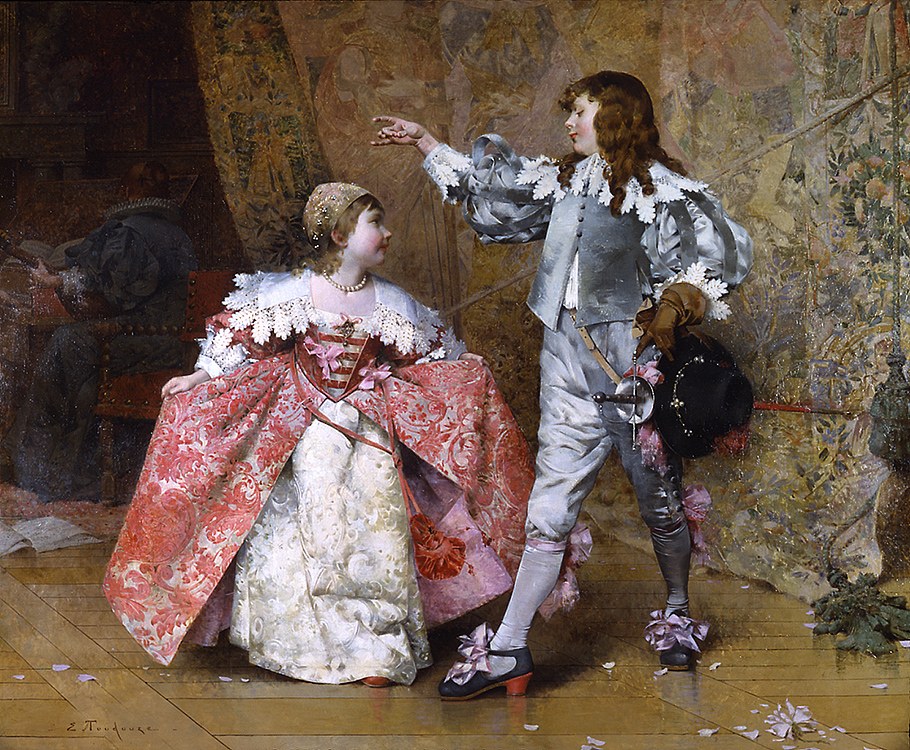
The work is valuable evidence of how 19th-century artists and audiences understood 18th-century court dance: as a spectacle of luxury, refinement, and ritual courtship rather than as movement practice. The painting also demonstrates the degree to which the minuet and other court dances had become historical and costume-bound by the Gilded Age—aestheticised and sentimentalised rather than danced.
What you are looking at
A young couple in formal 18th-century court dress perform or practice a dance in an ornate interior. The woman, seated or in a low position, wears a pale gown with an elaborate white lace collar and a draped coral-pink brocaded cloak or overdress; her hair is styled in the fashion of the period. The man stands beside her in pale blue silk breeches, white stockings, and a matching pale blue coat with white lace cuffs and collar, one arm extended toward the woman in a courtly gesture. The setting is a richly decorated room with gilded wall panels and what appears to be tapestry or painted wall decoration in warm earth tones. Scattered petals or confetti on the floor suggest a celebratory moment. A small dark figure—possibly a page or attendant—stands at the right edge of the composition. The lighting is warm and theatrical, emphasizing the luxurious textures of silk, lace, and brocade.
The dancing
The man's posture is upright and commanding, his extended right arm offering an invitation or instruction; his weight is balanced and his frame open. The woman's position—whether seated, kneeling, or in a deep curtsy—suggests deference and receptiveness to his lead. Their bodies do not touch; the spatial relationship is formal and observant of court protocol. The gesture suggests the opening moments of a choreographed dance or a formal acknowledgment between partners of rank.
The dance depicted
This appears to depict an 18th-century court dance, most likely a minuet or a formal processional dance from the aristocratic repertoire. The elaborate dress, the interior setting, the formal posture, and the woman's position all align with aristocratic social dance of the Rococo period. The title 'The First Dance' suggests either a wedding or betrothal scenario—a first formal dance between partners, which was a ritualised moment in court life. The man's instructional gesture and the woman's receptive posture suggest an element of teaching or initiation into the dance.
How it was made
This is an oil painting, likely late 19th century based on the brushwork, colour handling, and academic realism of the style. The artist has used detailed attention to fabric texture—the luminosity of silk, the intricacy of lace, the weight of brocaded cloth—which required skilled handling of oil paint glazes and highlights. The warm, diffuse lighting and soft shadows are characteristic of salon painting technique. The work appears designed for exhibition and private collection rather than public instruction, suggesting a medium-to-wealthy audience familiar with Rococo aesthetics and historical subject matter.
About this work
This is a Rococo-revival or historical genre painting depicting the formal opening moment of a court dance between aristocratic partners. It sits within a 19th-century fascination with the 18th-century aristocratic past, a period when academic painters used historical dress and manners to explore themes of courtship, propriety, and social ritual. The work treats the dance not as movement or spectacle but as a coded moment of social and romantic significance—the gesture, the dress, the setting, and the title all work to suggest that what we are witnessing is a ritual performance of consent, instruction, and hierarchy. The painting belongs in a dance history collection because it documents both an actual historical dance practice and the later culture that mythologised it.
How to look at it
Attend to the spatial relationship between the two figures: they are close but not touching, the distance itself meaningful and enforced by etiquette. Watch the quality of the man's gesture—it is neither aggressive nor uncertain, but assured and instructional, suggesting both his role as leader and his social position. The woman's passive reception is not weakness but compliance with a social code that the painting asks the viewer to understand and admire. The scattered petals and the warm, flattering light work together to suggest that this moment—this first dance—is being presented as a pinnacle of civilised refinement and romantic promise.
The artist
Édouard Toudouze (1848–1907) was a French academic painter known for historical genre scenes, particularly subjects drawn from 18th-century court life and aristocratic manners. He worked in the salon tradition and produced numerous works depicting moments of courtship, social ritual, and historical costume. His style is characteristic of late 19th-century academic realism—technically accomplished, narrative-focused, and designed to appeal to wealthy collectors with antiquarian interests.
The period
The painting dates to the late 19th century, a period of intense nostalgia for the 18th-century ancien régime, particularly among European and American collectors. The minuet and other court dances had fallen out of living practice by this time but were actively romanticised in literature, visual art, and historical writing. This was also the era of the Gilded Age, when wealthy American and European patrons collected historical genre paintings as markers of taste and culture. The rise of historical ballet and reconstructed court dances during this period reflects a similar impulse to recover and aestheticise the aristocratic past.
Where it lives
The work is recorded as being held in or sourced from Wikimedia Commons. No specific collection, accession number, or current location is given in the available record.
Dance in this work
Questions about this work
What dance are they performing?
The specific dance cannot be determined from the image alone, but the formal dress, the interior setting, and the 18th-century style strongly suggest a minuet or another slow, processional court dance. The title 'The First Dance' indicates this is a ceremonial or ritual moment rather than a social dance among equals. The man's instructional gesture suggests he may be teaching or leading a partner unfamiliar with the steps.
Why is the woman in such a low position?
The woman's posture reflects 18th-century court etiquette and the sexual politics of aristocratic dance. She may be in a curtsy, kneeling, or simply in a receptive stance that acknowledges the man's role as leader and instructor. This posture was conventional in court dances and in representations of courtship, where the woman's role was to respond to the man's invitation and guidance.
Is this a painting or a print?
This is an oil painting, as evidenced by the soft, blended brushwork, the luminosity of the fabrics, and the subtle modulation of light and shadow. The technique and finish suggest it was created for exhibition and private sale rather than mass reproduction.
When was this painted?
The catalogue record lists the date as 2014, which appears to be an error; the style, subject, and technique indicate this is a late 19th-century painting, likely 1880s–1900s. The 2014 date may refer to a digital cataloguing or donation event rather than the work's creation.
More dance artwork





