49 works in this view — arrow keys or swipe to move between them.
Dance in Art
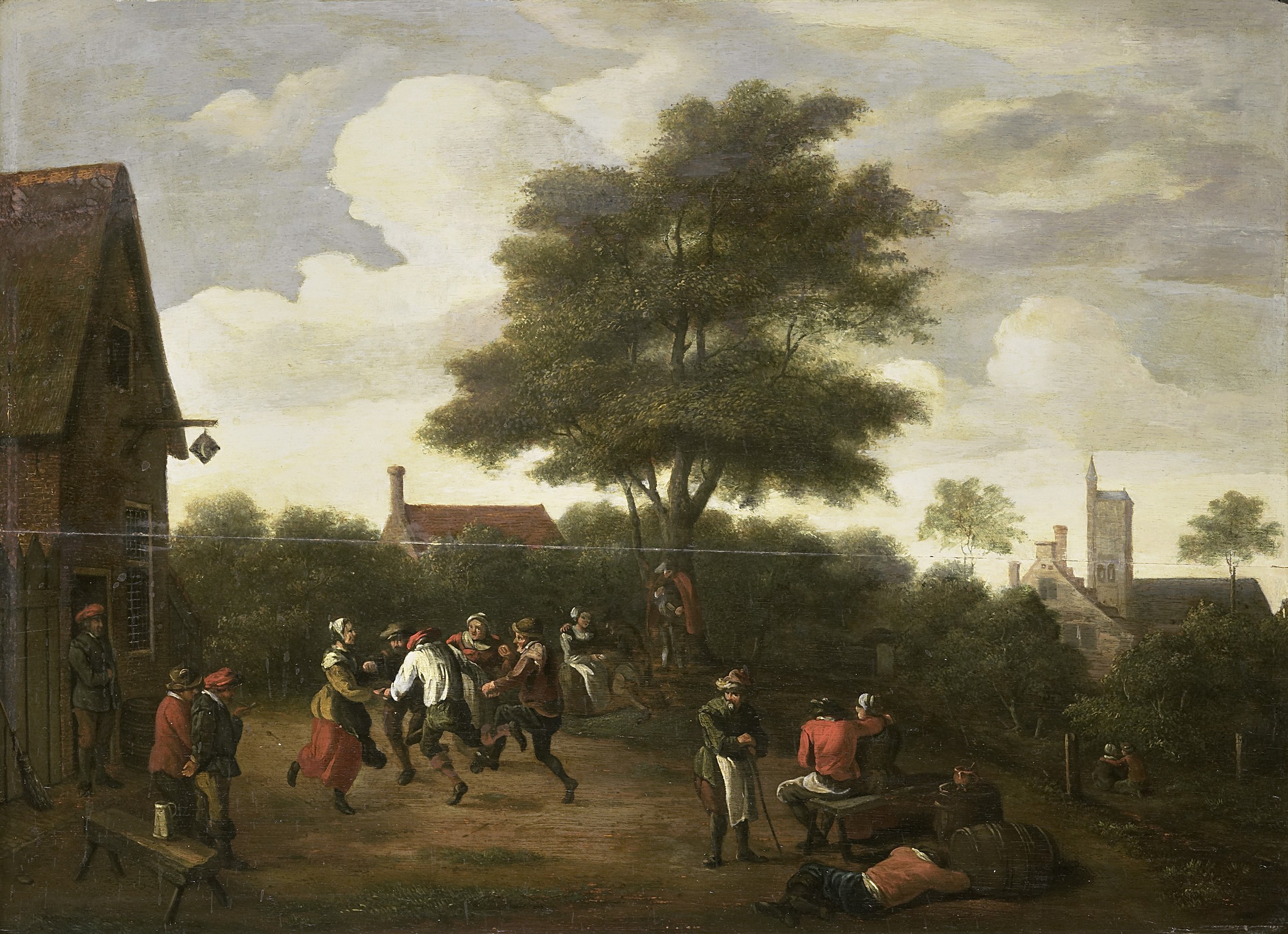
Peasants dancing label QS:Len,"Peasants dancing"label QS:Lnl,"Dansende boeren"
After David Teniers the Younger
- Source:
- Wikimedia Commons
- Rights:
- Public domain — free to use, share and adapt.
- Recorded as:
- public_domain
This image preserves a rare, close-observed record of how ordinary people actually danced in the early modern period—not idealized, not performed for nobility, but social and improvisational. The Teniers tradition of village painting is one of the few visual sources that allows dancers and historians to see beyond the codified court dances that dominate surviving dance manuals and formal art.
What you are looking at
A rural village gathering dominates this composition: a crowd of peasants dressed in 17th-century costume occupy the foreground and middle ground of a walled courtyard or common space. At left stands a substantial brick building with a tiled roof; at right, a church tower rises beyond the enclosing wall. The scene is lit by soft, diffused daylight under a clouded sky with white and grey cumulus clouds. In the immediate foreground, figures in bright red, gold, and earth-toned garments move and gesture; some appear to be dancing or engaged in festive motion, while others stand, watch, or rest. A man in red sits or reclines in the lower right foreground. At the center, a figure in white shirt and breeches occupies the focal point, surrounded by other dancers. The composition is crowded and animated, with the brushwork suggesting spontaneous, observed movement. The season appears late spring or summer: trees are in full leaf, particularly a large, shadowed oak or elm dominating the middle distance.
The dancing
The dancers lack the rigid formal posture of court dances; bodies are loose, weight shifts freely, and arm positions vary widely. Most figures stand upright but without the turnout or lifted frame of trained dancers. Their interaction is social and improvisational rather than synchronized—some face each other, others turn away; hands gesture freely into space or touch companions. The gathering shows mixed-gender groups, though the eye is drawn to a pair or small cluster near the center where a man in white appears to lead or partner a woman. Footwork is impossible to determine precisely, but the stance suggests weight distributed through the whole foot, not the heel-to-toe action of more codified forms. The informality and variety of arm and leg position across the group marks this as vernacular, not theatrical, dancing.
The dance depicted
This is almost certainly a depiction of peasant or village dancing from the Low Countries or Northern Europe in the early modern period. The dress, setting, and festive gathering—likely a kermis or village celebration—are consistent with seasonal or holiday dancing among rural working people. The painting type itself belongs to a well-established Flemish tradition of village-fair and kermis scenes, in which dancing was a central feature of community life. The dancers show no evidence of the codified steps, partnering, or spatial organization of court dances; instead, they demonstrate the kind of group and couple dancing that would have been learned through participation and example rather than instruction. This is social dancing for celebration and courtship, not performance or display.
How it was made
Oil on panel or canvas, executed in the style of Dutch and Flemish village scenes of the 17th century. The technique shows confident handling of narrative composition: multiple small figures are differentiated by costume color and gesture without losing coherence of the scene. The painter has used a relatively high horizon line, which allows the viewer to see into the crowd and track movement and interaction across the space. The brushwork is loose and summary in the distant landscape but more precise in the figures, with attention to the colors and textures of cloth. This format and approach—small-scale, densely populated narrative scenes—was well suited to the market for prints and paintings among a prosperous middle class; the work may have been engraved for wider circulation, though the current record does not state this.
About this work
This is a scene of rural festive dancing in the 17th-century Low Countries, painted in the manner of David Teniers the Younger, the great documenter of peasant life and celebration in Flanders. The work belongs to a tradition of kermis (village fair) and harvest scenes in which dancing was represented as a central pleasure and social bond of rural community life. For historians of dance, the painting is valuable as evidence of how vernacular couple and group dancing actually looked: without formal positions, with improvised arm movement, and organized around social bonding rather than aesthetic display. It shows the stark contrast between the courtly dances that were being codified and taught in noble households and the uninstructed, participatory dancing that occupied most people's festive occasions.
How to look at it
Attend first to the variety of postures and arm positions: unlike a formal dance, no two figures hold themselves quite the same way, and arms are not arranged in a pattern. Notice the man in white at the center: he appears to be a focal point, but the painter has not arranged the other figures in obvious symmetry around him. Look at the relationship between the dancers and the watchers—some sit, some stand at the perimeter, some join in—which captures the social reality of festive dancing as a fluid, voluntary activity. The painter has chosen a moment of active motion without freezing it into tableau; there is a sense of continuous movement rather than a single pose. The setting—the enclosed common space with its church tower and working buildings—grounds the dance in the actual village landscape, not a theatrical or idealized space.
The artist
The attribution is to David Teniers the Younger (1610–1690), the preeminent Flemish painter of peasant life, village fairs, and kermis scenes. Teniers worked in Antwerp and later Brussels, and his village scenes were enormously popular with wealthy merchants and the nobility—a paradox in which aristocratic patrons collected images of rural festivity and labor. His compositions, with their teeming figures, warm earth-toned palette, and careful observation of costume and gesture, became the model for a whole tradition; many copies and works in his manner were produced. The painting technique and compositional approach are consistent with Teniers's documented practice, though the catalogue notes this is a work "after" him, indicating it may be a later copy or studio work rather than autograph.
The period
The 17th century saw a widening gulf between court dances—increasingly formalized, codified in printed manuals, and tied to aristocratic display—and the unwritten, improvisational dances of rural communities. At the same time, the growth of a prosperous merchant class in the Dutch and Flemish cities created a market for paintings of peasant life that offered both entertainment and a kind of nostalgic view of rural authenticity and natural pleasure. The kermis tradition in painting coincided with the explosion of detailed, observational painting of everyday life. In dance history, this period marks the consolidation of the French court dances (branles, courantes, sarabandes) that would dominate European noble culture for the next century, making works like this one of the few visual witnesses to the persistence of older, local, uncodified dancing.
Where it lives
The work is attributed to or after David Teniers the Younger and dated circa 1620. The current holding collection is not recorded. The work was accessed via Wikimedia Commons, which indicates it is held in a public collection, though the specific institution is not provided in the catalogue record.
Dance in this work
Questions about this work
How do I know these are peasants and not courtiers dancing?
The dress is the primary marker: wool and linen garments in simple cuts and earthy colors, not the silks, brocades, and elaborate construction of court costume. The setting—a village courtyard, not a palace hall—and the informality of the gathering confirm it. Most importantly, the bodies tell the story: no formal frame, no synchronized positions, no evident steps or figures. Court dancers of this period were trained, turned out, and arranged in geometric patterns. These people are moving as they learned in their own communities.
What is the church tower doing in the composition?
It anchors the scene in a specific kind of place: a Christian village in Northern Europe. The church establishes the religious and social identity of the community, and its presence alongside the festive, potentially rowdy dancing creates a quiet tension that is characteristic of kermis painting—the sacred and the secular, order and abandon, side by side. It also helps structure the composition, giving visual depth and framing the crowd.
Is this a particular holiday or celebration?
The painting does not include obvious clues like harvest goods or specific saint markers. It appears to be a generic village gathering or kermis—the kind of seasonal, recurring festivity that was central to rural life. Teniers painted these scenes as generic types rather than specific events, and they would have resonated with viewers as recognizable expressions of rural custom and pleasure.
Could this be a patterned dance from a manual?
Very unlikely. The formalized dances recorded in 17th-century manuals—the branle, courante, sarabande, minuet—had prescribed steps, holds, and spatial patterns that produced a unified visual effect. This painting shows the opposite: improvisational, mixed in gender and age, with no evident sequence or geometric order. This is the dance that was never written down, which is exactly why paintings like this are so valuable.
More dance artwork





