49 works in this view — arrow keys or swipe to move between them.
Dance in Art
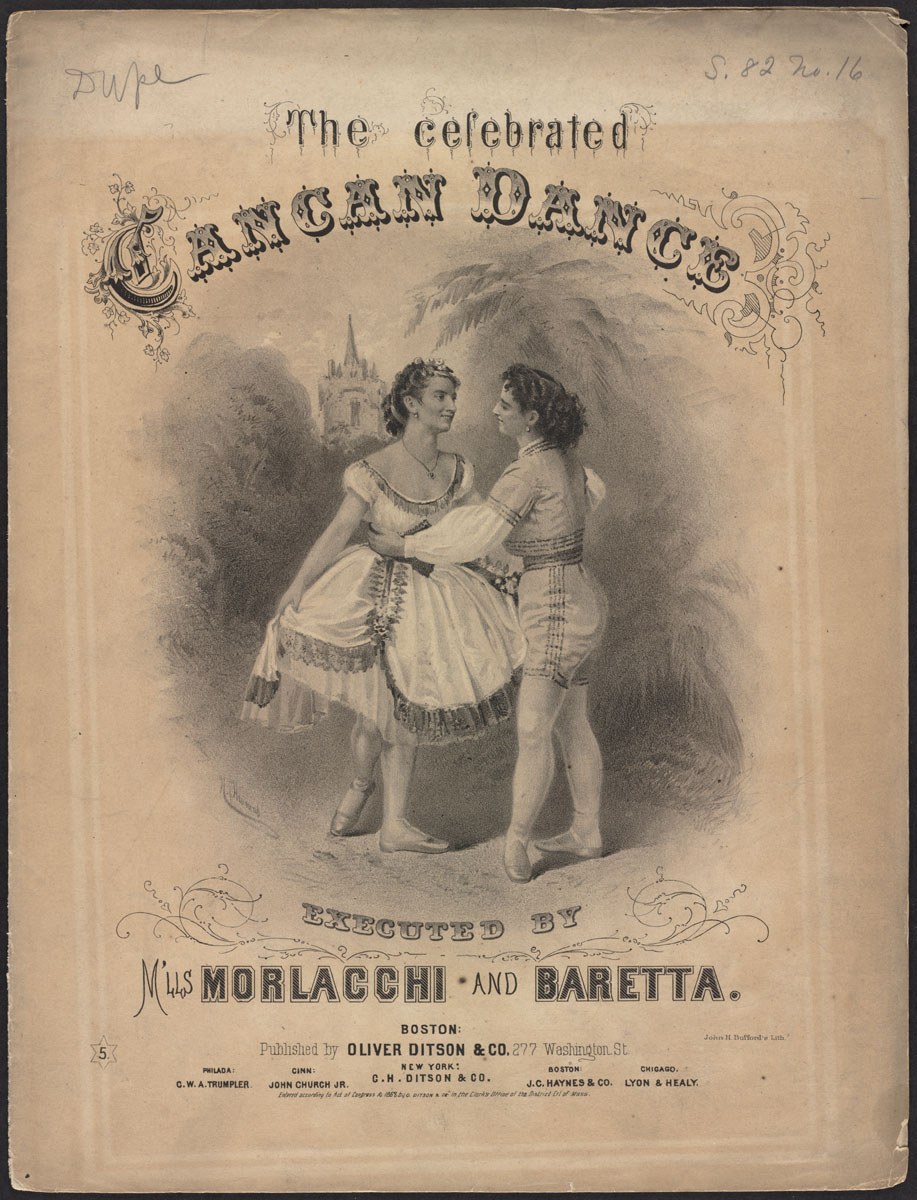
M'lls. Morlacci and Baretta dancing the Can Can Dance (Boston Public Library)
BPL
- Source:
- Wikimedia Commons
- Rights:
- Reusable with conditions: credit the creator. Source record ↗
- Recorded as:
- cc by 2.0
This is visual evidence of how professional performers transformed a disreputable street dance into a theatrical attraction, and how music publishing and lithography made it a home commodity in America. For dance historians, it documents the precise moment when the can-can became industry—and what was lost and gained in that transition.
What you are looking at
This is a lithographic cover for sheet music depicting two female dancers in classical dress performing the can-can. The woman on the left wears a short pleated skirt with decorative trim and a draped bodice; she is caught mid-leap or high kick, her body angled away from her partner. The woman on the right, dressed similarly, supports or catches her, their bodies in close contact. Both wear their hair up in period style. The background is softly rendered in charcoal grey wash, suggesting an interior or theatrical space, with a church or cathedral spire visible in the distance. Ornamental Victorian typography frames the title above and below, and the composition is professionally printed with careful attention to the lithographic line and tonal gradation typical of mid-nineteenth-century music publishing.
The dancing
Both dancers are in close proximity, suggesting partnered or ensemble movement. The figure on the left is captured at the apex of a high leg extension—characteristic of can-can choreography—with her supporting leg straight and her body in a balletic alignment. Her left arm reaches outward while the other steadies against her partner. The figure on the right leans in with arms engaged, one hand at the other dancer's waist or back, both women's torsos tilted toward each other. The composition suggests a moment of elevation and control rather than chaotic abandon, emphasizing technical display.
The dance depicted
This is a can-can, one of the most infamous dances of the mid-nineteenth century, performed here by professional dancers Mlle Morlacci and Mlle Baretta. The can-can was a high-kicking ensemble dance that emerged in Parisian dance halls and café-concerts in the 1840s and became wildly popular by mid-century despite (or because of) its reputation for scandalous exposures and energetic, unrestrained movement. This lithograph, paired with a musical composition by Paolo Giorza, documents the dance as a theatrical spectacle for a Boston audience in 1868, suggesting the can-can had become sufficiently domesticated to be promoted as sheet music for home piano performance. The image emphasizes the balletic poise and technical precision of professional execution rather than the disorderly vigor the dance was known for.
How it was made
This is a lithograph printed in Boston by John H. Bufford, a major American lithographic publisher of the nineteenth century, and published as a music cover by the firm C. H. Ditson. Lithography allowed for fluid line work and subtle tonal variation that could capture both the architectural precision of the lettering and the soft modeling of the figures; the grey wash background was likely applied by hand to each stone or developed through multiple passes. The technique was economical for mass production, making this an accessible commodity for middle-class households. The object belongs to the Boston Public Library's music collection, indicating it was preserved as a published artifact of commercial entertainment rather than as fine art.
About this work
This is a sheet music cover from 1868 documenting one of the nineteenth century's most controversial dances through the lens of professional theatrical performance. The can-can, which began in working-class Parisian dance halls as an improvised, often transgressive social dance, is here rendered as a polished spectacle—two skilled performers in classical costume executing high extensions and precise partnering. The lithograph is a record of how the can-can was repackaged and circulated in America: no longer scandalous, but commercially viable, domestic, respectable. It shows us not the can-can as it was danced in its original contexts, but how the Victorian era chose to sanitize and commodify it for sheet music, concert halls, and home entertainment.
How to look at it
Notice how the composition freezes the can-can at a moment of balletic precision rather than wild abandon: the high kick is executed with a straight supporting leg and classical carriage, not chaotic thrashing. The artist chose a moment of partnered connection rather than the solo, unrestrained dancing the can-can was famous for. This tells you something important about professionalization: the performance being advertised is legible and respectable to Victorian eyes. Look also at how the lithography renders the female figure—classically trained, idealized, graceful—and compare that to the moral language the can-can provoked at mid-century. The image is doing cultural work: selling transgression as art.
The artist
John H. Bufford (1810–1874) was one of the most prolific and respected lithographic printers in nineteenth-century America, based in Boston. He specialized in theatrical, musical, and commercial subjects, and his firm was known for technical quality and rapid turnover of popular designs. Bufford's work circulated theatrical imagery widely, making ephemeral entertainment—dance, opera, theatrical performance—accessible in printed form. He frequently collaborated with music publishers like C. H. Ditson to create cover imagery that would appeal to both concert-goers and domestic music consumers.
The period
The can-can rose to prominence in Paris in the 1840s–50s and sparked moral panic across Europe and America for its high kicks, leg exposure, and apparent lack of restraint. By the 1860s, as this lithograph shows, it had begun its transformation into a respectable theatrical entertainment—still scandalous enough to be thrilling, but sanitized by professional technique and classical dress codes. Simultaneously, lithography had become the dominant mode of theatrical promotion and sheet music illustration, making dance imagery ubiquitous in middle-class households. This was also the era of Romantic ballet's decline and the rise of spectacle-driven entertainment in music halls and café-concerts, especially in Paris and its American imitators.
Where it lives
This lithograph is held by the Boston Public Library in its music collection (accession 07_07_000028) and is catalogued as a published music cover of 1868. It is one of thousands of such promotional prints that circulated in America during the nineteenth century, neither unique nor precious, but invaluable as evidence of popular taste and theatrical practice.
Dance in this work
Questions about this work
Was the can-can really as scandalous as people say?
Yes—it was condemned by clergy and bourgeois critics for exposing women's legs and suggesting sexual impropriety. It originated in working-class dance halls, not concert halls. This image, however, shows the sanitized, professionalized version: high-kicking in classical dress under controlled theatrical conditions. By the 1860s, the can-can was already being rebranded for respectable audiences, though it remained slightly dangerous—part of its appeal.
How did lithography change what people saw?
Lithography was fast and cheap, allowing theatrical images to be printed by the hundreds and circulated to households that would never attend a concert. This sheet music cover meant that a Boston piano owner could bring the image (and music) of a Parisian dancer into their parlor. It democratized entertainment imagery but also domesticated it: the wild can-can became a piano piece to be played respectably at home.
Who were Morlacci and Baretta?
They are identified here as professional dancers, likely Italian or trained in the Italian classical tradition, performing in America in 1868. No substantial biographical records survive, but their names on this cover suggest they had sufficient reputation or novelty to merit advertising through sheet music. They are known to us only through this image and the publication that promoted them.
Did people really dance the can-can like this?
Not always. The theatrical version, executed by trained dancers in costume with musical accompaniment, looked like this. The original can-can, as danced in Paris dance halls, was looser, more improvised, and more sexually charged. This image shows what professional ballet-trained performers made of the can-can when it moved into concert venues and middle-class parlors.
More dance artwork





