49 works in this view — arrow keys or swipe to move between them.
Dance in Art
Can-Can Dancers.label QS:Len,"Can-Can Dancers."
UnknownUnknown , misattributed to Jean-Louis Forain
- Source:
- Wikimedia Commons
- Rights:
- Public domain — free to use, share and adapt.
- Recorded as:
- public_domain
The can-can was one of the first dances to be associated with modern urban nightlife and sexual transgression; its depiction in fine art—rather than merely in posters or popular prints—signals its cultural status during this period. For historians of dance and gender, this image documents a form that was simultaneously celebrated and condemned, and shows how artists engaged with contemporary entertainment as a subject worthy of aesthetic attention.
What you are looking at
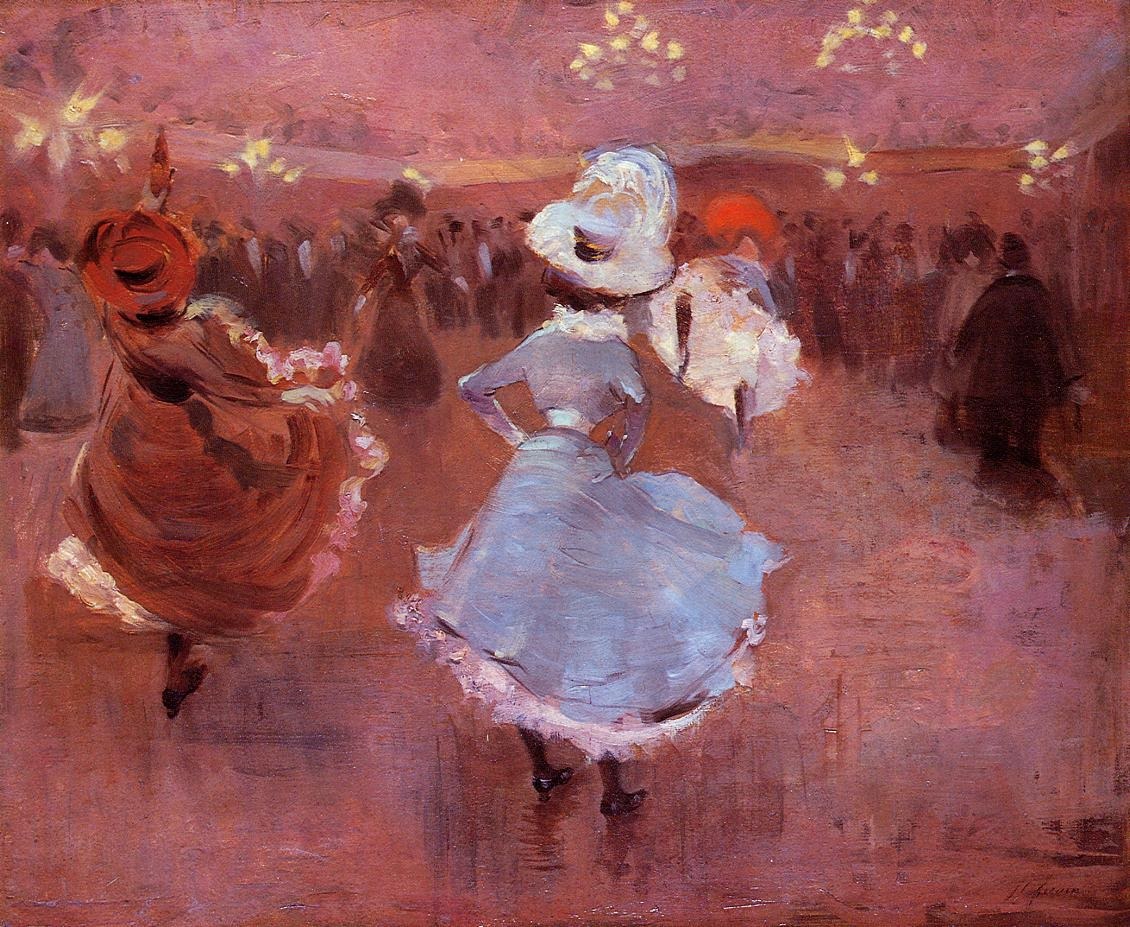
A lively ballroom or dance hall scene rendered in warm reddish-brown tones with gold accents on the walls or ceiling. In the foreground, a woman in a lavender-blue dress with a full skirt executes a vigorous movement, her body twisted in an exuberant pose; her companion, in deep red, leans back dynamically. A second couple is visible to the right. The setting is crowded with figures in evening dress, many rendered as shadowy forms in the background, suggesting an evening entertainment or social gathering. The brushwork is loose and impressionistic, emphasizing movement and gaiety over precise detail. Warm light suffuses the scene, with touches of pale yellow in highlights on clothing and faces.
The dancing
The foreground dancer's posture shows the high energy and playful abandon characteristic of the can-can: her body is sharply angled, one leg appears lifted or extended, and her torso twists away from her partner. Her skirts billow and catch light as they swing. The red-dressed figure beside her mirrors this dynamic quality with a pronounced backward lean. The positioning and energy suggest close partnership but with the exaggerated, theatrical movement typical of the style. The brushwork captures momentum rather than precise anatomical definition.
The dance depicted
This depicts the can-can, the high-kicking, fast-paced social dance that emerged in Parisian dance halls in the mid-nineteenth century and became a signature of venues like the Moulin Rouge. The can-can was danced in couples or groups, featuring lifted skirts, high leg extensions, and rapid rotational movement, accompanied by orchestral music. By the 1880s–1890s it had become a symbol of Parisian nightlife and bohemian entertainment. The painting captures the characteristic dynamic, playful energy and the visual spectacle—the swirling skirts and animated postures—that made the dance famous and controversial in equal measure.
How it was made
Oil paint on canvas (based on the brushwork and surface quality visible in the image). The loose, impressionistic technique—evident in the sketchily rendered background figures, the soft handling of light, and the emphasis on movement over detail—allows the artist to convey the sensory excitement and motion of the scene rather than documentary accuracy. This painterly approach was well suited to capturing the ephemeral gaiety of dance-hall entertainment and suggests an audience familiar with Impressionist and post-Impressionist work.
About this work
This is a scene from a Parisian dance hall, most likely dating to the late nineteenth century, capturing the energy and spectacle of the can-can at the height of its popularity. The work belongs to a significant tradition of artists documenting and celebrating the entertainment culture of Paris during this period—the dance halls, cabarets, and music venues that defined urban modernity. The painting testifies to the can-can's role not merely as a dance but as a marker of a particular moment in urban leisure and artistic attention.
How to look at it
Pay attention to the arrested moment of movement: the artist has frozen a instant of rapid rotation and high energy, with limbs and skirts caught mid-swing. The composition is deliberately off-center and dynamic, refusing the static formality of earlier ballroom dance paintings. The warm color palette—dominated by reds, purples, and golds—creates an atmosphere of heat and excitement rather than cool observation. Notice how the background figures blur into shadow, making the foreground couple the focus while still suggesting the crowd and conviviality that gave the can-can its social context.
The artist
The catalogue attributes this work to an unknown artist, with a note of misattribution to Jean-Louis Forain (1841–1931), a French painter and printmaker known for satirical scenes of Parisian society, theater, and entertainment. Forain was particularly attentive to nightlife subjects and the social dynamics of dance halls and cabarets. Whether or not this work is by Forain, it sits comfortably within the tradition of artists who made the Parisian entertainment scene a central subject.
The period
The can-can emerged in the 1840s but became a major cultural phenomenon during the Belle Époque (roughly 1870–1914), when Parisian dance halls and cabarets achieved peak visibility and notoriety. Artists including Henri de Toulouse-Lautrec, Renoir, Degas, and Forain documented these venues as sites of modernity, social mixing, and spectacle. The dance itself was controversial—condemned by moralists for its display of women's legs and its association with sex work—but celebrated by artists and bohemian audiences as vital, liberated, and quintessentially modern. This painting captures the moment when the can-can was transitioning from scandalous novelty to iconic symbol of Paris.
Where it lives
The work is recorded in Wikimedia Commons. No holding collection or accession information is currently recorded in the catalogue. The painting's attribution history is uncertain; the note of misattribution to Forain suggests it has circulated under multiple names or with unclear provenance.
Dance in this work
Questions about this work
What exactly is the can-can?
The can-can is a high-energy partner dance that emerged in Paris in the mid-nineteenth century. It features rapid movement, lifted skirts, high leg extensions, and exuberant, playful partnering. It was danced in music halls and cabarets, often to lively orchestral music, and became a symbol of modern Parisian nightlife—celebrated by artists and bohemians, condemned by moral authorities.
Was the can-can really as scandalous as people say?
Yes. The visible display of women's legs, the suggestive movements, and the association of dance halls with sex work made the can-can highly controversial in respectable society. Yet this transgressive reputation was exactly what made it attractive to artists seeking to depict modern life, and to audiences interested in a new kind of freedom and entertainment.
Why did artists paint dance halls?
Dance halls and cabarets were quintessentially modern spaces: they were sites of social mixing, entertainment technology, artificial light, and sexual ambiguity. For artists interested in depicting contemporary life rather than history or mythology, these venues offered color, movement, psychological complexity, and visual spectacle. They also raised questions about class, gender, and urban experience.
Is this really by Forain?
The catalogue records it as unknown, with a note that it has been misattributed to Forain. Without seeing the painting itself or other documentation, we cannot be certain. Forain did paint similar subjects, so the attribution is plausible; but the history of this work's circulation remains unclear.
More dance artwork





