49 works in this view — arrow keys or swipe to move between them.
Dance in Art
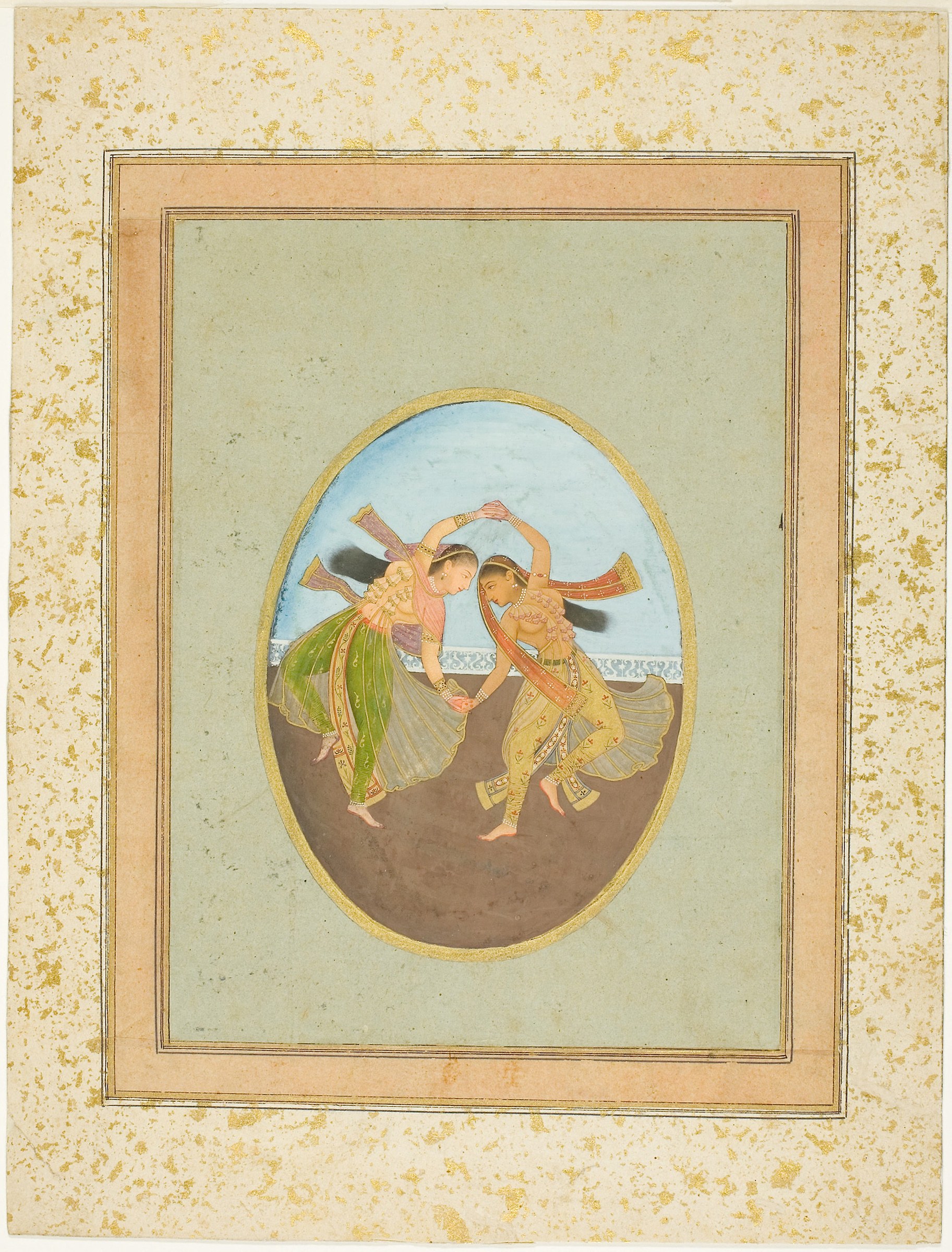
Two Girls Performing Kathak title QS:P1476,en:"Two Girls Performing Kathak "label QS:Len,"Two Girls Performing Kathak "
anonymous
- Source:
- Wikimedia Commons
- Rights:
- Public domain — free to use, share and adapt.
- Recorded as:
- public_domain
This is one of very few surviving visual records of how Kathak was performed in the early 18th century—before colonial disruption and the form's later reconstruction in the 20th. The painting shows the actual postures, costume, and context of the dance as it existed in its own time, not as it was later imagined or revived. For Kathak dancers and historians, it is primary source material.
What you are looking at
Two young female dancers occupy an oval frame set against a pale green ground within a double-bordered rectangular mount. Both wear richly colored and patterned garments—the figure on the left in coral-red and green, the figure on the right in yellow with decorative patterns—that suggest South Asian dress. Their movements are animated and synchronized, bodies bent forward at the waist in mirror-image positions, arms raised and angled expressively. The upper figure in the composition appears to play a wind instrument, possibly a pungi or similar double-reed pipe. The lower background shows a sky-blue horizon with what may be architectural elements or a distant landscape, suggesting an outdoor or courtly setting. The entire composition is rendered in a refined Indo-Persian painting style, with delicate brushwork, subtle modeling in earth tones and ochres, and careful attention to ornamental detail in the dancers' clothing and jewelry.
The dancing
The two figures are positioned in a playful, mirrored relationship. Both are bent sharply forward from the hips, knees slightly flexed, with their upper bodies nearly parallel to the ground. Their arms are lifted and bent at the elbows, hands positioned expressively at shoulder height and above, fingers extended. The spatial relationship is intimate—the dancers are very close, their bodies angled toward each other, suggesting a partnered interaction or duet. One figure appears to be playing an instrument while both move, indicating that music and dance are simultaneous. The poses suggest rapid, rhythmic footwork and weight shifts characteristic of Indian classical dance rather than a sustained, held position.
The dance depicted
This work depicts Kathak, the North Indian classical dance form identified in the title. Kathak is characterized by rapid footwork (tatkar), rhythmic patterns in time (taal), and interpretive hand gestures (mudras) that this painting captures in an arrested moment. The bent-forward torso, flexed knees, and expressive arm positions are consistent with Kathak's dynamic vocabulary. The presence of what appears to be a musician—one dancer holding an instrument—reflects the collaborative relationship between dancer and instrumentalist central to Kathak performance. The painting documents how Kathak was performed in early 18th-century courts, likely in a Mughal or post-Mughal North Indian setting, as a courtly entertainment involving young female dancers (sometimes called tawaif or court dancers) who performed for noble patrons.
How it was made
This is a miniature painting in the Indo-Persian or Mughal tradition, executed in watercolor or opaque pigment (likely gouache) on paper, mounted within a carefully constructed frame. The refined technique—with its delicate line work, subtle color modulation, and gold-leaf accents in the border—indicates this was a prestigious court or nobility commission, not a popular broadside or widely distributed print. The small scale and intimacy of the work, combined with its formal mounting, suggest it was made for a private collection or album (muraqqa), circulated among educated elite viewers rather than the general public. The preservation of the manuscript and its Wikimedia Commons provenance indicate this likely survives in an institutional collection.
About this work
This is a miniature painting documenting two female dancers performing Kathak, the classical dance form of North India, in what is dated to around 1701. The work is executed in the refined watercolor-and-gold technique of Indo-Persian miniature painting, the artistic tradition of Mughal courts and their successors. It captures a moment of vital, bent-bodied movement—both dancers engaged in rhythmic interplay with musical accompaniment. The work is valuable not as a generic 'dance scene' but as specific evidence of how Kathak was performed, staged, and valued in early modern South Asian courts: as a courtly entertainment involving young female professionals, choreographed to percussion and wind instruments, and deemed worthy of preservation in an elite collector's album.
The painting sits at the intersection of art history and dance history. For dancers and choreographers, it is documentary evidence of historical Kathak practice and costume. For art historians, it exemplifies the court miniature traditions of post-Mughal India. For scholars of South Asian performance, it records a moment when classical Indian dance forms were being practiced in courts across North India, before the collapse of many of those courts and the transformation of dance's social status under British rule.
How to look at it
Look at the geometry of the bodies: both dancers are bent forward at nearly identical angles, creating a visual rhythm that mirrors musical rhythm. The artist has frozen the moment mid-movement, capturing not a static pose but a transient instant of dynamism. Notice the careful placement of the hands and fingers—these are not merely decorative but convey the hand-gesture vocabulary (mudras) of Kathak, even in stillness. The close proximity of the two figures and the way they are angled toward each other suggest the competitive-yet-collaborative energy of Kathak duets. Finally, note the attention to costume detail: the patterned fabrics, jewelry, and ornaments are not incidental decoration but period-specific evidence of how dancers dressed for court performance.
The period
Early 18th-century South Asia was a period of political fragmentation following the decline of Mughal imperial authority, with competing regional courts in Delhi, Lucknow, Jaipur, and elsewhere. Many of these courts maintained traditions of courtly entertainment, including music and dance, as markers of patronage and refinement. Miniature painting was at this period a prestige art form centered in these courts, often depicting scenes of leisure, music, dance, and courtly life. Kathak itself was evolving during this period, absorbing Persian and Central Asian influences while developing the rapid footwork and rhythmic precision that would become its signature. The painting reflects a court culture in which classical dance was an elite performance art, not yet subject to the moral scrutiny and social marginalization it would experience under British rule.
Where it lives
The work is recorded as sourced from Wikimedia Commons. The catalogue record provides no holding institution, collection name, or accession details. Its survival in digital archives suggests it is held in an institutional collection, likely in India or in a Western museum with South Asian holdings, but this cannot be confirmed from the available record.
Dance in this work
Questions about this work
Is this a painting or a print?
This is a miniature painting—a hand-executed watercolor or gouache work on paper, not a print or photograph. It belongs to the Indo-Persian miniature painting tradition, which was the prestige art form of Mughal and post-Mughal courts. Each work was unique, made for private collectors.
What is Kathak, and how is it different from other Indian classical dances?
Kathak is the classical dance form of North India, characterized by rapid, rhythmic footwork (tatkar), intricate rhythmic patterns (taal) synchronized to percussion, and expressive hand gestures (mudras) that tell stories. Unlike the more sculptural, linear forms such as Bharatanatyam (from the South), Kathak emphasizes movement in time and spatial flow, with dancers traveling across the floor. It developed in courts and temples, absorbing influences from Persian and Central Asian traditions.
What is the instrument one dancer appears to be playing?
The painting shows what appears to be a wind instrument, possibly a pungi (double-reed pipe) or a similar flute-like instrument used in North Indian classical music. The presence of the musician-dancer reflects the integrated nature of Kathak performance, where dancer and instrumentalist collaborate in real time.
Why are both dancers doing nearly the same movement?
In Kathak, duet forms often involve synchronized or mirrored movements, creating visual and rhythmic counterpoint. The paired dancers may be performing a compositional form in which both execute the same pattern in unison, or alternate in conversation-like exchanges. The bent-forward posture suggests rapid footwork and weight shifts, the core of Kathak technique.
Who were these dancers, and who performed Kathak in 1701?
Kathak in early 18th-century courts was performed by professional female dancers (sometimes called tawaif or court dancers) who trained from childhood and performed for noble patrons. They were skilled musicians and choreographers in their own right. The identity of these particular dancers is not recorded; the painting documents the form and the context, not the individuals.
More dance artwork





