49 works in this view — arrow keys or swipe to move between them.
Dance in Art
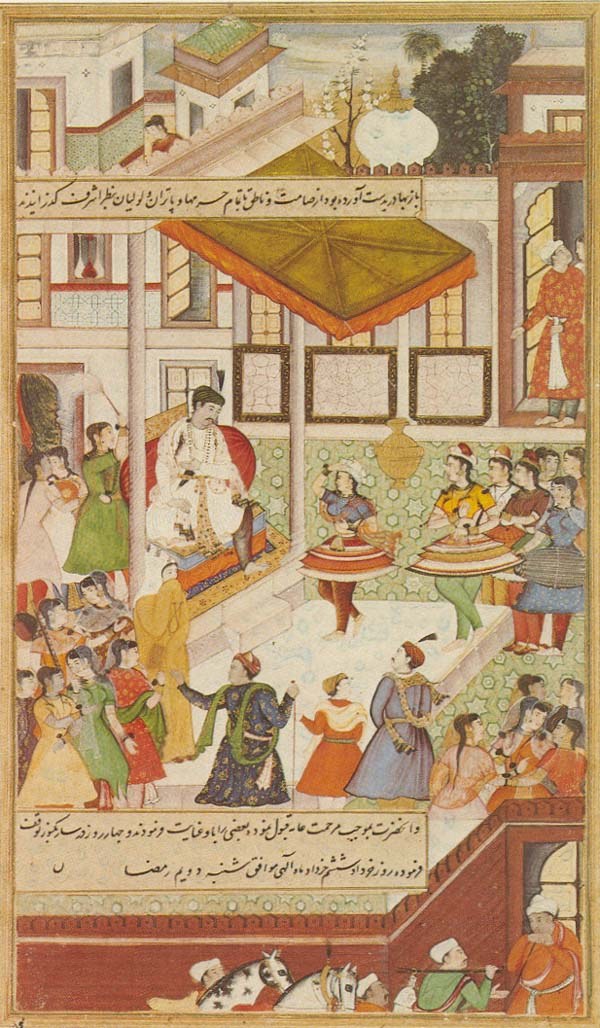
Dancing girls from Malwa entertain Akbar
Unknown authorUnknown author
- Source:
- Wikimedia Commons
- Rights:
- Public domain — free to use, share and adapt.
- Recorded as:
- public_domain
This is one of the few sixteenth-century visual documents of Kathak performance, showing the dance form as it was understood and practiced in the Mughal court at its height. It provides rare concrete evidence of costume, spacing, gesture, and the social framing of dance as imperial spectacle during this period. For dancers and historians of South Asian classical forms, it offers a window into how Kathak was valued, taught, and performed before the colonial period transformed Indian dance culture.
What you are looking at
A court entertainment scene depicts dancing girls performing before the Mughal Emperor Akbar, who sits elevated on a platform at upper left wearing white robes. The composition is organized vertically through a cross-section of a palace interior: upper rooms and terraces where attendants observe; a central courtyard where the performance unfolds on a patterned tile floor; and lower chambers where officials and guards attend. A large yellow canopy stretched over the courtyard frames the dancers. The women performing wear brilliantly colored robes in reds, oranges, and blues, their movements captured mid-gesture with raised arms and swaying postures. A substantial crowd of courtiers and attendants, many in rich dress, surrounds the dancers—some standing, some seated, some watching from windows and doorways. The scene radiates the formal hierarchy and visual splendor of court spectacle: the dancers occupy the center ground, the emperor the highest vantage, and concentric rings of witnesses mark their relative status. The painting's palette emphasizes warm ochres and reds against white-washed walls, with gold leaf highlighting architectural details and textile patterns.
The dancing
The dancers stand and move with arms raised and extended—not in rigid geometric alignment but in fluid, somewhat independent gestures suggesting individual expression within a coordinated performance. Their postures show weight shifted, hips inclined, torsos turning; the arms appear to lead the movement rather than stabilize it. At least five female dancers are visible in the central courtyard space, spaced to allow each body room to move. None are in closed holds or ballroom frame; instead each woman occupies her own space, moving with what appears to be upper-body articulation and turning. The surrounding figures are static witnesses—seated or standing in formal dress—which isolates the dancers perceptually and focuses attention on their movement quality.
The dance depicted
The inscription and catalogue record identify this as Kathak dance performed by women from the Malwa region before Akbar in 1561. Kathak—one of India's primary classical dance forms—is characterized by intricate footwork, spins, and upper-body articulation, often accompanied by rhythmic hand-clapping and drum patterns. What this image shows aligns with Kathak's aesthetic: the raised arms, the turning movements, the individual spatial presence, and the focus on the dancer's torso and head as expressive centers. The historical frame is significant: Kathak was a court art form in the sixteenth-century Mughal period, performed by professional dancing girls (tawaif) who were valued for technical skill and artistic accomplishment. This painting documents a specific performance occasion—not a generic dance scene—and captures Kathak as a living courtly practice.
How it was made
This is a leaf from a manuscript, likely the Akbar-nama (the chronicle of Akbar's reign), a major Mughal imperial manuscript now in the Victoria & Albert Museum (accession I.S. 2-1896). The medium is opaque watercolor (gouache) on paper with gold leaf, characteristic of Mughal miniature painting of the late sixteenth century. The technique required precise draftsmanship, careful layering of pigments, and strategic use of burnished gold to emphasize architectural surfaces and textile patterns. The small scale (typical of manuscript pages) required the artist to convey spatial depth and the presence of many figures through careful compositional stacking and the use of size gradation—smaller figures in the distance, larger in the foreground—rather than linear perspective. This technique was ideally suited to narrative historical documentation: the painting records not a single moment but a comprehensible event with all key participants visible.
About this work
This is a documentary image of Kathak dance at the court of Akbar, painted in the late sixteenth century as part of the emperor's official chronicle. It records a performance of professional dancers from Malwa, a region of central India, and captures the aesthetic and context of Kathak as a courtly art form at the height of the Mughal period. The painting is one of the primary visual sources for how Kathak was practiced and valued in this era—not as folk performance but as sophisticated court entertainment requiring years of training.
The work belongs in a gallery of dance imagery because it makes visible a specific dance tradition at a precise historical moment, grounded in documentary intent. It shows us how movement was organized, how dancers related to space and each other, and how the court structured and witnessed dance as a marker of cultural refinement and imperial power. For scholars of Indian classical dance, Mughal court culture, and the visual representation of movement, this image is essential primary evidence.
How to look at it
Attend first to the spatial organization: notice how the painter has arranged the scene vertically to show Akbar elevated and central, the dancers below him in the open courtyard, and the crowd arranged in depth. Look at the dancers' arms and torsos—observe how they are turned and raised, how the bodies incline and twist rather than standing upright. Notice that each dancer occupies her own space and that their movements appear individual rather than synchronized. The yellow canopy overhead frames the performance and marks it as a formal, sponsored event. The abundance of witnesses—attendants in windows, officials standing by, the crowd's evident attention—tells you this is not private practice but public spectacle, an expression of the emperor's power to commission and observe excellence.
The period
This painting dates to the late sixteenth century, during the reign of Akbar (1556–1605), one of the Mughal Empire's greatest rulers. Akbar was known as a patron of the arts and a figure of religious syncretism; his court assembled artists, poets, and performers from across his domains and beyond. The Akbar-nama was commissioned as an official chronicle and represents one of the finest achievements of Mughal manuscript painting. Kathak dance was flourishing in this period as a court art form, practiced by hereditary communities of professional dancers who served noble courts across north India. The dance was intimately connected to Mughal court culture and the patronage system: dancers gained status and livelihood through performance for the emperor and his nobles, and their skill was understood as a marker of refinement and cultural knowledge.
Where it lives
This leaf is from the Victoria & Albert Museum's Akbar-nama manuscript (accession I.S. 2-1896, folio 16/117), dated c. 1590. The manuscript is one of the primary illustrated chronicles of Akbar's reign and remains in the V&A collection. The source reference cites Rumer Godden's biography of Gulbadan (Akbar's sister), which discusses this image and its historical context.
Dance in this work
Questions about this work
What is Kathak, and how is it different from other Indian classical dances?
Kathak is a North Indian classical dance form built on intricate rhythmic footwork, spins, and expressive upper-body movement, traditionally accompanied by tabla (drums) and music. Unlike the more lyrical, devotional Bharatanatyam of South India, Kathak emphasizes rapid footwork patterns (tatkar), complex rhythmic cycles, and dramatic turns. It was historically centered in the courts of Mughal and Rajput rulers, where it developed its distinctive vocabulary of movement and its association with professional dancing courtesans.
Who were the tawaif (dancing girls) who performed Kathak?
Tawaif were professional women dancers and entertainers who served at court and in noble households. They were trained from childhood in dance, music, and poetry, and gained status, wealth, and influence through their skill and artistry. They were not slaves but independent professionals whose performance skill and cultural knowledge were highly valued. The tawaif system declined under British colonial rule, which criminalized and stigmatized these dancers.
What is an Akbar-nama, and why does this painting matter as a historical document?
The Akbar-nama is an official illustrated chronicle of Emperor Akbar's life and reign, compiled in the late sixteenth century by court historians. It was written and painted to glorify the emperor and record his achievements, patronage, and power. This leaf is valuable because it documents not allegory or legend but a specific performance event—an actual entertainment that took place at court—and thus captures the visual reality of how Kathak was danced, what dancers wore, and how the court valued and staged dance performance.
How do we know this shows Kathak dance and not some other form?
The painting's caption and historical record identify it as such. Additionally, the visual evidence—the raised arms, the spinning movements, the upper-body articulation, the individual spatial presence of each dancer, and the courtly context—align with what we know of Kathak aesthetics and practice in this period. The dance's evolution is documented in later Kathak texts and oral traditions, which preserve movement patterns and philosophy that are consistent with what this image shows.
More dance artwork





