49 works in this view — arrow keys or swipe to move between them.
Dance in Art
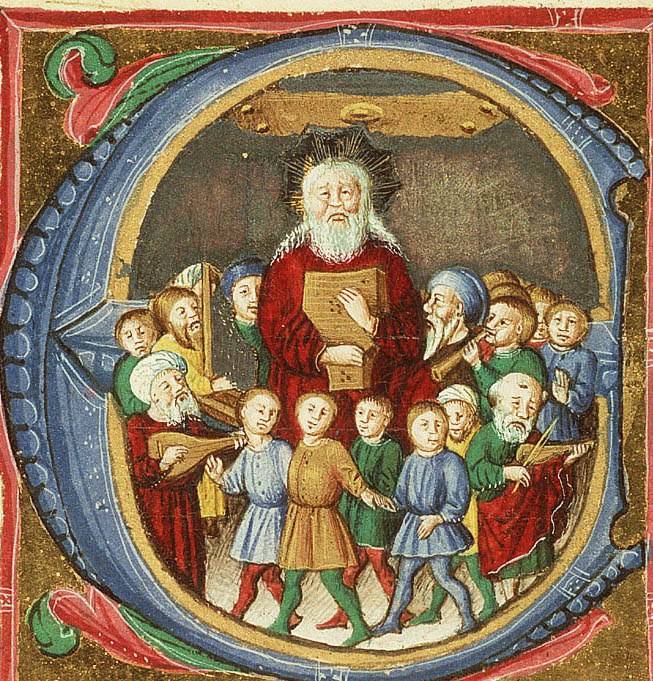
David with musicians and dancing children
Master of Isabella di Chiaromonte, Matteo Felice (illuminators)
- Source:
- Wikimedia Commons
- Rights:
- Public domain — free to use, share and adapt.
- Recorded as:
- public_domain
This is one of few surviving visual records of children's sacred dance in the Renaissance, and it places such movement at the centre of devotional practice rather than at its margins. The work shows that dance was understood as a form of praise and blessing, not performance, and that it was led by authority figures (here, the king-priest) rather than by professionals.
What you are looking at
A bearded patriarch in a red robe and halo stands centrally in an architectural frame, holding a tablet or book, surrounded by a crowd of younger figures in medieval dress. The children and youths—rendered in smaller scale and positioned around and below the central figure—wear tunics and hose in shades of blue, green, and ochre. Some stand upright; others appear to be in motion with raised arms and bent knees. The setting is a vaulted interior, suggested by the blue and gold architectural frame with its scalloped edges. The whole scene is rendered in the bright tempera colours and gold leaf characteristic of 15th-century manuscript illumination, with the figures arranged in a compressed, hieratic space that prioritises narrative clarity over spatial realism.
The dancing
The central adult figure is static and frontal, a point of visual authority. The surrounding younger figures show varied body positions: several have arms raised or extended outward, some knees are bent in what could suggest jumping or springing movement, and the overall arrangement suggests energetic, playful motion. The scale differential between the adult and children emphasises their role as subjects of his attention. The grouping is dense and informal, without the ordered lines or paired holds of formal courtly dance.
The dance depicted
This appears to document sacred or didactic dance rather than courtly performance. The bearded figure with halo is David, the biblical psalmist-king, and the scene depicts him leading or blessing children in movement. The context of a psalter suggests these may be dancing children in a liturgical or ceremonial setting, possibly inspired by the biblical account of David dancing before the Ark. The movement suggested in the children's postures—raised arms, bent knees, scattered positioning—is consistent with processional, celebratory, or mimetic sacred dance of the medieval period, not ballroom or theatrical dance of the Renaissance.
How it was made
This is an illuminated manuscript page, executed in tempera and gold leaf on vellum. The technique allowed rich colour saturation and the application of burnished gold, evident in the halos, borders, and background. The miniature format and precious materials indicate this was a luxury object, likely a psalter for private devotional use by a wealthy patron. The gold-leaf background and hierarchic scaling follow Byzantine and medieval conventions rather than Renaissance perspective, suggesting the work maintains conservative iconographic traditions even as its style becomes more naturalistic in the rendering of fabric, faces, and anatomy.
About this work
This illuminated psalter page from the 1460s depicts King David surrounded by dancing children in a sacred or ceremonial context. The scene illustrates a biblical narrative—David's leadership of sacred music and dance—rendered in the language of 15th-century Italian manuscript illumination. The work sits at the intersection of liturgical art, narrative manuscript tradition, and the emerging Renaissance naturalism in figure painting: the gold-leaf background and hieratic scale are medieval, but the faces show individual expression and the bodies show anatomical understanding typical of the later quattrocento.
For a dance gallery, the work documents how sacred movement and children's participation in ritual music-making were understood and valued in Renaissance Italy. The visual record suggests that such dancing was celebratory, unstructured compared to courtly forms, and integral to religious ceremony. The manuscript format means this image circulated among the educated and pious elite, preserving their understanding of David as a paradigm of inspired, joyful motion.
How to look at it
Attend to the children's bodies rather than the composition as a whole: notice which limbs are raised, which knees bent, how weight is distributed. The artist has chosen a moment of active, joyful movement rather than stillness—the multiple small bodies in varied postures create a sense of ongoing motion. The formal Byzantine halo and the dense gold background are the visual language of medieval sacred art, signalling that this is not secular entertainment but blessing and praise. The manuscript's small scale—this is a page you would hold in your hands—means the viewer is drawn into intimate engagement with the scene rather than viewing it from a distance.
The artist
The work is attributed to the Master of Isabella di Chiaramonte and Matteo Felice, Sicilian or Southern Italian illuminators active in the mid-15th century. These artists were working in the tradition of high-quality liturgical manuscripts for noble and ecclesiastical patrons, combining Byzantine and Gothic conventions with the emerging naturalism of the Italian Renaissance. The precision of the figural work and the richness of the materials suggest a workshop of considerable reputation.
The period
In the 1460s, sacred dance and music-making in the Catholic liturgy were undergoing reappraisal as humanist ideas circulated through Italy. Biblical figures like David were being invoked as models of inspired leadership and emotional expression; the revival of classical texts brought renewed attention to dance in religious ceremony. At the same time, manuscript illumination was shifting from purely decorative traditions toward narrative clarity and emotional engagement with the subject. This page reflects both movements: it takes a sacred-dance narrative seriously as a subject, and renders it with attention to individual expression and bodily conviction.
Where it lives
The work is recorded in Wikimedia Commons. It is identified as part of an illuminated psalter dated c. 1465–1470, though no holding institution is recorded in the catalogue provided.
Dance in this work
Questions about this work
Is this a real account of how children danced in the Renaissance?
The scene illustrates a biblical narrative (David dancing before the Ark), not necessarily a record of contemporary practice. However, it does reflect Renaissance understanding of how sacred joy and music-making were expressed through movement, and it suggests that children's participation in such dancing was valued and blessed by authority figures. Liturgical documents and music theory texts of the period confirm that processional and celebratory movement were part of sacred ceremony.
Who was King David in Renaissance thought?
David was understood as a prototype of the inspired musician-ruler, a figure who combined authority, piety, and emotional expressiveness. In psalters especially, which record his compositions, he was a guide to the interior experience of prayer and praise. The halo signals his sanctity and his role as a spiritual exemplar, not merely a historical king.
What is this object and how was it used?
This is a leaf from an illuminated psalter—a luxury manuscript containing the Psalms, used for private or monastic devotion. The owner would hold it, turn its pages, and use the illustrations and text as a focus for prayer and meditation. The miniature scale and precious materials (gold, fine tempera) indicate it was made for a wealthy patron and would have been kept in a chapel or private chamber.
More dance artwork





