49 works in this view — arrow keys or swipe to move between them.
Dance in Art
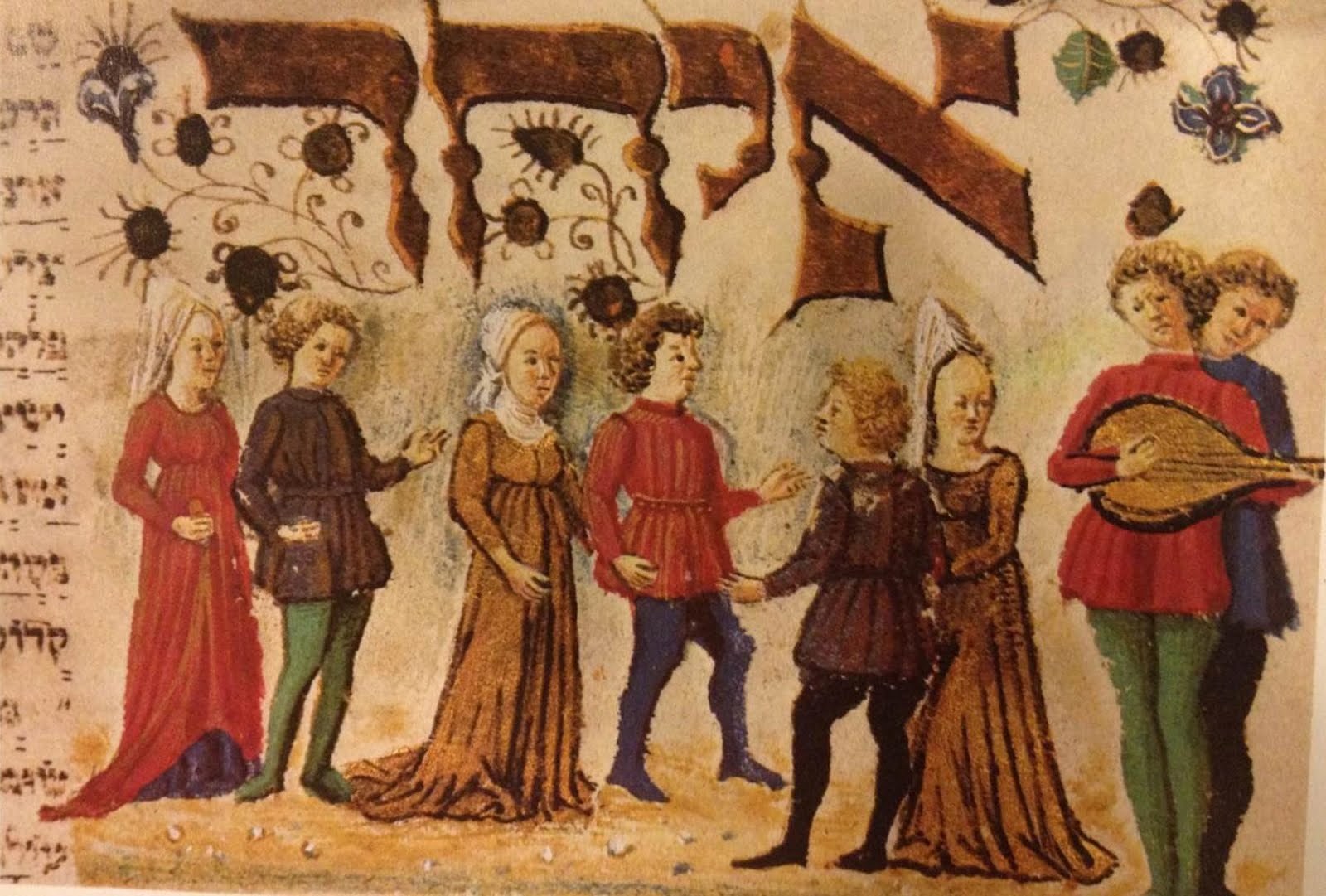
Rothschild miscellany dancing
Unknown authorUnknown author
- Source:
- Wikimedia Commons
- Rights:
- Public domain — free to use, share and adapt.
- Recorded as:
- public_domain
Mixed-gender social dancing in the 15th-century Mediterranean was not universal; this image provides material evidence that Jewish Italian practice diverged from Christian norms. For historians of gender and family, it documents the social authority given to couples as units. For dance historians, it shows the baseline—how ordinary people moved together without choreography, training, or performance intent—against which all other Renaissance dance can be measured.
What you are looking at
Seven figures in rich medieval dress stand against a pale background decorated with ornamental foliage and a heraldic banner. They are arranged in a loose line across the composition, none rigidly aligned. The figures wear the dress of mid-15th-century Italy: the women in long gowns with flowing sleeves—one in red, one in gold, one in rust—and the men in shorter tunics with tight hose in contrasting colors (red, blue, green). Most wear caps or headdresses of the period. Above them hangs a heraldic shield or banner in brown and gold, and scattered around are stylized flowers and leaves. The ground is indicated by a thin baseline. The scene has the flat, linear character of manuscript illumination: figures overlap slightly but are not arranged in illusionistic depth. The palette is tempera on vellum, with gold leaf.
The dancing
The seven figures are not locked in formal dance holds or synchronized steps. Instead, they stand in conversational proximities, some turned toward one another, others in profile. Several gestures suggest interaction—hands raised or extended toward neighbors—but the postures are upright and composed rather than captured mid-movement. One woman on the right stands with her hand to her side; another appears to gesture with an open palm. The men stand with feet planted and weight centered. There is no evidence of the leap, turn, or articulate footwork that would define later European dance. The bodies are stiff and formal by later standards.
The dance depicted
This is a documentary image of social mixed dancing in mid-15th-century northern Italy, almost certainly from a Jewish household context. The Rothschild Miscellany is a Hebrew manuscript of prayers and commentary, and this image illustrates a Jewish custom of the period: couples—husbands and wives—dancing together socially. This was a marked distinction from unmarried men and women dancing separately, which was the default in much of Christendom. The image shows the basic format: informal grouping, no apparent choreography, and the mixing of men and women as partners. The dance itself appears to be a variation of the widespread European folk and court dances of the period, without the formality or structure of a named court dance like the Pavane. It is social and recreational rather than performative.
How it was made
This is an illuminated manuscript leaf, painted in tempera and gold leaf on vellum. The technique allows the precise rendering of costume detail—the folds of wool, the pattern of embroidery, the texture of linen headdresses—which is a major value of the medium. The gold leaf and bright color palette indicate wealth and careful patronage. Manuscript illumination of this quality circulated among the educated and prosperous, typically within families or religious communities. This particular manuscript is Hebrew, and the dancing figures serve as a visual gloss on a text about Jewish life and practice; the image thus documents not only how a dance looked but also that it mattered enough to record for a literate, likely rabbinical audience.
About this work
The Rothschild Miscellany dancing scene is a rare documentary image of social dancing in a Jewish household of mid-15th-century Italy. It shows neither a virtuosic performance nor an allegorical or devotional tableau, but simply the custom of mixed dancing—husbands and wives together—as an illustration of Jewish domestic life. The image is valuable precisely because it is unselfconscious: the artist was not making a statement about dance, but recording how people danced at home. The figures wear the authentic dress of their time and place, stand in natural conversational groupings, and display no formal technique. It is one of the very few European images from this period that document everyday social dance rather than court ceremony or theatrical spectacle.
How to look at it
Look at the hands and faces: the figures are neither frozen in a leap nor arranged in a perfect line. Instead, they stand casually, some turned toward their neighbors, gestures small and natural. The artist has chosen a moment of standing and socializing rather than active dance movement. Notice the costume detail—the precision of the headdresses and sleeve patterns—which tells you this is an eyewitness record, not a stylized fantasy. The figures occupy roughly the same baseline and are arranged roughly left to right, a compositional choice that emphasizes the group and the occasion over any individual virtuosity or narrative drama.
The artist
The artist is unknown. The manuscript was created in northern Italy (likely the Veneto region) in the mid-15th century, probably by a Jewish scribe and artist or team working for a wealthy Hebrew patron. The Rothschild Miscellany is a prayer book and biblical commentary compiled and illustrated with unusual care and expense, suggesting either a commission by a synagogue or a very prosperous family. The illuminations throughout reflect Italian Renaissance aesthetics—attention to costume, spatial arrangement, and narrative moment—but adapted to illustrate Hebrew text and Jewish practice.
The period
In the 15th century, social dancing in Europe was increasingly seen as a mark of civility and courtship. In Italian courts and among the urban merchant class, dancing as a social accomplishment was becoming fashionable. Yet it remained highly gender-segregated and rule-bound in Christian contexts: young unmarried men and women rarely partnered except in very formal structures. This image shows a different tradition. The Rothschild Miscellany was created during a period of relative stability and prosperity for Italian Jewish communities, who maintained their own customs, including patterns of family and social life that sometimes diverged from Christian practice. The image is a snapshot of that distinct world.
Where it lives
This leaf comes from the Rothschild Miscellany, a Hebrew illuminated manuscript created in Italy in the mid-15th century. The source given is Wikimedia Commons; the specific holding institution is not recorded in the available metadata.
Dance in this work
Questions about this work
How do we know these are Jewish dancers?
The image appears in a Hebrew religious manuscript (the Rothschild Miscellany) and illustrates Jewish custom and practice. The manuscript's text and illustrations together document Jewish life. The scene itself, with its emphasis on mixed couples, aligns with the historical record of Jewish dancing practice in this period and region, which differed from Christian norms.
Why do they look so stiff?
This is not stiffness but a period and medium convention. Manuscript illumination privileges clarity of costume, identity, and spatial arrangement over the illusion of captured motion. The figures are posed rather than dynamic—a choice that made sense for a documentary image meant to illustrate a text, not to celebrate dance virtuosity.
What dance is this?
It is not a named or choreographed dance in the sense of Pavane or Galliard. It is social mixed dancing—the broad category of movement that couples performed together at home or at celebration. The specific steps and figures are not legible from the image; what we see is the social format and the occasion, not the dance technique.
Is this the only image of Jewish dancing from this period?
It is among the very few documentary images of Jewish social life from 15th-century Europe, and one of the rarest that records dance. Most surviving images of dance from this period are either court dances, religious ceremonies, or allegorical scenes. A domestic scene of this kind is exceptional.
More dance artwork





